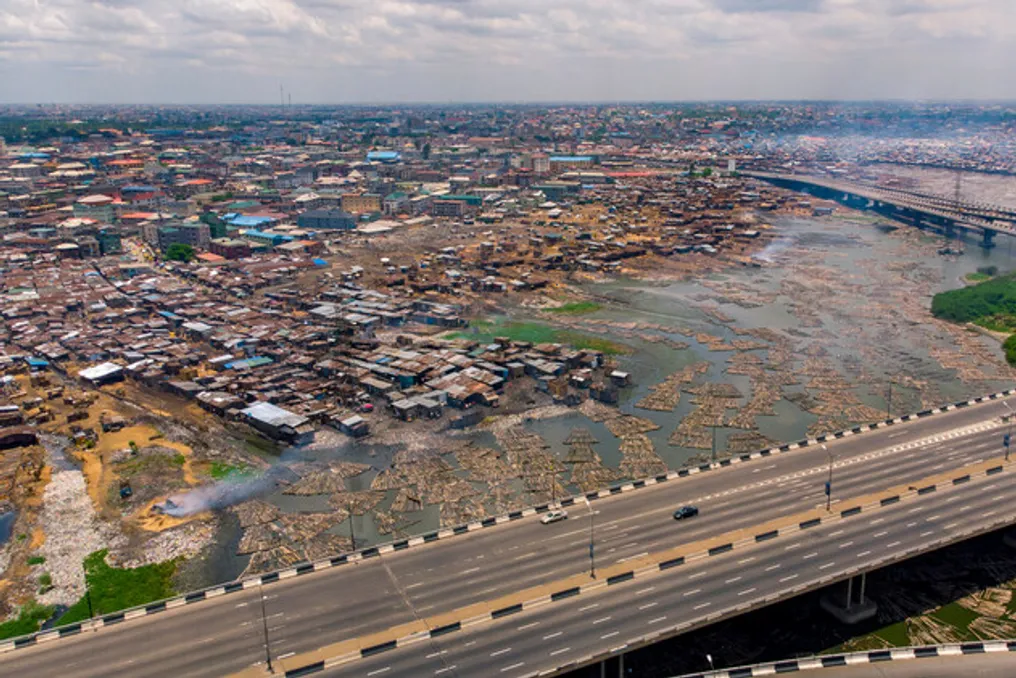
Lagos is a city shaped by time, human interaction, natural forces, and its constantly evolving, sometimes complex, relationship with these three elements. This is most evident during the rainy season.
The Eco area is situated on a floodplain. Its geographical position predates the city itself, dating back to before the first street was opened or the first boundaries were established. Drainage systems and projects that gradually turned into private water fronts were built on a landscape that was inherently always in dialogue with water. Flooding is not an anomaly; it is the land insisting on a dialogue that will inevitably repeat.
The city expanded by draining and occupying swampy lands and mangrove swamps with sand—initially not out of malice, but due to necessity, urban pressure, and the inability of government administration to keep pace with its own growth. Swampy areas and floodplains were ignored, treated as if they had simply become dry land, forgetting what was there before. The land gave way to projects, and then infrastructure appeared, blocking waterways upon which the very soil depended.
Approximately 59% to 96% of Lagos's protected wetlands have been lost due to sand embankments and real estate speculation. Over 91% of the city's soil is now impermeable under concrete and asphalt—surfaces that do not engage in a dialogue with water but attempt to hold it back. Nevertheless, the water continues to return.
Yet, the embankments continue. Coastal development projects push the city further toward the water, responding to the pressure of a growing population, although they rarely satisfy the majority who suffer from construction on land that has not forgotten water. There are plans, including the Lagos State Adaptation and Climate Resilience Plan and the Lekki Integrated Master Plan, but the gap between government policy and practice is as vast as the floodplain itself.
Lekki Peninsula, June 2026
The Lekki Peninsula, a coastal strip in Lagos stretching from the city boundary towards the Atlantic and connecting to the mainland via the Lekki-Epe Expressway, is where this tension becomes most apparent. Rapid urbanization has transformed old fishing villages into a dense residential and commercial landscape where informal settlements and gated communities coexist—a duality that defines much of Lagos's urban expansion.
The rainy season always arrives with force, announcing its presence and lasting from April to July, and again from September to October. However, this year, when NIHSA forecasts above-average rainfall—up to 3030 mm in Lagos's coastal areas, and climatologists classify the city as one of the most vulnerable on the West African coast to sea-level rise and increasingly unpredictable rains—the season was particularly relentless. Along the Lekki-Epe Expressway, drainage channels created by new road infrastructure flooded areas across the Lekki Peninsula. Weakening foundations and blocking access roads, streets were underwater, transport was stranded, and people were cut off. Water surged into both contexts. On the same day, the Lagos State Government ordered the removal of structures blocking the drainage channels, and inspectors arrived in the middle of the flood, not before it.
Floods reveal not only inequality, though the resource gap for recovery is significant. They reveal something more fundamental: all infrastructure on the peninsula, whether formal or informal, shares the same underlying problem: it was built on a floodplain that the city has never properly managed. The difference lies in presentation. The logic is absent.
Water comes; it announces itself. The city stops, and then slowly adapts. People wait, transport reroutes, streets flood, and in this collective pause, something we have always known emerges: the rain always falls. Just as before, and just as it will again.
As the water rises, it becomes something elusive. Moving between nature and structure, landscape and city, between the planned and what has always been here. It flows through the streets, seeps through door cracks, and comfortably settles as a guest in a family home. The boundary between public and private, so carefully maintained in the language of the planned city, physically dissolves. The street and the house merge into a continuous layer of water. What was inside is now outside. What was private is now public.
This dissolution raises a question that the flood makes difficult to avoid: at what point does the landscape turn into architecture? By flooding homes, overflowing from gutters onto streets, under the influence of the sea and rain impacts, the city is forced to negotiate with its own soil. Something spatial happens here that no plan anticipated or articulated—but perhaps should have. The flood does not recognize the urban grid. It moves like the city's population: finding passages, occupying edges, and reorganizing space according to its own logic.
The answer is not planned, but the city finds its way. Transport opens new routes of movement, forging temporary paths through flooded streets. Inside homes, people improvise, quietly adjusting and adapting to accommodate this unwelcome presence. This is adaptation imposed by necessity.
Another Logic
Along the coast, informal settlements have long developed their own approach to water: temporary, improvised, and not always sufficient, but directed—by sheer necessity—to work with existing conditions rather than against them.
Eve Nnadji from ADD.apt, an office built around empathy, prioritizing people and deeply understanding the environment as the basis of the project, develops research and works that propose structures and strategies that work with the floodplain's hydrological processes, not against them, utilizing ancestral ties to water that predate the city's foundation. She describes this approach as an architectural reconstruction of ecological consciousness undermined by colonialism. The precise diagnosis: Lagos was built on water, and then taught to forget it.
Kunle Adeyemi from NLE Architects has begun spreading this idea to other African coastal cities such as Lagos, Kinshasa, Cairo, and Abidjan, exploring how they mitigate climate risks and coastal flooding. His work, based on practical experiments like the Makoko Floating School, presents water not as an enemy of the city, but as infrastructure and opportunity—an entirely different urban logic.
Lagos is a continuous dialogue between the land, the people, and the space in a city that has never fully reconciled with itself. Architecture here should not strive for dominance over the environment, but rather for coexistence and continuity, shaped by the territory and the lives that interact with it.
Flooding demands not just a solution; it demands an understanding as part of a broader cycle, a seasonal return, a landscape that insists on its own continuity. It is a reminder that the city and water have always been in dialogue, whether the city acknowledges it or not. It is architecture that moves, deeply rooted, yet always in motion.