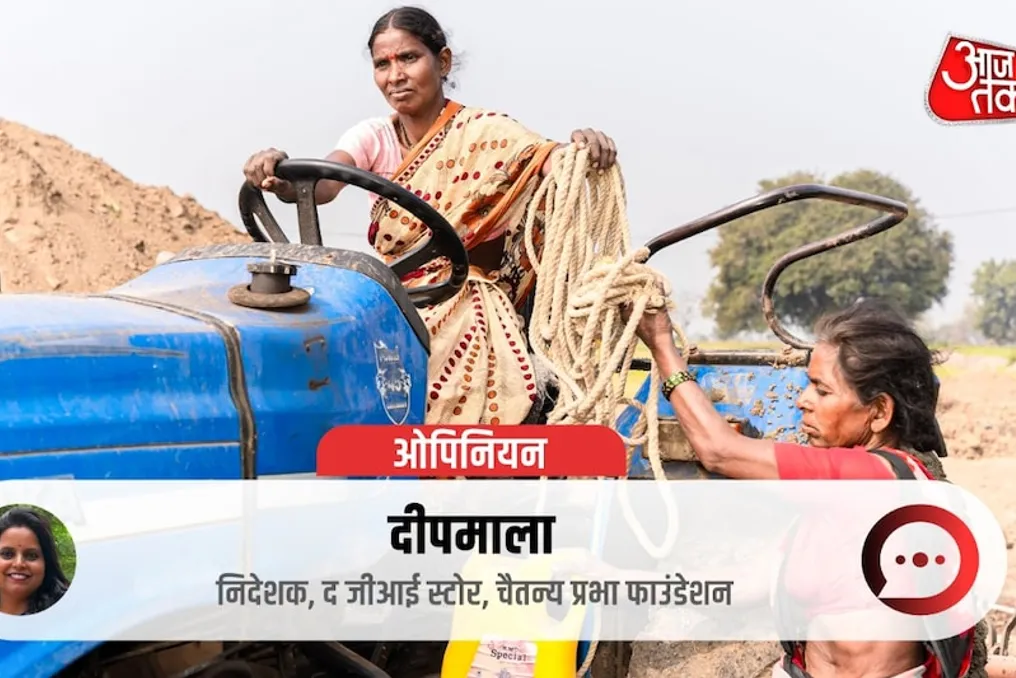
A profound question arises regarding how women should be perceived: merely as objects of respect? The author suggests that for the region's development, it is beneficial to view women not only as worthy but also as a force for creation. The real progress of any society is determined by how actively its half participates in the development process.
When women step beyond the threshold of the home and begin working in fields, factories, offices, markets, startups, self-help groups, and entrepreneurship, utilizing their labor and potential, it changes not only the lives of these women but also the direction of the entire economy. The increase in women's participation in labor activities under Yogi's government in Uttar Pradesh over the last nine and a half years serves as clear evidence of this.
The statistics on female strength in Uttar Pradesh are not just an increase in employment figures; they reflect an expansion of social awareness, according to which women are becoming participants in the family's economic responsibilities, acting as an active force for development, and taking charge of decision-making for themselves and their families. Prime Minister Yogi Adityanath has presented a vision of development based on female strength, and their presence has become extensive—from self-help groups to banking and digital services, from fields to small businesses, from traditional work to modern entrepreneurship.
This shift demonstrates that when opportunities, safety, skills, and institutional support converge, women's talent stimulates not only the family but the economy of the entire state. Although reverence for women exists in Indian thought, it becomes significant when embodied in policy, reflected in the budget, manifested in employee appointment procedures at police stations, and visible in the confidence of any daughter walking through a village street. In a vast state like Uttar Pradesh, where traditions are deeply rooted, this issue holds both deep political and economic significance.
A recent ceremony honoring working women in the Pindra constituency in Varanasi reflected this idea. More than ten thousand women—workers from Ayandadi, cooks, cleaners, Asha workers—gathered in one place. These were women whose labor long fueled the foundations of society, but until ten years ago, they lacked recognition. Today in Uttar Pradesh, this recognition is loud and reflected in the statistics.
The most fundamental indicator is the increase in the participation of female labor potential in the state from 12% to over 36%. This threefold jump cannot be the result of a single program. It is the consequence of a long process involving education, safety, and the provision of opportunities. When the state recognizes that a daughter's dream should not remain unattainable just because she was born into a poor family, it is obligated to support her at every stage—from education to capital.
Programs such as the Kanya Sumangala scheme, which provides financial support of ₹25,000 from birth to university graduation, reserving half the seats in Atal schools for daughters, expanding Kasturba Gandhi schools up to the 12th grade, and the upcoming inclusion of 50,000 talented daughters in the Rani Lakshmi Bai scheme, are not isolated elements but links in a single concept. The foundation of this concept is never leaving a daughter alone, but making her part of the mainstream.
The issue of safety is central to all these discussions, as while a woman does not feel safe, educational and employment opportunities remain incomplete. The increase in the number of female police officers in the state from 10,000 to 44,000 and the prospect of further growth is a message of strength. Shakti Mission centers, female police officers at women's stations, an integrated system of women's stations, and the creation of three PAC women's battalions in honor of historical heroines such as Virangana Avanti Bai Lodhi, Uda Devi Pasi, and Jalkari Bai are simultaneously symbolic and practical achievements.
After issues of safety and education, the third, perhaps most decisive link is economic self-sufficiency. Initiatives like Lakhpati Didi, Drone Didi, and BC Sakhi move women beyond traditional spheres and connect them with areas such as technology, banking, and entrepreneurship, which were previously dominated by men. Under the Ganga Project, 4,000 women entrepreneurs are planned to be prepared in 8,000 Gram Panchayats. This decision transforms the rural woman from a consumer into a producer and service provider.
The joining of over 400,000 women to dairy organizations such as Balini, Samarthya, Kashi, Baba Gorakhnath, and Srujani, their participation in over 96 million SMEs, and managing approximately half of the 24,000 startups shows that women are no longer just seeking jobs but creating them. This change permanently alters societal thinking, as a daughter or daughter-in-law in the home who possesses economic independence also becomes an equal participant in decision-making within that home.
An emotional connection throughout this picture is also the marriage of over 500,000 daughters under the government's collective marriage scheme. Furthermore, more than 10 million households have gained ownership of their homes through this program.