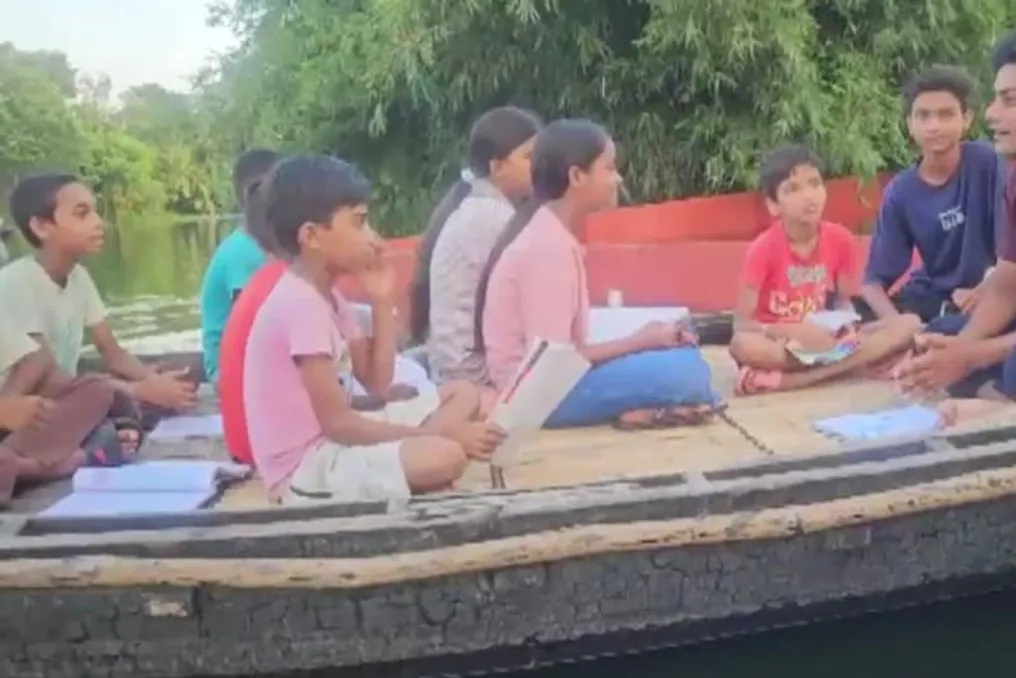
In flood conditions in Bihar, a teacher organized lessons on a boat after the school was flooded
Read more
Aaj Tak
www.aajtak.in

In flood conditions in Bihar, a teacher organized lessons on a boat after the school was flooded

Flooding in Bihar has halted life in many areas. Roads are submerged, and homes are filled with water. Schools have also suffered from the elements, which has directly impacted children's education. However, an unusual story of continuing classes under such difficult circumstances has emerged in the Katihar district.

In Raghunatpur, which is part of the Amdabad block in Katihar district, the school was flooded. The village roads were underwater, and water surrounded the houses, making schooling impossible. In this situation, a private tutor, Mohammad Saheb, found a relatively calm spot with low water levels near the school and turned a boat into a classroom.

Now, children study while sitting on this boat. They bring their books, and Mohammad Saheb teaches them. Special attention is paid to the fact that the teacher himself picks up the children and safely takes them home after classes end. He has received official consent from the students' parents to conduct these lessons.

The impact of the flooding in Katihar district is severe: approximately 939,766 people in seven affected blocks are in the disaster zone. Raghunatpur in Amdabad is among these affected areas, where only water is visible. Roads are flooded, water surrounds the houses, and the primary school grounds are also underwater. The water reaches half the height of the fence and the main school entrance.

Even after the water level recedes, it will take a long time for life in the region to return to normal. Residents of this area face this catastrophe every year, so the teacher could not allow such prolonged damage to children's education.

Mohammad Saheb notes that the impact of the flooding in the region will last for a long time. He believes that if children's education is interrupted, it will negatively affect their future and ability to develop skills. It was with this thought that he started classes on the boat. For teaching, he chose a quiet spot with a small amount of water, where the lesson takes place. The children come here with parental permission. The teacher himself seats them on the boat and escorts them home after the lesson concludes.

Mohammad Saheb explains that the children living in the flood-affected areas are accustomed to such conditions. He asserts that due to the low water level, there is no danger to studying on the boat. For them, the most important thing is the continuation of education. He teaches the children for about one to one and a half hours. Although the school is closed due to the flooding, classes on the boat continue so that children's education does not stop completely.

The children who study on the boat also feel comfortable in this format. Satyam, a fifth-grade student, says there is little water. His parents allowed him to study on the boat with the teacher. Anna, a sixth-grade student, also notes that she is not afraid to study on the boat because of the low water level, and she enjoys learning. According to her, the teacher teaches for about an hour and a half.

Although the school building was flooded by the flood, children's education has not stopped completely. The boat, standing in the water near the school, now serves as their classroom. Books are open, the teacher is teaching, and the children are learning. This attempt to continue education in difficult conditions demonstrates a unique picture in itself.
Similar stories

Children from poor backgrounds in Bihar study in huts without furniture or toilets; anxiety grows over snakes
Read more
www.aajtak.in

Children from poor backgrounds in Bihar study in huts without furniture or toilets; anxiety grows over snakes

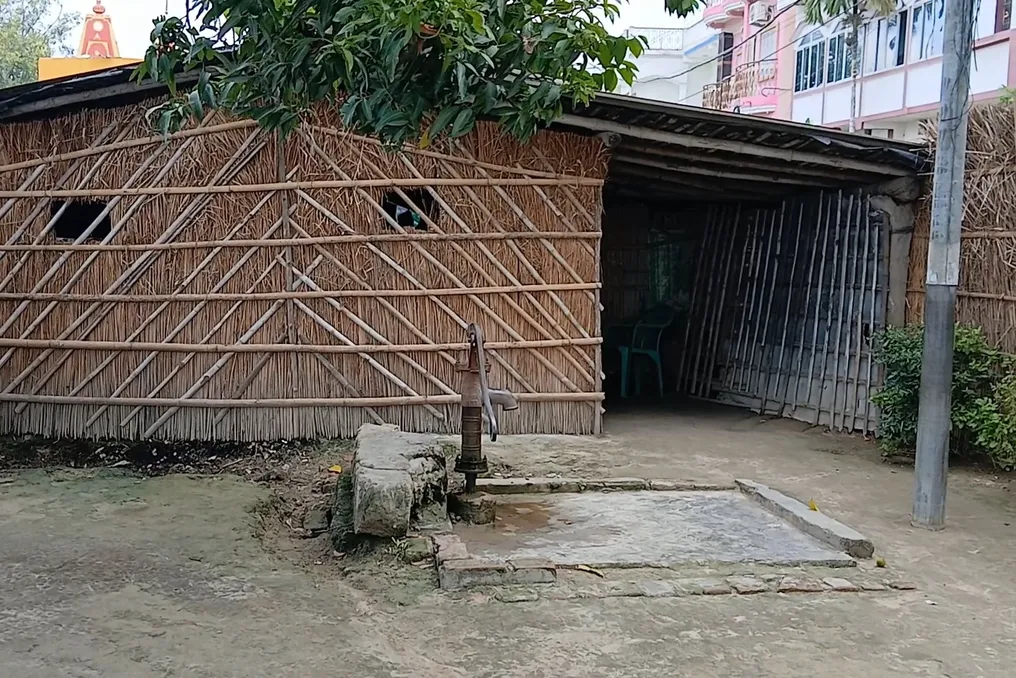
Despite claims of modernizing government schools in Bihar, transforming them into exemplary institutions and providing children with modern amenities, the reality at one of the government primary schools in the center of Samastipur city tells a different story. Here, children are forced to study on the ground in hut-like premises because there are no permanent classrooms. The school lacks desks, tables, or even a decent blackboard. In the summer, when the fan is not working, students try to cool down by covering their textbooks and notebooks. During the rain, the roof leaks, forcing classes to be interrupted. Furthermore, the school lacks sanitary facilities.

The greatest concern is that most students in this school come from the nearby Dalit community. Their parents face serious financial difficulties and cannot afford to send their children to more distant educational institutions. The situation is complicated by the increased sightings of snakes in the vicinity of the school, which heightens anxiety among children and their parents. This school is located on the roadside near the B.Ed college in Samastipur city, and it hosts students from the first to the fifth grade.

The condition of the school can be assessed by the fact that only two rooms are used for teaching children from the first to the fifth grade. Students from the first to the third grade attend simultaneously in one room, while the fourth and fifth grades have lessons in another. The insufficient amount of seating furniture forces many of them to open their textbooks and notebooks directly on the ground while teachers strive to conduct the lesson. The problem is exacerbated by the increasing number of students. It is difficult for teachers to educate children of different grades in one place: while first-grade students are occupied, second and third-grade students must be in the same room. Moreover, the separate room for fourth and fifth graders is also inadequate.

The children's problems worsen on hot days. Due to the lack of sufficient fans in the school, students suffer from stuffiness and heat. The situation is such that the teachers themselves are seen waving their hands as fans. Children also use their notebooks or books as fans to ease the heat. At an age when children should be provided with the best learning environment, they are forced to learn while enduring the effects of the weather. For the students of this school, heat is not just an inconvenience; prolonged stay in closed and hot premises makes learning extremely difficult. After the heat problem, the rainy season becomes another serious test for the school. Water begins to seep through the school building's roof. Under these conditions, conducting classes is difficult, and there is a risk of books and notebooks getting wet. This is why classes are often suspended and declared holidays during the rains. While government schools talk about smart classrooms, digital education, and improved buildings, this school in Samastipur cannot even provide basic protection from the rain.

The state of basic amenities in the school can be judged by the fact that there are not even toilets for the children. A toilet is an absolutely necessary basic condition for primary school students. However, this service is also unavailable at this school. The question arises: when will the responsible authorities pay attention to this government school facility located in the middle of the city?

In addition to the poor construction of the school, another problem worries the children and parents. According to local residents, snake sightings are regularly recorded nearby. In a school situated in a hut-like and open environment, fear persists among the children. Parents are also concerned about possible accidents involving their children. A school should be a place where a child feels safe, but due to the dilapidated building and surrounding environment, safety becomes a matter of concern.

The school director, Vishwajit Jha, stated that he has repeatedly discussed the school's condition with officials from the Education Department. According to him, officials have suggested several times merging the school with another educational institution. However, this decision is unacceptable to the parents. The director explains that a large number of children from the nearby Dalit community attend this school. Parents argue that they are not willing to send their children to another school located about two kilometers away. Thus, the option of merging the school is also not a simple solution.

The main concern of the parents is the distance to the school. Families state that, being economically weak, it will be difficult for them to transport young children to a school located two kilometers from home daily. Therefore, parents insist that the school building must be permanent right here.

Popular