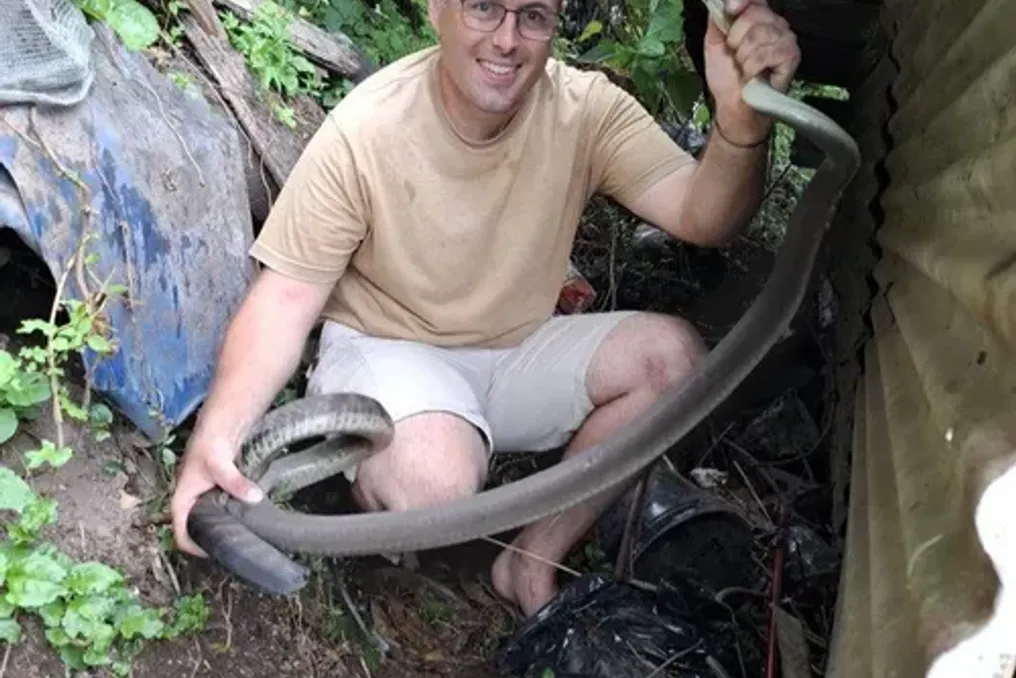
Nick Evans, a snake rescuer from Durban, openly discussed his more than decade-long struggle with clinical depression, severe anxiety, and complex post-traumatic stress disorder (PTSD). He shared how suicidal thoughts affected his life and the lives of loved ones, as well as the family support, treatment, music, nature, and sense of purpose that help him through the darkest days.
During Suicide Prevention Month, Evans shared his deeply personal experience, emphasizing that he speaks about his difficulties not for attention or pity, but in the hope that someone battling similar thoughts might recognize themselves in his story.
He stated: 'My clinical depression, severe anxiety, and complex PTSD led me to battle suicidal thoughts for over 10 years.' His mental health issues sometimes became so serious that he required hospitalization twice. He also underwent various types of treatment, took different medications, and consulted numerous doctors.
In recent years, he noted that he was fortunate enough to find a psychologist and psychiatrist whose work suited him. However, despite the treatment, suicidal thoughts have not completely disappeared. Evans reported: 'Despite good treatment, my suicidal thoughts come in waves. Sometimes for long periods, sometimes for a day or two.'
The Hidden Battle
Evans described this experience as a state where a person feels cornered in an exhausting mental battle, symptoms of which include hopelessness, excessive rumination, and loss of joy. He recounted that sometimes it was difficult for him to find pleasure even in objectively positive events—a condition known as anhedonia.
Furthermore, he mentioned a constant need for reassurance, self-doubt, and the oppression caused by worries that might seem minor under other circumstances. Nevertheless, Evans admitted there are times when he is not in such a state.
For him, this struggle can take a physical form. He explained: 'When I think about suicide, I take it very seriously because I feel so much pain that I just want the suffering, this mental battle, to end. I want to get rid of the pain, the stress.'
The scale of suicides in South Africa underscores the importance of conversations about mental health and suicide prevention. According to the South African Federation of Mental Health (SAFMH), approximately 23 suicides and 230 serious suicide attempts occur daily in the country. SAFMH reported that South Africa ranks 10th in the list of countries with the highest number of suicides, with a rate of nearly 24 per 100,000 people.
The organization also highlighted a significant gender imbalance in suicide statistics. SAFMH noted that out of 13,774 registered suicides in South Africa for a certain year, 10,861 (78.85%) were men, and only 2,913 (21.15%) were women. These figures correspond to a rate of nearly 38 per 100,000 among men and approximately 10 per 100,000 among women.
Finding Reasons to Stay
Yet, even in the darkest moments, Evans found reasons to keep living. His family remains one of his strongest supports, especially his wife and mother. He knows that losing him would be terrible for them, even when his mind says otherwise.
He also clings to the words instilled in him by his mother and grandfather in childhood: 'Never give up.' His wife has become a huge source of support for him. Treatment remains part of his daily life, including taking medication and attending sessions with a psychologist and psychiatrist. Additionally, he joined the South African Depression and Anxiety Group (SADAG).
However, one of the biggest sources of relief for Evans is far from the city, amidst the wilderness. He believes the bush gives him a sense of happiness that is hard to find elsewhere. 'The main thing for my treatment is being in the bush.'
Nature reserves around Durban offer some solace, but Evans feels most at peace in the game reserves of Northern KwaZulu-Natal, Kruger National Park, and other wild areas. He immerses himself in studying wildlife, botany, animal tracks, species, and scents. It is there that he dreams of one day living and working. 'I plan to live and work in the bush someday. I just have to do it.'
Evans also believes there may be meaning in his work rescuing reptiles. On busy days, saving snakes and other reptiles occupies his mind and gives him a sense of purpose. He acknowledges that sad cases affect him, but tries to focus on successful rescues. Nevertheless, even answering a phone call can feel overwhelming during the darkest periods.
Speaking publicly about his experience, Evans ultimately aims to reach someone who might be silently struggling with the same issue. He hopes that by sharing what helped him survive, others might find something to help them through their darkest moments. 'I hope this helped a reader who is struggling to feel connected and perhaps try some things that support me in life.'
He also hopes that his honesty will help those who love a person experiencing suicidal thoughts better understand what that person is going through. 'I hope I helped someone who lives with someone who is suffering to understand that person.'