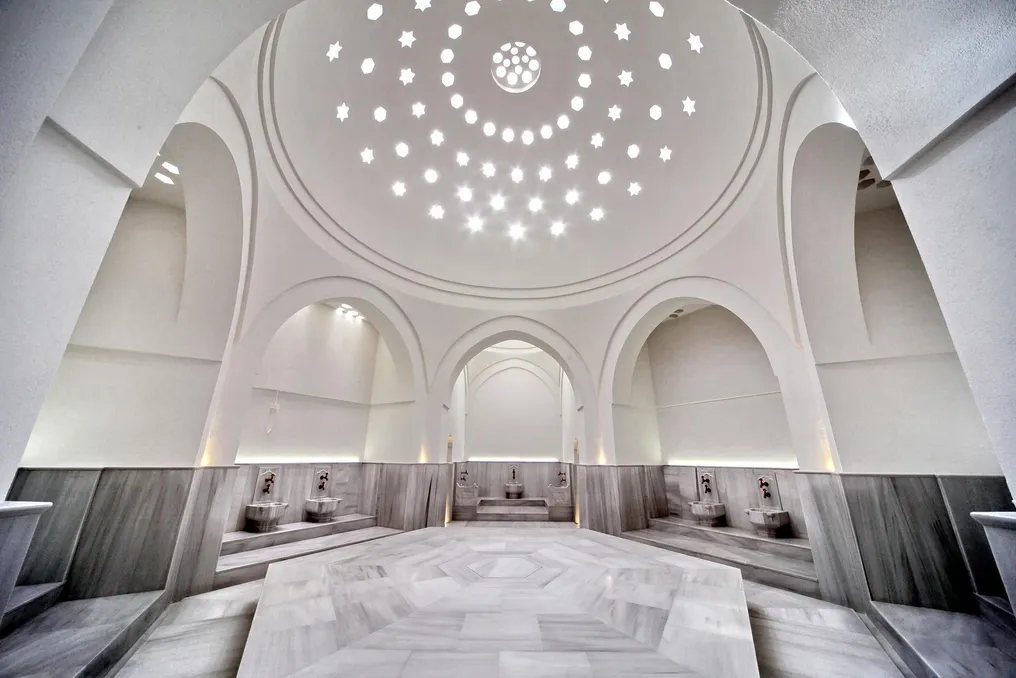
The Turkish bath was part of the population's routine in Turkey during the Ottoman Empire, specifically between the 15th and 16th centuries. This cleansing ritual, which involved heat, exfoliation, and washing, was essential before the implementation of the modern sewage system. People frequented hammams, which are the names given to bathhouses, before entering mosques to pray. Besides hygiene, these places served as socialization points, potentially occupying an entire day.
Although the tradition has evolved and there is no longer a hammam in every neighborhood as occurred in the Ottoman Empire, Turkish baths maintain their local cultural relevance. Currently, Istanbul, the former Constantinople, has about 60 establishments. In these places, rituals usually last approximately two hours and are sought after for both relaxation and spiritual aspects, not just cleanliness.
The typical experience begins with changing clothes; hammams provide robes, slippers, and disposable underwear. Next, the visitor is led to a room equipped with heated marble stones, where they can lie down. The process continues with exfoliation and jets of water on the body, culminating in a massage.
Next, we present a selection of five recommended hammams to visit in Istanbul:
Hammam with History and Restoration
One of the hammams, reopened in May 2024, is almost five hundred years old and is located in the historic Zeyrek neighborhood. After a restoration process that lasted thirteen years, the space was renewed with environments characterized by half-tiled walls, marble finishes throughout, and domes with star-shaped openings.
Built in the 1530s, this hammam houses various artifacts from the Roman, Byzantine, and Ottoman empires. Historical items discovered during the renovation, along with the original tiles, can be viewed in an internal museum.
After passing through the heated room, the client has the option to wash themselves or opt for the classic experience, where a therapist performs the washing and exfoliation. The most complete package includes the bath, a full body massage, a facial treatment, and a selection of dried fruits accompanied by biscuits and tea.
Hammam Designed by Mimar Sinan
Operating since 1584 in Çemberlitas Square, near historical landmarks such as the Grand Bazaar and the Blue Mosque, this establishment was conceived by Mimar Sinan, recognized as the father of Ottoman architecture. He designed the hot marble stone room to present a square shape externally but surprise with a circular dome supported by twelve columns internally. Natural lighting is ensured by openings of different shapes present in the domes.
Although it features gold inscriptions and marble, its decoration is more discreet compared to other hammams. The traditional bath can be complemented with treatments such as cranial massage, aromatherapy, and clay mask application.
Another hammam, also designed by Mimar Sinan, was built between 1578 and 1583 to serve members of the Ottoman navy in the Tophane district. Reopened in 2012, the Kılıç Ali Paşa Hamam is notable for being one of the most traditional and having a more classic look in Istanbul, located near the Museum of Modern Art.
The restoration of this hammam required traversing four hundred and thirty years of layers of debris and materials that concealed its original structure. The works managed to restore the main dome, which reaches 17 meters in height and 14 in width, as well as the internal rock walls.
Unlike other hammams that maintain separate entrances for men and women, Kılıç Ali Paşa has only one door, using separate schedules to accommodate each public, as it was built exclusively for Ottoman soldiers. The traditional bath here can incorporate five types of massage.
Royal Luxury Near the Blue Mosque
Located between the Blue Mosque and the Hagia Sophia Museum, this third hammam, also a work of Mimar Sinan, was intended solely for the royal family of Sultan Suleiman the Magnificent during the 16th century. As expected, the highlight here is luxury: the place features gold epigraphs, stained glass, paintings, and rooms that simulate the experience of bathing under the stars.
This hammam remained closed until 1910 and was reopened in 2007, during which time it served as a prison and carpet shop. Currently, services range from traditional washing to sophisticated experiences, including hand and foot exfoliation, clay masks, aromatherapy, facial massage, and organic amenities.
In the bohemian area of Çukurcuma, there is a nearly two-hundred-year-old hammam, but it was only reopened for baths in 2018. Although it retains features such as domes, high footrests, and ventilation openings, its predominantly white appearance contrasts with the other establishments. An important difference is the absence of gender distinction, allowing everyone to bathe simultaneously, although only five visitors are accepted at a time.
At this last location, there are three types of baths: the traditional one, one that includes hand and foot exfoliation, and another that offers a forty-minute massage. Additional packages for facial masks and aromatherapy can be purchased.