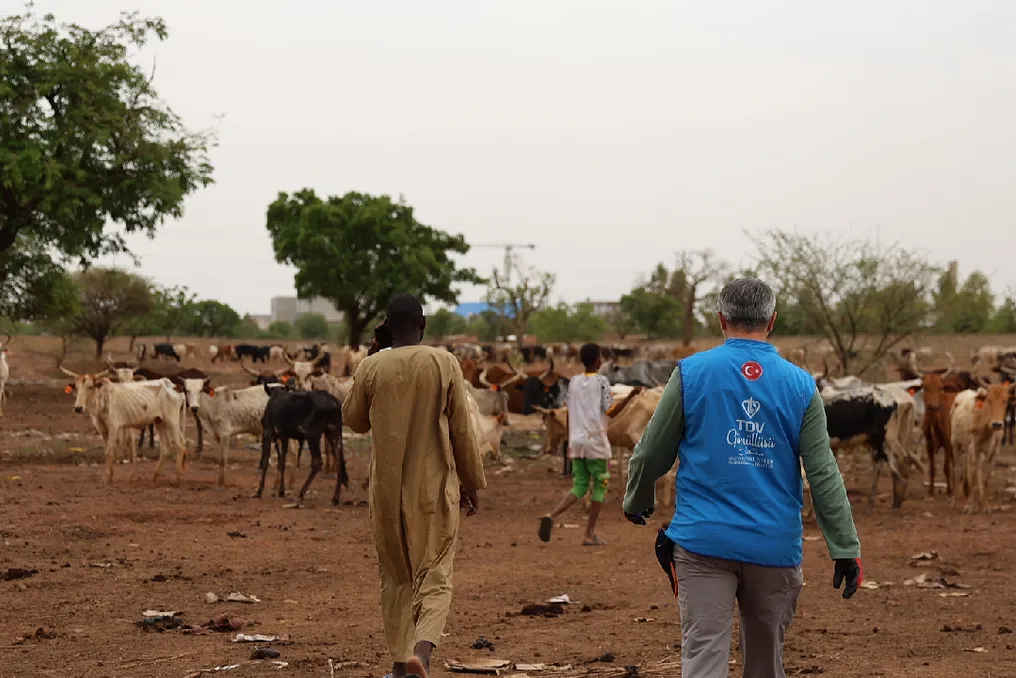
Study shows climate forecasts are insufficient to protect poor African farmers without practical support
Read more
CGTN
cgtn.com

Study shows climate forecasts are insufficient to protect poor African farmers without practical support

Although improved weather forecasts can help pastoralists prepare for intensifying droughts, a new study indicates the limited effectiveness of these forecasts if vulnerable households lack the means to respond to warnings.

An international group of researchers, led by the University of Sydney and Imperial College London, argues that combining climate information with measures such as fodder for livestock, drought insurance, targeted financial aid, and improved market access can protect some of the poorest pastoralist communities in Southern Africa from climate shocks.

This study, published in the journal Nature Sustainability, comes amid regional preparations for the potential impact of a powerful El Niño event.

Forecasts alone are insufficient

Lead researcher Dr. Matt Clark noted that the problem is not simply the lack of access to climate information, but the limited capacity of poorer farmers to react to it.

Clark stated: 'If the forecasts prove correct, and we see the development of an almost record El Niño, we expect this will exacerbate inequality on Southern African pastures.' While well-off livestock owners can sell animals before drought conditions worsen and then rebuild their herds, poor herders often do not have the financial resources to reduce herd size or buy additional feed.

This forces them to keep livestock on increasingly degraded pastures, increasing the risk of animal death and further loss of household welfare. The consequences can extend beyond individual families, affecting food security, livelihoods, and the health of fragile pastures.

The researchers emphasize that practical support enables farmers to act on forecasts before the drought hits, potentially reducing both economic losses and environmental damage.

Combining adaptation measures

The team used detailed modeling to examine how pastoralist households in Botswana, Eswatini, Lesotho, Mozambique, Namibia, South Africa, and Zimbabwe might respond to increasing rainfall variability.

Researchers integrated projected precipitation data from European climate models with information on livestock, vegetation, and household welfare. Their first simulation scenario, based on the status quo, showed that greater rainfall variability could lead to reduced household welfare, increased livestock losses, grassland degradation, and widening inequality.

In the second simulation scenario, various adaptation measures were tested. Climate forecasts alone provided only modest benefits, as many poor households could not afford to utilize this information. Risk mitigation measures could also cause environmental trade-offs.

However, when climate information was combined with practical and financial support, researchers found that households cope better with drought preparedness while simultaneously reducing pressure on pastures. The model also suggested that adaptation could spread between neighboring communities, as farmers learn from each other and adopt successful strategies.

Dr. Gina Arena from the Conservation International's Herding for Health initiative noted that growing climate uncertainty increases the risks faced by pastoralist communities. She added that research can help identify effective solutions while simultaneously mitigating the risks associated with their implementation.

The researchers conclude that this approach does not necessarily require new technologies; instead, existing forecasting systems must be integrated with programs that provide vulnerable communities with resources to respond. Clark also noted that this framework could be applied outside of Southern Africa, including Australia and other regions where livestock producers face increasingly unpredictable rainfall. The findings underscore the broader issue of climate change adaptation: early warnings save lives and livelihoods only when the recipients have the resources to act.

Similar stories

Strong El Niño threatens African agriculture, demanding advance preparation
Read more
foodformzansi.co.za

Strong El Niño threatens African agriculture, demanding advance preparation

Africa may face a season of intense heat, drought, flooding, and disrupted rainfall patterns due to the strengthening of an unusually powerful El Niño event in the Pacific Ocean.

The latest forecast from the U.S. National Oceanic and Atmospheric Administration (NOAA) indicates that El Niño is strengthening, with a greater than 90% probability that it will become a very strong event during the autumn-winter period of 2026/27 in the Northern Hemisphere. There is a 69% chance that the event will exceed the strength of any recorded El Niño since 1950 between October and December.

Dr. Henno Havenga, senior lecturer in climatology at the School of Geospatial Sciences at Northwestern University (NWU), noted that the term 'super El Niño' is widely used but is not an official scientific classification. He explained that this description refers exclusively to an extremely strong El Niño event. El Niño occurs when the central and eastern parts of the equatorial Pacific Ocean become abnormally warm, and atmospheric circulation above it changes. These changes can affect weather conditions far beyond the Pacific Ocean through so-called teleconnections.

Havenga emphasized that the strength of the developing event does not guarantee catastrophe in all countries or regions; El Niño only changes the odds, but does not dictate the weather from one area to another. Nevertheless, it can increase the probability or exacerbate certain conditions typically associated with El Niño.

For most of Southern Africa, such conditions include reduced rainfall, drought, and abnormally high temperatures. The heat worsens the damage as it increases evaporation and the demand for water for crops, livestock, and people precisely when reserves may be depleting.

He added that even within one country, rainfall might arrive too late, fall in the wrong places, or come down in short, destructive squalls instead of the timely and evenly distributed rain needed for agricultural crops. 'The timing, distribution, and intensity of precipitation can either amplify or compensate for the typical El Niño signal locally.'

According to Havenga, agriculture is one of the most vulnerable sectors, but the consequences will extend far beyond the farm. Poor harvests can lead to reduced food availability, weakened rural incomes, and rising prices.

He warned that commercial producers may have access to insurance, financing, irrigation, or alternative markets, whereas smallholder or subsistence farmers may lose both family food and income-generating produce.

Water security issues are equally pressing. Hot and dry weather increases demand while simultaneously reducing the amount of water in rivers, reservoirs, and wells. Havenga noted that local authorities cannot afford to lose treated water due to leaks and poorly maintained infrastructure during such a period. He advised that 'reducing leaks and unnecessary losses from existing water infrastructure is one of the most practical interventions available to us. At the same time, all users should generally conserve water.'

Intense El Niño can put a strain on healthcare systems, energy systems, and ecosystems. Extreme heat poses a particular danger to outdoor workers, the elderly, children, and people with chronic illnesses. Drought can affect drinking water quality, sanitation, and nutrition, while floods can contaminate water sources and increase the risk of diseases.

Havenga stated that one cannot assume that every ecosystem will simply return to its previous state after a severe drought. However, reducing anthropogenic pressure, including excessive water abstraction, land degradation, and unnecessary habitat disruption, can improve the ability of ecosystems to withstand and recover from this phenomenon.

He insisted that governments must repair water infrastructure, prepare food security programs, and ensure the ability to quickly launch disaster response systems. Havenga called for developing financial aid, agricultural support, and drought relief mechanisms before farmers and communities find themselves in difficulty.

He stressed that drought is a slow-developing risk. Its consequences may initially be unnoticed, but it develops gradually, and this slow progression can catch people off guard. 'The advantage is that early warning systems allowed us to discuss this event starting in May. We must use this warning to reduce our vulnerability and prepare for a difficult season, rather than waiting until the drought has already set in.'

Strengthening El Niño threatens Africa with harsh weather, requiring resilience-building measures
Read more
iol.co.za

Strengthening El Niño threatens Africa with harsh weather, requiring resilience-building measures

As the El Niño phenomenon intensifies, Africa must strengthen its capacity to withstand climate variability. A scientist emphasizes that leaders and local communities need to act immediately to secure harvests, livelihoods, and healthcare systems.

The powerful El Niño phenomenon is gaining strength in the Pacific Ocean, setting the stage for a potentially devastating season on the African continent. According to the latest forecast from the U.S. National Oceanic and Atmospheric Administration (NOAA), there is over a 90% probability that this El Niño will develop into one of the most intense events in history during the autumn and winter of 2026/27 in the Northern Hemisphere.

The forecast indicates a 69% chance that this event will exceed the strength of any El Niño recorded since 1950, presenting an alarming scenario for the African continent, which stands at the threshold of a multifaceted climate crisis. Unlike past models, the impact of this phenomenon will be diverse: Southern Africa may face extreme heat and drought, while East Africa could suffer from excessive rainfall and flooding.

Impact on Agriculture and Water Security

The consequences of this intensifying weather phenomenon could prove particularly devastating for agriculture. Many farmers in Southern Africa may face reduced rainfall and rising temperatures, leading to drought, exacerbating water demand and crop viability issues. This combination is capable of destroying food production during periods of resource scarcity.

The risks are extremely high for smallholder and subsistence farmers. As Havenga warns, 'unlike commercial producers who can obtain insurance, financing, or irrigation, small farmers risk losing both vital food for their households and produce intended for sale.' He adds that 'such a drought can cause both a food and income crisis, disproportionately affecting communities heavily reliant on local harvests and village markets.'

The problems extend beyond agriculture as the risk of water insecurity increases. Hot, dry weather increases demand while water reserves diminish, creating a precarious situation for local residents. Havenga insists that 'local authorities must prioritize maintaining water purification systems to mitigate losses from leaks. Encouraging all users to conserve water is paramount.'

Risks to Health, Energy, and Ecosystems

The consequences of strong El Niño extend far beyond agriculture and water supply; they affect health, energy systems, and ecosystems. Extreme heat increases risks for outdoor workers, vulnerable national health sectors, and populations suffering from chronic diseases.

Furthermore, while drought can degrade drinking water quality and nutrition, floods bring their own dangers, including contamination and increased disease risk. Countries dependent on hydropower may face reduced electricity generation due to lower rainfall, balancing the growing demand for cooling amid rising temperatures.

Natural ecosystems are also not immune to this pressure. Drought can lead to reduced vegetation growth and increased wildfire risk, while animal populations may struggle due to limited resources. Havenga cautions: 'we cannot assume that ecosystems will return to their previous state after a drought,' calling for better management of environmental stress.

Call to Action

Nevertheless, hope is not lost. Africa possesses tools to mitigate the effects of El Niño, partly thanks to advanced forecasting and lessons learned from previous climate-related disasters. The real danger arises if governments and communities fail to take action in anticipation of the coming season.

Farmers are advised to revise their agricultural strategies, using information about impending climate changes to make informed decisions regarding planting schedules and water use. Governments must focus on repairing outdated water infrastructure, activating food security programs, and establishing effective emergency response protocols before the consequences of drought become severe.

Dr. Havenga notes: 'Drought is a slow-developing risk. It may take time before its effects are felt, which underscores the importance of proactive rather than reactive measures.' The preliminary warning from weather experts, ongoing since May, provides a vital opportunity to reduce risks and prepare for potentially difficult seasons ahead. There is an urgent need to utilize existing knowledge and implement preventive measures now, instead of waiting for the full manifestation of the developing climate crisis.

Popular