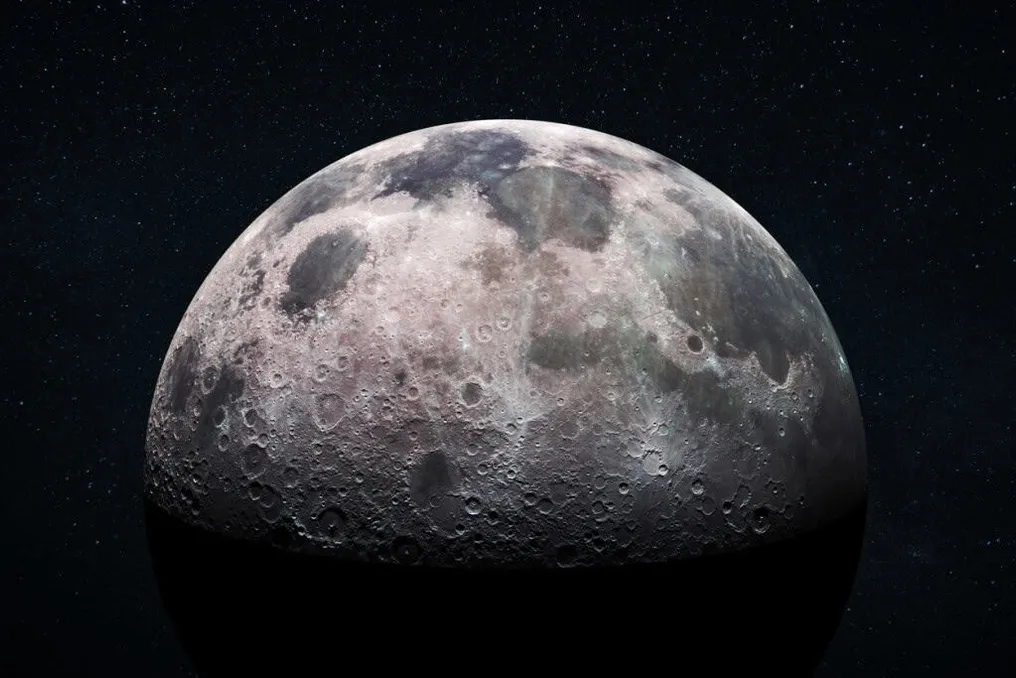
The idea of establishing a city on the Moon is frequently mentioned in the context of human expansion into space, as Earth's natural satellite is seen as a potential starting point for future explorations beyond the Solar System, with NASA already developing plans for a lunar base.
However, a permanent city on the Moon faces a fundamental challenge: water availability. A recent study investigated this issue and concluded that, even under an extremely optimistic scenario regarding the amount of accessible water and reuse capacity, a lunar metropolis with one million residents could sustain itself for just over one hundred years before exhausting its water reserves.
Analysis of survival scenarios
The researchers, Dr. Martin Elvis and Dr. Jonathan McDowell, based their work on a rather generous estimate of one billion tons of water present on the Moon. This volume is equivalent to about four hundred thousand Olympic swimming pools or the amount of water that flows through Niagara Falls in approximately seven minutes.
The calculation also assumes that this water can be purified and reused with an efficiency of 98%, an index comparable to that achieved on the International Space Station (ISS). With these two premises—large volume of water and high recycling efficiency—a population of one million people would consume the resource in just over a century.
However, the more realistic estimate suggests an amount of water thirty times smaller than the optimistic scenario. In this situation, a lunar city with one million inhabitants would have a lifespan of only a few years before facing water scarcity.
Smaller communities would have greater longevity; for example, a village with a thousand inhabitants or a city with ten thousand people could last for centuries, although they would eventually also face resource depletion.
To mitigate this problem, one possible solution would be to further increase water use efficiency. Furthermore, the developed technology could benefit Earth, particularly in combating droughts. Another avenue for a solution involves seeking new water sources in deeper areas of the lunar surface or even exploring asteroids and comets.
Limitations of other resources
Zach Weinersmith pointed out that the only locations on the Moon with a high concentration of carbon are the waste products generated by Apollo mission astronauts, such as urine, vomit, and feces. Even so, the available quantity is minimal. Weinersmith clarified that it is not feasible to produce more carbon locally, as it originates from stars, characterizing an intrinsic problem.
The researcher also emphasized that lunar water itself, often viewed as a facilitating resource for colonization, is finite. Despite the enthusiasm for future space cities, experts recommend that obstacles be meticulously examined before such projects are implemented. The study was published in the journal Frontiers in Space Technologies.