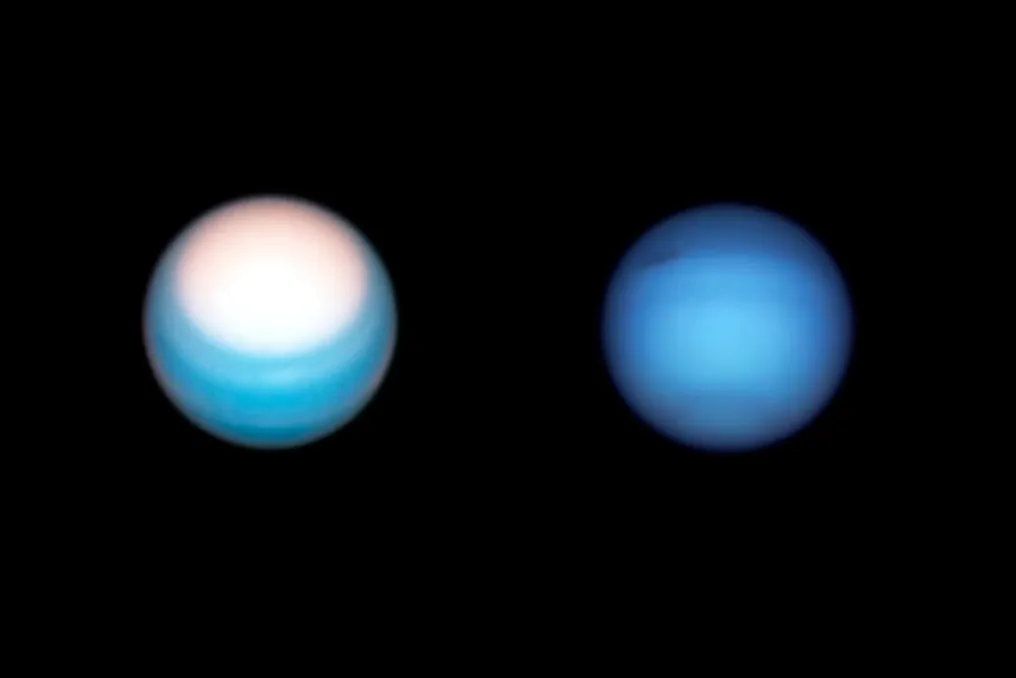
Uranus and Neptune, celestial neighbors, share characteristics such as being blue, gaseous, and icy, in addition to having magnetic fields distinct from all other bodies in the Solar System.
The magnetic irregularities of these ice giants have always represented an enigma to astronomers. To aid in understanding this phenomenon, Earth is used as a reference, where the magnetic field originates in the planetary core, generating a clear separation between the north and south poles, known as a 'dipole'. This mechanism is also observed on other planets in the Solar System, such as Jupiter and Saturn.
However, Neptune and Uranus present notable exceptions. Their magnetic poles are tilted at 47 and 59 degrees, respectively, relative to their rotation axes, and the intensity of these fields varies significantly across the surfaces of the planets. Unlike Earth, their fields are completely tilted and decentralized.
Researchers have found a possible explanation for this phenomenon. Based on new discoveries, the theory suggests that the extreme conditions of high temperature and pressure on these planets caused a reorganization of hydrogen and oxygen that constitute water. This reorganization gives the ice unique electrical and mechanical properties, directly affecting the planets' magnetic fields.
The crucial distinction in the ice of these worlds lies in the movement of hydrogen atoms: while oxygen maintains a solid crystalline structure, hydrogen behaves like a liquid. This results in ice that acquires what is called superionic behavior, characterizing it as an electrical conductor superior to other forms of ice.
To replicate the conditions of the ice on Uranus and Neptune, scientists used a device called a diamond anvil, using it to compress water molecules under pressure similar to the atmosphere of these planets. Additionally, the team heated the anvil with a laser until the samples reached temperatures in the order of thousands of degrees.
If this hypothesis is validated, it will change the conception of the origin of the magnetic field of the ice giants. Instead of deriving from the planetary core, as happens on Earth, these fields could arise from the flow of electric charges present in the superionic ices located near the surface.
The researchers' next focus will be to investigate the behavior of this specific type of ice, both in terms of electrical and mechanical aspects. According to them, the type of magnetic field it can generate depends not only on how the charge moves but also on how it deforms under the intense pressures and temperatures found inside the most distant planets.