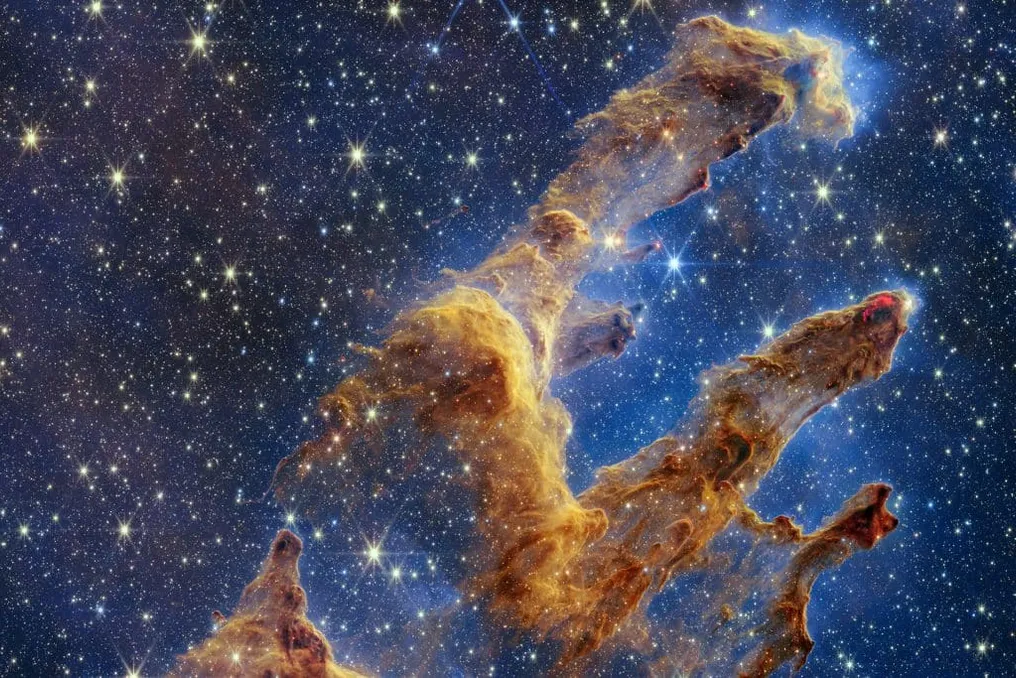
The space image you like the most might be fake. Although images taken by telescopes and probes have helped the public approach astronomy for decades, revealing structures invisible to the human eye and visualizing phenomena millions or billions of kilometers from Earth, progress in artificial intelligence (AI) threatens this trust. Today, the line between legitimate scientific evidence and simple digital fabrication is becoming increasingly blurred.
The problem is not just the ability to create fake photographs. Astronomy works with images that go through many stages of processing before reaching the public. For those unfamiliar with these procedures, a real photograph, data composition, simulation, and AI generation can look very similar.
In this situation, science popularization takes on an additional responsibility. In addition to presenting discoveries and explaining phenomena, it is now necessary to contextualize accompanying images, clearly indicating what was observed, how the data was obtained, and what type of representation is being used.
These difficulties did not begin with generative AI. In 2022, French physicist Étienne Klein published an image on social media presented as Proxima Centauri, the star closest to the Sun, allegedly registered by NASA's James Webb Space Telescope (JWST). However, the photo actually showed a piece of chorizo on a black background. Klein later explained that it was a provocation regarding the ease of accepting and spreading information on the internet, but the publication caused a big resonance and was initially perceived by the public as true.
This incident showed how an image can gain authority simply by association with scientific information. With current AI generators, the problem has taken on a different scale: it is now possible to create highly realistic images of planets, eclipses, galaxies, spacecraft, and other phenomena without any corresponding records.
This year, for example, fake images attributed to NASA's Artemis 2 mission circulated on social media, supposedly created during the astronauts' flight around the Moon. Checks revealed artificial images and content presented out of context. In one case, the supposed photograph of Earth from the Orion spacecraft's viewport had characteristics incompatible with that craft. Another image showed the Oriental Basin on the Moon, but it did not match the real data obtained by the crew.
This case draws attention to the fact that disinformation does not necessarily have to invent the entire event. The mission took place, the astronauts flew around the Moon, and they took real photos. A false image can simply be linked to this context to gain credibility.
In astronomy, the distinction between recording and representation is particularly important. Telescopes observe not only visible light. Depending on the instrument, they can capture infrared, ultraviolet, X-ray radiation, and other ranges of the electromagnetic spectrum that are inaccessible to the human eye.
Data requires processing to turn into understandable images. In certain situations, colors are assigned to different wavelengths to highlight specific structures or characteristics. Brightness and contrast adjustments may also be used.
Therefore, an authentic scientific image may look completely different from what a person would see observing the object directly. This does not mean that the record is false. There is a fundamental difference between processing data obtained by an instrument and fabricating a representation without corresponding observational data.
Studies of visual communication in astronomy analyzed this issue even before the popularity of AI. The Aesthetics and Astronomy project, developed by researchers at the Harvard-Smithsonian Center for Astrophysics in the United States, studied how aesthetic characteristics of images affect public perception and understanding. With the advent of AI, a new concern arises: besides interpreting the choices made by scientists and observatories, the public must evaluate the origin of the content received.
Concerns about misinformation existed among popularizers long before the appearance of this new generation of tools. During 'Space View' on Friday (11), amateur astronomer and astrophotographer Marcelo Domingues reminded that this was also one of the goals of the Astronomia ao Vivo project, created in late 2012 to bring astronomy closer to the public via the internet, combining observations, news, interviews, astrophotography, and broadcasts of celestial phenomena. Over the years, the project also aimed to debunk conspiracy theories and unfounded information circulating online.
Domingues recalls that during the launch of Astronomia ao Vivo, claims that lunar missions were a hoax coexisted with ideas such as a flat Earth and a hollow Earth. According to him, this content found little opposition on the internet, which contributed to its spread. In this context, the project also became a space for clarification. When the team lacked sufficient knowledge on a certain topic, they consulted researchers and other specialists to provide well-founded explanations. Domingues stated: 'These absurdities become popular because no one refutes them.'
If the problem used to be refuting unfounded claims, today the visual representation itself can be used to give a false narrative an appearance of authenticity. Thus, AI amplifies a problem that science popularizers already knew: the difficulty of delivering correct information to the public with the same force as misleading content.
José Serrano Agustoni, known as Zeca Astrônomo, also participated in the discussion. Having studied electrical engineering at the Federal University of Rio Grande do Sul (UFRGS) and being a former oil engineer at Petrobras, he dedicated himself to science popularization after retirement, using his own equipment in open internet broadcasts.
Zeca extends this discussion beyond astronomy. In his opinion, the difficulty in countering content created or enhanced by artificial intelligence lies not only in the ability to create convincing images but also in the advantage this type of content can gain competing for public attention against scientific explanation. He notes: 'The question is not whether there are people to counter it. The question is that sometimes lies are much more beautiful than the truth.'
According to Zeca, false information can be constructed in a fantastic, extraordinary, and instantly appealing way, whereas the correct explanation is often simpler or requires prior knowledge to understand. For example, a story about an alleged alien invasion can instantly arouse curiosity, while explaining a real phenomenon may require concepts of physics or astronomy.
It is this difference in appeal that makes the fight against disinformation more difficult. The issue is not just about providing the correct answer after false content has spread. It is also about fighting for public attention by presenting scientific information in an understandable and interesting way, without sacrificing accuracy. With increasingly convincing artificial images, this balance becomes even more crucial.
This statement points to the central difficulty of science popularization. The correct explanation may require context and prior knowledge. A false story can simply exploit wonder: an impossible phenomenon, an extraordinary discovery, or a situation that seems to confirm what the public already wants to believe.
Therefore, debunking an image after it goes viral may be insufficient. Science popularization must constantly provide reliable sources and educate the public to understand the context of the information received.
In such a scenario, provenance becomes as important as appearance. Photos and data published by space missions and observatories are usually linked to information about the mission, the instrument used, the date, authorship, and the processing performed.
The answer, therefore, is not to turn the public into experts in identifying AI-generated images. It lies in strengthening scientific and visual literacy: understanding that an image can be processed without being false; that artistic representation is not a record; and that a photograph gains value as evidence only when its origin can be verified.
For astronomy, this presents a new challenge, but it does not diminish the power of images as a tool for popularization. On the contrary, the easier it is to create the appearance of reality, the more important it is to explain what lies behind each record.
In the age of AI, science popularization also means teaching the viewer to ask not only 'what am I seeing?' but also 'where did this come from and what data supports what is shown?'
}, 2. {