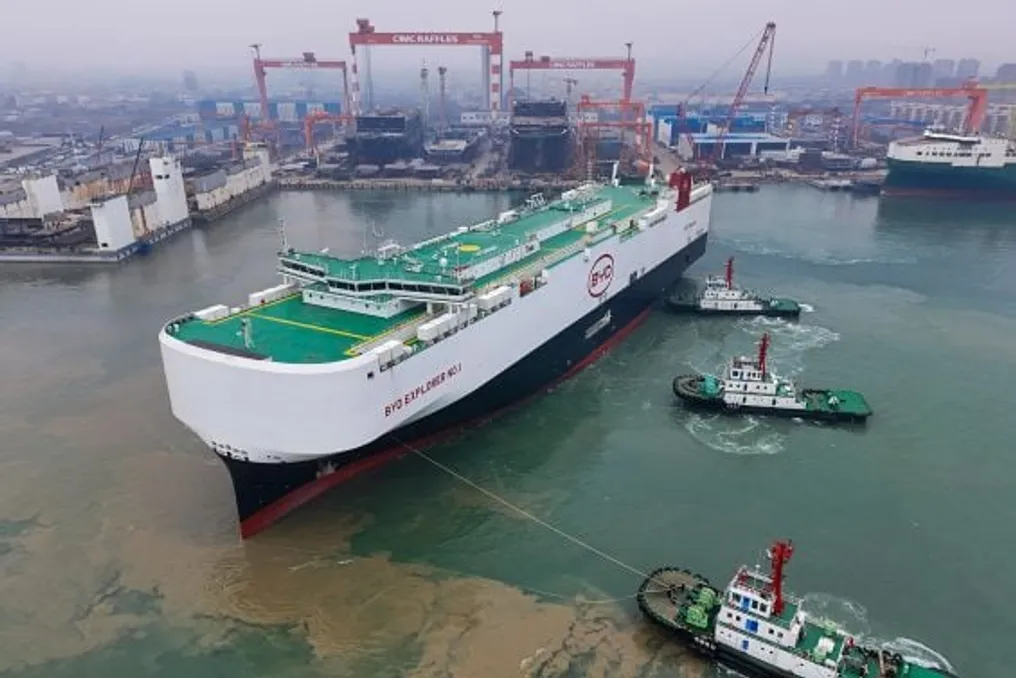
Amid a drop in sales in China, BYD is reported to have ordered ten new cargo ships intended for export. Each of these vessels would have a capacity of 9,200 Twenty-foot Equivalent Units (TEU), which would raise the Chinese automaker's own fleet to a total of 18 vessels.
The information about this order was disclosed by maritime transport publications New Ships and Assafina Online, but it still lacks official confirmation from the company. The ships would be manufactured by China Merchants Industry at shipyards located in Jinling and Haimen, with delivery expected between 2027 and 2029. The contract value was not revealed, nor did BYD or the shipyard make statements about the deal.
These vessels are of the PCTC (Pure Car and Truck Carrier) type, designed exclusively for vehicle transport. This new order would add 92 thousand TEUs to the existing capacity, raising the total fleet to over 130 thousand TEUs. It is important to note that the TEU unit measures onboard space, not the volume of cars shipped annually.
BYD had completed its first fleet, consisting of eight ships, in September 2025, when the BYD Jinan unit began operations. All these ships are of the RoRo (roll-on/roll-off) type, allowing vehicles to enter and exit on their own wheels, eliminating the need for containers, and have a capacity for 7,200 or 9,000 cars, depending on the model.
The first ship, named Explorer No. 1, was delivered in January 2024. According to CIMC, responsible for construction, it was transferred to the shipping company Zodiac Maritime and subsequently chartered by BYD. With a declared capacity to ship 1 million cars per year in the current configuration, the fleet would reach 2.5 million units annually after the addition of the ten new ships, according to CarNewsChina's estimate.
The fleet also serves to supply factories located outside of China. In September 2025, the BYD Zhengzhou unit transported right-hand drive cars to the brand's Thai unit, located in the United Kingdom. Vehicles produced in Thailand can avoid anti-subsidy tariffs imposed by the European Union, which amount to an additional 17% on top of the 10% already applied for BYD.
In terms of exports, in August, BYD sent 184 thousand passenger vehicles manufactured in China, representing a 131% increase compared to the previous year and a 6% growth compared to July, according to the Chinese association CPCA. This volume accounts for 35.4% of all new energy vehicles exported by the country that month. In the period from January to August, 1.127 million units were shipped, an 88% increase compared to the same period in 2025.
In the domestic Chinese market, the scenario is opposite. The BYD brand registered sales of 184 thousand cars in China in August, which represents a 35% drop compared to the same month last year. In the first eight months of 2026, the domestic market saw 1.15 million units sold, marking a 43% decline.
Brazil plays a fundamental role in this logistics system. As BYD's largest market outside of China, the country hosts the Camaçari (BA) factory, which began production in July 2025. In March, this factory announced export orders for 100 thousand vehicles to Argentina and Mexico. Local production helps reduce vulnerability to the 35% import duty rate, which came into effect for electric and hybrid vehicles starting in July 2026.