For over a century, scientists have questioned the possible existence of an unknown planet hidden in the most distant regions of the Solar System. The search for this hypothetical world has gone through various stages over decades and continues to this day.
The discovery of Neptune in 1846 demonstrated that the existence of an invisible planet could be inferred from the gravitational effects exerted on other worlds. This idea spurred the search for a ninth planet, which seemed to conclude in 1930 after the discovery of Pluto by astronomer Clyde W. Tombaugh.
Decades later, Pluto officially lost its planetary status and was classified as a dwarf planet. This change fueled a discussion that continues, but it also left another question open: does a ninth planet actually exist, hidden in the Solar System?
Some astronomers believe the answer may be close. In 2024, a Caltech team presented new results focusing on long-period, low-inclination objects that cross Neptune's orbit.
According to Batygin, 'these objects are dynamically unstable, so the population must be constantly replenished.' He explained that the 2024 work showed that Planet 9 naturally explains the observed population, whereas a model without this planet strongly contradicts the data after accounting for observational distortions.
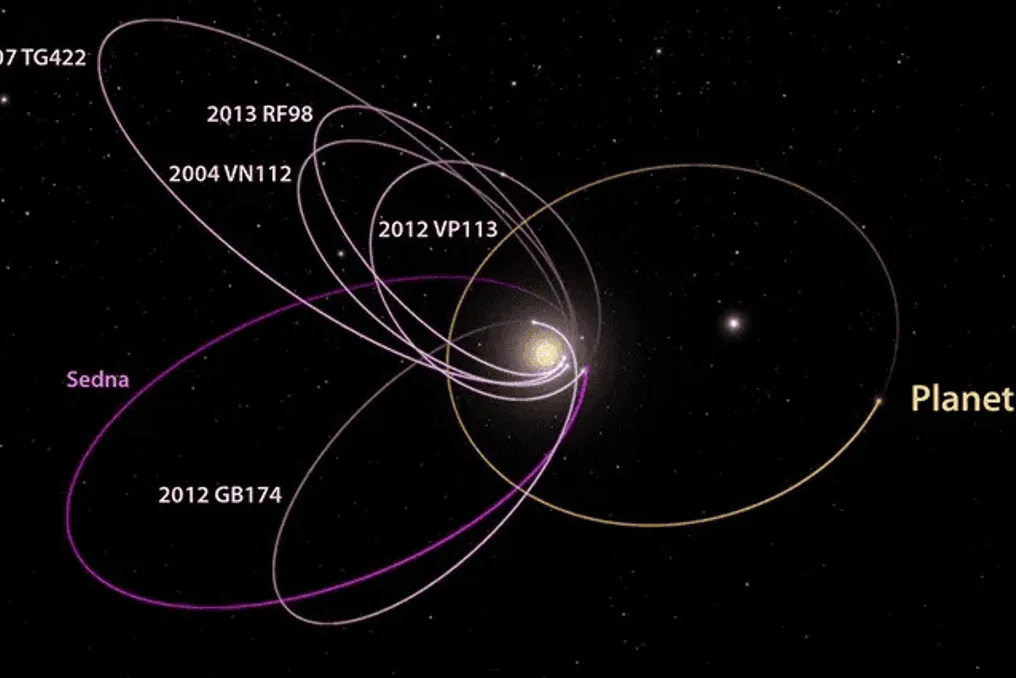
According to Batygin, the Planet 9 hypothesis can explain various unusual characteristics of the outer Solar System. Among these are the orbital clustering of objects, large aphelion distances observed by some of them, the presence of bodies in retrograde orbits, and objects with highly inclined orbits.
Despite the body of evidence, one fundamental element is still missing: the direct detection of the planet itself. Batygin admits that such an observation has not yet been made, but he asserts that something must explain the data collected by him, Brown, and other researchers. The astronomer stated: 'If the observed dynamic structure is real, there is currently no alternative theoretical explanation that is as convincing.'
Planet 9, with a mass approximately equal to Neptune's mass, could explain why few known trans-Neptunian extreme objects appear clustered in certain areas of space.
