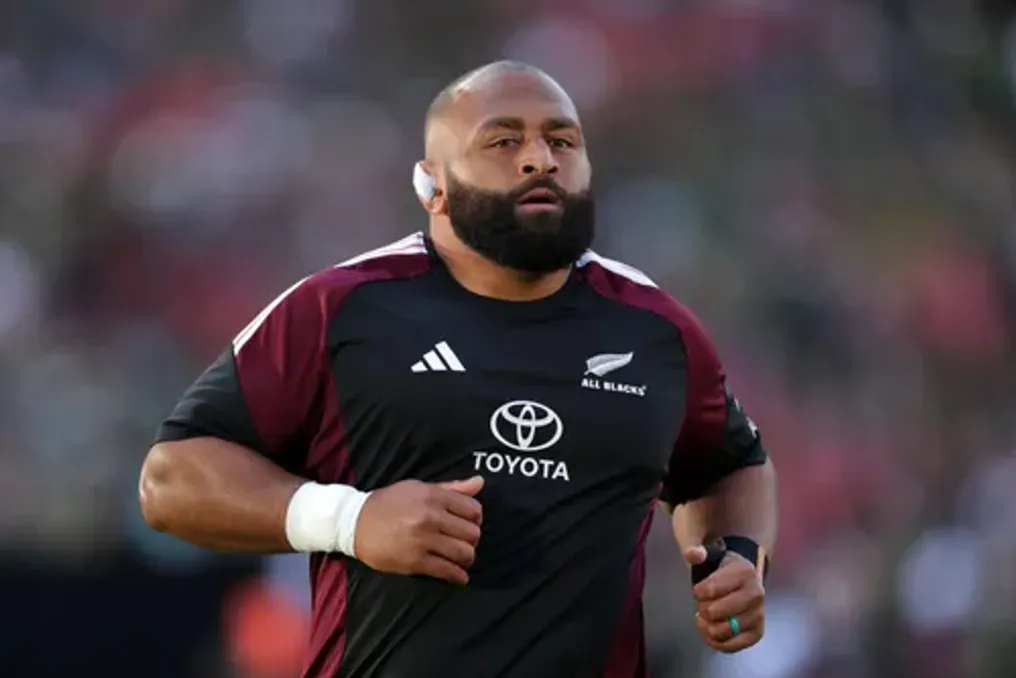
Springboks' victory over All Blacks warns Wallabies ahead of Perth match
Read more
IOL
iol.co.za

Springboks' victory over All Blacks warns Wallabies ahead of Perth match

Following a successful confrontation in the 'Greatest Rugby Rivalry' series against the All Blacks, the Springboks team, under the guidance of Rassie Erasmus, will focus its attention on the Wallabies ahead of a match scheduled in Perth in a couple of weeks.

Having concluded the 'Greatest Rugby Rivalry' series, the Springboks are now turning their gaze towards the Wallabies, aiming to secure another convincing victory over the Southern Hemisphere team.

The team, which became champions after defeating the All Blacks 3-1 in four tests, demonstrated its ability to win in difficult conditions, despite trailing 1-0 at the start of the match. They managed to regain dominance over New Zealand by securing three consecutive victories.

These four intense matches were filled with high intensity, and the South Africans displayed their class against the determined New Zealand side in each one.

The first defeat at Ellis Park with a score of 33-16 was a serious cause for reflection, and the Boks were not proud of that result. In that game, they looked out of form, but they needed at least one more test, besides the battle with Argentina in South America, to fully blossom.

This is exactly what happened. With the support of thousands of fans at the FNB stadium in Cape Town, they secured a 33-26 victory, and later in Baltimore with a score of 43-28; the Springboks showed some of their best performances in the Rassie Erasmus era, despite all the external noise directed at the team, especially after the first loss at Ellis Park.

The team improved weekly, which was evident in their playing style. Nevertheless, there were areas for improvement, such as the inability to convert numerous 22-meter attempts and playing throughout the full 80 minutes. These aspects will be the focus during the trip to Australia to improve in these areas.

The selection in Soweto and Baltimore showed stability despite several injuries. Erasmus made many changes between the matches with Argentina and Ellis Park, as well as between Ellis Park and Cape Town, which affected the continuity of the Boks' play. However, the coach managed these changes and led a strong team thanks to the depth of the squad he built, something many teams cannot boast.

Although the victory over the Wallabies is the primary goal, this single test gives the world champions another opportunity to experiment with the squad. Although the same squad will travel from the USA to Perth, there are several reserve players who lack playing time.

The next game will give Erasmus more chances to experiment with combinations and allow some players, such as Pieter-Steph du Toit, Jesse Kriel, and Malcolm Marx, who received red cards against the All Blacks, to rest.

The Boks also do not plan to deviate significantly from their game plan. They might change tactics, play in an attacking style, and overcome a team like New Zealand through six points to four, as seen in Baltimore, but the physical approach and set-piece play will always be a priority.

Australia can expect a clash of mauls and running attacks at the Optus Stadium.

Rassie Erasmus stated: 'I know that we sometimes irritate people around the world with how we play, but we care most about the people of South Africa.' He added: 'We understand their opinions and enjoy the teasing, but there is only one reason for us as a team and for us as a country—it is (that we play) for South Africa.'

Similar stories

Springboks and All Blacks to meet in Baltimore for the final match of the series
Read more
iol.co.za

Springboks and All Blacks to meet in Baltimore for the final match of the series

A unique rugby match will take place in Baltimore on Saturday, where the Springboks and All Blacks will have their last confrontation in a significant four-match series. It is expected that the M&T Bank Stadium will be filled with numerous South African expats.

The respective rugby unions of South Africa and New Zealand may gain significant financial benefits from hosting the tournament in an untapped market, despite the local audience possibly being unfamiliar with the sport. Nevertheless, M&T Bank Stadium is guaranteed to attract passionate fans, especially South African expats eager to experience the 'taste of home.' Given that approximately 133,000 South Africans reside in the US, a large portion of them wishes to see the game live, as rugby is deeply ingrained in their culture.

Cultural differences between the matches will be quite noticeable. Unlike the traditional test matches of the Springboks in South Africa, which feature the aroma of smoke from numerous barbecues in the parking lots, the M&T Bank Stadium in Baltimore operates under much stricter health and safety regulations. Open fires and informal areas give way to organized crowd control, with spectators being directed directly from public transport to the venue.

Instead of the usual walk to the stadium, fans will encounter highly commercialized pre-game zones, such as the official 'TailGOAT' experience, which includes live DJs, brand activations, and high entry fees for all-inclusive food and beverage packages.

The financial contrast will be evident inside the stadium. In a South African stadium, beer typically costs around R60 ($3.50), whereas in Baltimore, fans will have to pay at least $15 (more than R260) for one mug. Local snacks, like biltong, will not be found there; they will be replaced by overpriced packs of beef jerky sold for $10 (R175) or more for a small piece.

The presentation of the game will also receive a full American sports modernization. Spectators can expect constant sensory engagement: high-quality fan cameras, stadium noise meters, and continuous sponsor activations on giant video screens. Instead of local youth matches or brass bands during breaks, World Rugby might feature a major musical act.

Although the probability of a military aircraft flying over is low, nothing can be ruled out in the world of glamorous American sports entertainment. With a stadium capacity of just over 70,000 people, a fully packed audience of loud South Africans and Kiwis is quite achievable.

However, the true test of this American experiment depends on the audience outside the stadium. The real potential lies in global television and streaming broadcasts, where the potential audience is growing exponentially. To reach these viewers, the match will be broadcast on Paramount+ in the US and free worldwide via World Rugby's RugbyPass TV. This sets the stage for curious NFL fans who might get acquainted with this sport. At first glance, both sports share a recognizable oval ball and crushing collisions, but will American sports fans stay to learn more?

Five Reasons Why Springboks Could Achieve a Convincing Victory Over All Blacks in Baltimore
Read more
iol.co.za

Five Reasons Why Springboks Could Achieve a Convincing Victory Over All Blacks in Baltimore

The Springboks, led by Rassie Erasmus, are poised to achieve a dominant victory over the All Blacks. The fourth match of the 'Great Rivalry' rugby series is approaching, and signs indicate that the Springboks will have their first 80-minute match in this series and will heavily defeat the All Blacks.

The Great Rugby Rivalry

The Springbok team possesses momentum and confidence. They are in their eighth year under Rassie Erasmus and have established a habit of recovering from setbacks and performing strongly in major tournaments, such as two World Cups and the British & Irish Lions series.

This pattern is repeating itself in the 'Great Rivalry' matches. Although the Springboks lost the first match, they responded with wins in the subsequent two games and appear to have learned how to exert constant pressure on the All Blacks.

In contrast, New Zealand is only in the third month of Dave Rennie's era and is still learning on the fly. The Springboks clearly know their goals, whereas the All Blacks are still searching for their path.

All Blacks Have Suffered Mental and Physical Losses

In the match in Kalabaas, the All Blacks gave everything, leaving nothing on the field and giving South Africa everything they had, yet they still suffered a defeat. The score of 29-24 may underestimate the significance for New Zealand, and they are aware of this. More seriously, three of their key players have sustained injuries, notably their talisman Ardie Savea.

The importance of Savea to the All Blacks cannot be overstated—he is not only a world-class player but also a center of cohesion, an inspiring captain who leads by example. His absence creates a huge gap.

The Springbok attack is putting pressure on New Zealand. The dominance of the Springbok forwards was reportedly hindered by an overly meticulous approach to the scrum in the second match. However, last week, Nick Amashukeli allowed the teams to interact more freely, similar to how Matthew Carlie did in the first match.

The result was telling: the All Black forwards began spending more time moving backward. Signs suggest that Karl Dixon from England will again allow the forwards to compete honorably for the scrum in the fourth match. If this happens, the All Blacks will face a serious problem, as the authority of the Springbok forwards grows as the series progresses, and the pressure inevitably exerts physical and psychological impact.

The All Blacks are experiencing a shortage of personnel. At the start of the series, Erasmus noted that the All Blacks players accumulated about 60 minutes more per person during the World Cup than their Springbok counterparts. This is partly because Erasmus rotated his squad widely during the tournament, while Rennie did not have such an opportunity.

Now the consequences are becoming clear. Over seven matches in the RGR, several players from the All Blacks' first team were forced to return home: from early casualties Billy Proctor and Kalaba Clark to Savea, Quinn Tupai, and Luca Jakobsen. Rennie was forced to make significant changes for the fourth match, including eight newcomers in the matchday squad. This is a large number of changes for a team aiming to win a match of this magnitude.

Springboks Have Gained Speed

This series has been very intense, but when the third match reached critical moments, it was South Africa that managed to find extra pace. Jesse Kriel's try changed the course of the game, and the Springboks sealed the victory. They won two consecutive matches and, crucially, demonstrated how to finish a competition of this level.

The All Blacks must win in Baltimore to level the series score. This might seem like an advantage for New Zealand, but psychologically, it could work in reverse. The Springboks cannot afford to lose the series, so they can play with the confidence of a team that has already proven its point, and with the freedom that comes from not needing to prove anything.

If South Africa can replicate something like their rout of the All Blacks with a score of 43-10 in Wellington last year, Baltimore could become another memorable chapter in the Great Rivalry.

}, {
All Blacks player George Bower warns Springboks about the upcoming battle in the scrum
Read more
iol.co.za

All Blacks player George Bower warns Springboks about the upcoming battle in the scrum

Loosehead All Blacks George Bower stated readiness for another intense clash against the Springboks on Saturday in Soweto. He challenged the South African team ahead of the third match in the greatest rivalry series in rugby, insisting that New Zealand is ready to meet the world champions in a tough fight.

The scrum has been a topic of discussion throughout the series after the All Blacks struggled under pressure at Ellis Park stadium in the first match. Then the Boks again took the upper hand in the scrum moments during their 33-26 victory in Cape Town last week.

With the current score at 1-1, Bower believes that the All Blacks have no reason to avoid a heavy confrontation when the teams meet at the FNB stadium in Soweto (match starts at 17:00). Although there is verbal sparring surrounding the scrum, Bower expresses only anticipation for the opportunity to fight against one of the best scrums in the world.

Since returning to the All Blacks, he has become a pillar of the team, providing stability in the scrums and posing a serious challenge to the Bok tightheads during the tour. Bower emphasized his desire to participate in the scrum, stating on Thursday: 'Oh, I love the scrum. I want to scrum.'

He noted that despite much talk from both sides, it all comes down to the first scrum. 'We'll see who talks,' he added. He acknowledged that South Africa prides itself on its scrum and uses it as an opportunity to earn penalties and advance. However, he also stated that the All Blacks' mentality after the first match is that they are at the same high level.

Bower expressed his intention to challenge them, noting that they know about the approaching opponents, but they are also ready themselves. 'I want to scrum, and I know my five back players want to scrum too. As a team, we must focus on our connection and density, our binding and our setup, and hopefully, this will neutralize what the South Africans bring this weekend.'

Popular