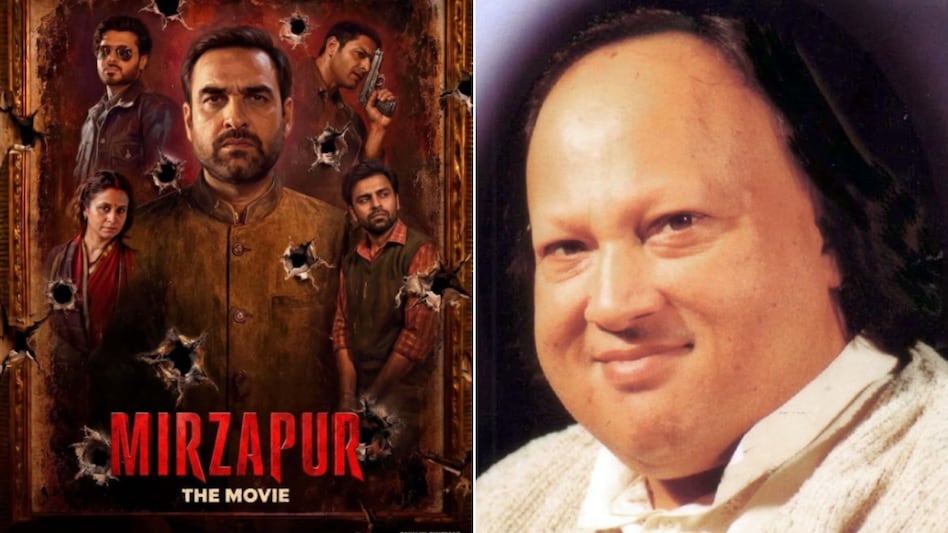
The film 'Mirzapur: The Movie' has demonstrated significant box office success, collecting 120 crore over five days. In addition to the cast, action, and intimate scenes, one of the film's tracks, 'Sanson Ki Mala Pe,' is attracting considerable attention. This number is presented for the first time in this franchise, and its version was created with modern musical arrangements, thanks to the work of Madhur Sharma and Vaibhav Pani.
The classic composition by Ustad Nusrat Fateh Ali Khan plays during the mid-credit scene of the film, evoking a sense of nostalgia in viewers. The song is rapidly gaining popularity online. Even before its appearance in 'Mirzapur,' this track had become iconic in many films. Despite the decades that have passed, interest in this song remains high; it has captured people's hearts both in khawati gatherings and through the Hindi film industry.
The history of 'Sanson Ki Mala' dates back to 1979, when Nusrat Fateh Ali Khan first arrived in India. He was invited by Raj Kapoor to perform at the wedding of his son, Rishi Kapoor. The singer's performance was so impressive that the song became an eternal classic. Later, this hit track was prepared for commercial release and appeared in Nusrat's album 'Supreme Collection Volume 12' in 1982. Nusrat imbued the song with Sufi and khawati undertones. In 1983, he performed it at a live concert in Birmingham, after which the song gained worldwide fame.
Due to the song's significance, debates arose regarding authorship. Some claimed it belonged to Mira Bai, while others pointed to Tufail Hashirpuri. The song is associated with Mira Bai's devotion to Krishna, evident from its mood. It uses words such as Shyam, Mohan, Vrindavan, and Gokul, which clearly indicate worship of Krishna. However, according to Sufinama, the composer of the composition is the poet Tufail Hashirpuri, born in 1914 and died in 1993. When the song was first commercially released, the word 'traditional' was listed instead of the author's name. Later, Tufail Hashirpuri was credited with the authorship. Perhaps the presence of religious terms in the poem led to it being more often associated with Mira Bai. This song is unique because it has never been confined to the boundaries of one religion, music, or love; it unites human and spiritual love.
'Sanson Ki Mala' was part of Bollywood even before 'Mirzapur.' A version of it appeared in the 1996 film 'Jit.' Then, in 1997, it was used in the film 'Koyla,' where it was performed for Shah Rukh Khan and Madhuri Dixit. Rajesh Roshan composed this track, and Kavita Krishnamurthy provided the vocals. In 2011, Michael Winterbottom used the original version performed by Nusrat Fateh Ali Khan in the film 'Trishna.'
Although Nusrat's version was a hit, the renowned Pakistani singer Rahat Fateh Ali Khan also performed this song. After Nusrat, his family passed down this hymn from generation to generation. In 2020, Rahat recorded this song in his style, paying tribute to his uncle and teacher Nusrat Fateh Ali Khan, as well as his father Farrukh Fateh Ali Khan.
The love for 'Sanson Ki Mala' has also manifested on YouTube. Its popularity is not limited to cinema and official music releases; other streaming platforms have also created covers of it. The famous Pakistani instrumental group Leo Twins released a version using violin and guitar, which became a hit and which they perform at their concerts. In 2022, Portuguese guitarist Andre Antunes experimented with this song, adding heavy guitar riffs to Nusrat Fateh's voice. This experiment was highly praised by listeners, as the song carries a spiritual tone. Because of this, new compositions have been created in various religious songs using the music of 'Sanson Ki Mala' and new lyrics.
Every singer strives to reinterpret 'Sanson Ki Mala' in their own style. Its main feature is its ability to harmoniously fit into any musical genre due to its very strong core. This is why the journey of 'Sanson Ki Mala' began with Nusrat Fateh Ali Khan and passed through Kavita Krishnamurthy, Rahat Fateh Ali Khan, instrumental artists, metal guitarists, and spiritual music singers, up to 'Mirzapur: The Movie.' This song is being reborn across generations in every era. It remains to be seen in what new film and by which new singer we will hear this song after 'Mirzapur.'