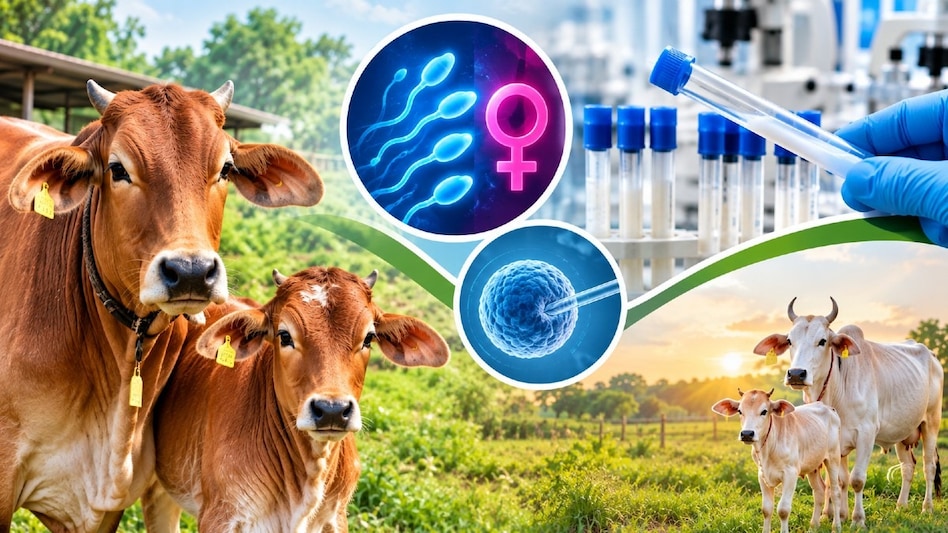
The Government of Madhya Pradesh is paying close attention to improving breeds and scientific animal husbandry with the aim of strengthening the dairy industry. An important part of this campaign has been the use of sexed semen and artificial insemination. The goal is to increase the number of animals of superior breeds, as well as to raise milk yields and farmers' incomes.
The technology of sexed semen is being actively introduced in the region, which, according to available information, allows for the production of about 90 percent female calves. Currently, about 20 percent of the total artificial insemination in the state uses this technology.
At the Central Semen Centre located in Bhopal, semen from advanced breeds such as Gir, Sahiwal, Tarparkar, and Murra is produced. The centre currently prepares about 500 thousand doses per year, with plans to increase production in the coming years.
The government has developed a plan for a large-scale increase in artificial insemination. Under the Hiranyagarbha campaign, a target of 47.50 million artificial inseminations has been set for the current fiscal year. About 28 million artificial inseminations were conducted last year, and more than 10.5 million procedures have already taken place from April to August 2026.
It is planned to achieve 50 percent coverage by artificial insemination within the next five years.
The improvement in breed quality and the development of animal husbandry are also reflected in milk collection. Over the last year and a half, daily milk collection in the state has increased from 8.73 million kilograms to approximately 12 million kilograms in July 2026.
The state government has set a goal to make Madhya Pradesh a 'dairy hub' within the next five years. To achieve this, it is planned to establish 26 thousand dairy cooperatives in the region.
Changes in the direction of breed improvement are also noted in the 21st livestock census. According to these data, the number of animals of improved breeds has roughly doubled compared to the 20th livestock census.
The state is focusing not only on increasing the herd size but also on increasing the yield per animal. According to the Government of India, the productivity of local and uncertified cattle was 927 kg per head per year in 2014-15, which rose to 1343.2 kg in 2024-25.
Over the same period, the productivity of buffaloes increased from 1880 to 2365.2 kg, and the average productivity of cows reached 2251 kg per year, compared to 1648 kg.
Milk availability per capita in Madhya Pradesh has also increased, reaching 707 grams per day, which is higher than the national average of 485 grams per day. The main reasons cited for the increase in milk yield are breed improvement, better nutrition, disease control, and scientific animal husbandry.
The government is implementing several programs for breeding and distributing animals of improved breeds. These include the 'Mukhyamantri Dairy Plus', 'Acharya Vidyasagar Gau Sanvardhan', 'Mukhyamantri Dudharu Pashu Praday', and 'Dr. Bhimrao Ambedkar Kamdhenu' programs. These initiatives help provide farmers with superior breeds and encourage the import of the best breeds from other states.
Under the 'Dudh Smriti' campaign, coordination has been established with about 18 million families to increase milk yield per animal. Farmers are provided with information on balanced nutrition and better feeding through the 'Gorras' application. Furthermore, the production and use of silage are encouraged, and new projects related to silage production are being created under the National Livestock Mission.
The core of the Madhya Pradesh government's strategy for the next five years consists of breed improvement, artificial insemination, sexed semen, improved nutrition, milk collection, and cooperative expansion. If the set goals are achieved, a significant expansion of the dairy industry is expected, with an increase in animal population and yield per head.