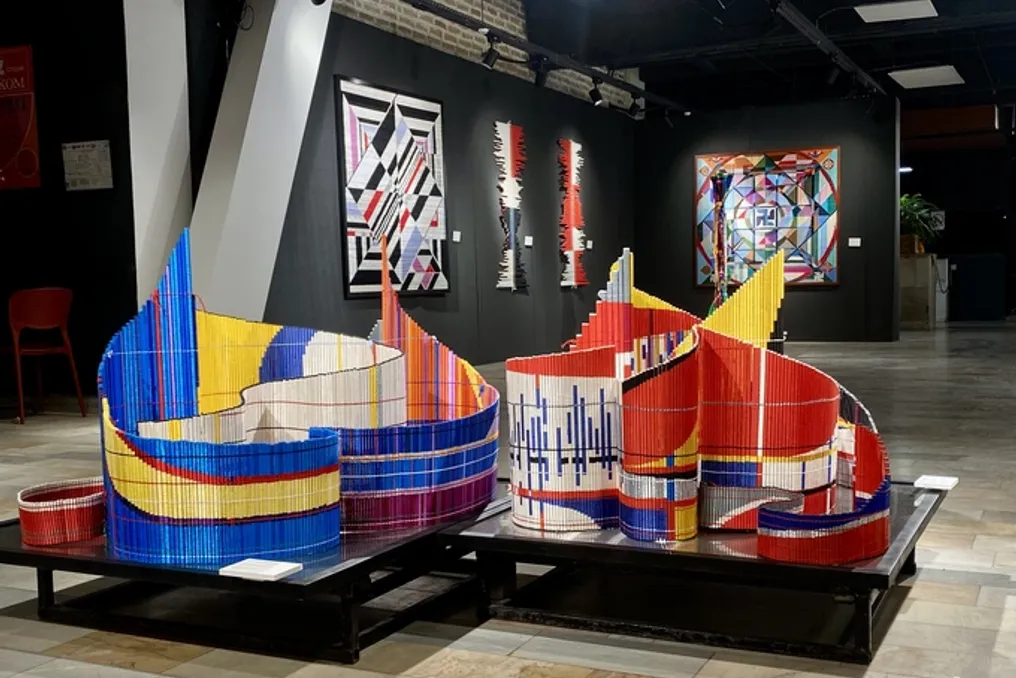
The exhibition by artist Vyacheslav-Yuri Useinov titled 'Between the Fig Tree and Kizyak' opened at the 'Ilhom' gallery. The name Useinov has a double meaning, with the second being related to his birth date—April 12, 1962—which coincides with Cosmonautics Day, significant in Uzbekistan and the Soviet Union thanks to Yuri Gagarin.
Throughout his creative career, the artist explores space, yet his focus remains on the artistic rather than the cosmic dimension. As he developed, Useinov found existing methods insufficient and decided to abandon the standard coordinate system, developing his own approach to organizing image and space.
The presented exhibition can serve as a basis for a deep analysis of contemporary art, touching upon figures such as Marinetti, Bauhaus, Malevich, and Nathalie Sarrault. However, Useinov suggests viewing this exhibition not merely as a collection of works, but as visual proof of his own artistic concept, which he formulated in 2008 in the manifesto 'On Fractal Verism.'
The central idea of this direction is an attempt to unite seemingly incompatible elements: the high precision of observation (from the Latin *vero*—truthful) and 'fractals'—infinitely repeating geometric shapes when scaled. This type of painting requires considerable patience: from a distance, it may appear harmonious and calm, but upon closer inspection, it reveals numerous small details before reforming a cohesive image.
At the opening, Useinov emphasized that, unlike many colleagues who seek themes and devise them theoretically, what matters to him is the 'experiencability of the world,' which must not depend on the past or the future. He stated that the art he presents is a reflection of an 'imprinting state,' that is, a state of 'here and now.'
The exhibition, comprising about thirty works, both well-known and new, is built on the play of the title's meanings. The word 'tut' has a double meaning: it indicates location and is simultaneously the name of one of the most common trees in Uzbekistan. This sets the main logic of the project—the transition from a concrete, everyday object to a model of the world order.
For Useinov, the fractal is not a mathematical illustration but a fundamental principle of artistic thought: form arises from the process of repetition and self-similarity, multiplying while maintaining an internal connection to the original element. An example of this approach is the use of the 'chi' technique, popular in Central Asia for weaving mats, where each stick woven with colored wool thread can generate a whole. In this method, the artist seeks to derive the artistic form directly from the material itself, avoiding the imposition of a predetermined geometric scheme.
The author's most striking statement manifests at the intersection of complex theory and primitive material. Useinov contrasts the fig tree with the kizyak, or 'silk paradise,' transforming it into a kind of anti-art. Craft paper is also used, which the artist wets and rolls, giving each stroke the appearance of a broad brushstroke.
The master explained that this seemingly provocative duality—the combination of natural beauty and decorativeness with what is usually ignored by aesthetics—creates a certain tension that runs counter to current marketing trends.
Useinov does not limit himself to market criticism; he pushes market mechanisms to absurdity by organizing a performance auction in the foyer of 'Ilhom.' Works from different periods were put up for auction, and visitors actively participated in the bidding. However, the auction turned out to be a deception: at the end, Useinov gave all the works to the winners for free. This gesture, although seemingly playful, precisely continues the logic of the exhibition, as the market was staged solely for its subsequent cancellation.
Despite the possibility of arguing about the scale of this program, its declaration of a new era, and its claims to revise the history of art, it is precisely this excessiveness, this desire to step outside the framework of linear art time, where the present must always rely on the past and anticipate the future, that makes the project significant. Useinov calls on viewers to stop time in the present—at the point where the fig tree can become a model of the Universe, and the kizyak—an act of artistic protest, and a single stick—the beginning of a fractal world. The exhibition will be open until October 13, admission is free.