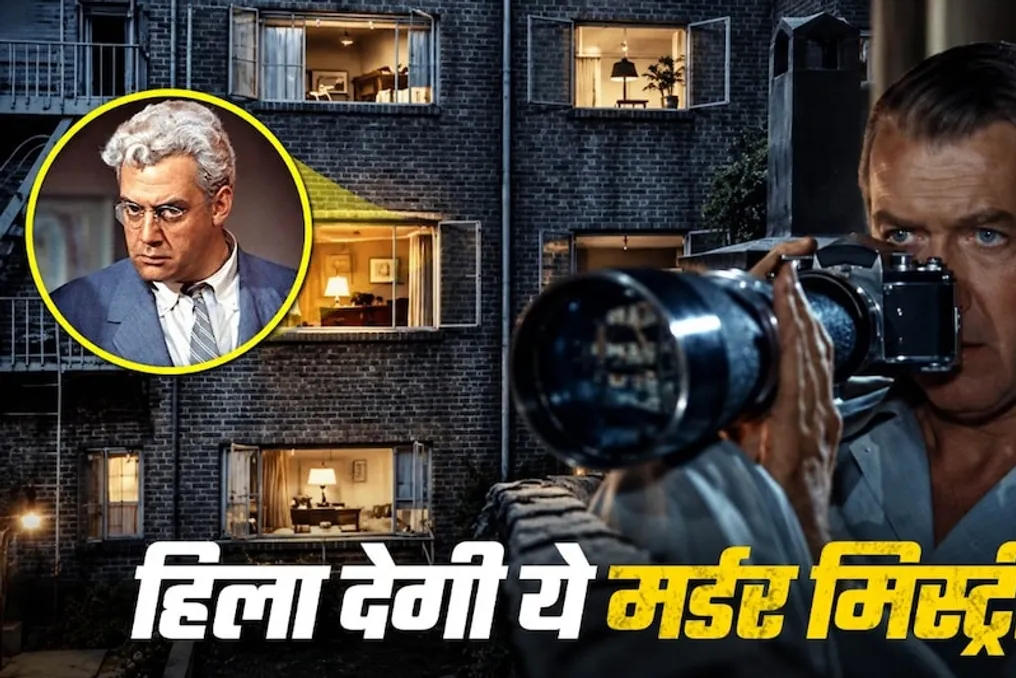
When Alfred Hitchcock's film 'Rear Window' was released in 1954, there were no cameras in every home, social media, or easy access to other people's lives like today. However, Hitchcock captured human curiosity, which manifests everywhere—from social media and surveillance to neighbors' windows and phone screens—the desire to know what is happening in other people's lives, even about seven decades ago.
In the film, a character named Jeff Jeffries, who is a photographer, is in his apartment in a wheelchair due to a broken leg. He has nowhere to go and few things to do, but a large courtyard opens up before him, with other apartments located behind it. Gradually, Jeff begins to observe the lives of the people living behind these windows: some are lonely, some are in love, some are making music, some are experiencing the beginning of marriage, and some show the bitterness of relationships.
But one night, Jeff notices something in the behavior of his neighbor Lars Thorwald that makes him suspect he might have killed his wife. The question arises not only about what Jeff saw, but also whether what we see is the truth?
This is where Hitchcock uses his main device. Jeff's eyes become the audience's eyes. The camera mainly shows what Jeff can see from his room; we are not allowed to look inside Thorwald's house to see the truth. We are as helpless as Jeff. He sits in a wheelchair and looks through binoculars at another window, and we continue to look at this window on the screen. Thus, Hitchcock almost completely eliminates the distance between the viewer and the character. We are not just watching Jeff spy on his neighbors' lives; we are spying together with him.
The most interesting twist of 'Rear Window' is that the film involves us in the very activity that the film itself questions. This means that 'Rear Window' is not just a detective story about murder. It is a film about the human habit of secretly looking into the private lives of others. Jeff had no need to watch his neighbors. At first, he did it just to distract himself from boredom, but the more he watched, the stronger it seemed that he was starting to understand these people. This deception is what interests Hitchcock—how we can build an entire story about a person by seeing only fragments of their life.
The main play of the film is that Hitchcock makes the viewer guilty. We know that Jeff is observing his neighbors without their permission, but we remain as curious as he is. When something suspicious appears in a window, we also want to look closer. When the story seems normal for a moment, we too feel anxious that the matter might end in murder. In other words, the viewer himself enjoys the voyeurism that the film questions. Critics who wrote about the film considered it a commentary on both cinema and the relationship between cinema and the viewer.
Hitchcock turned one place into a whole world. Almost the entire picture unfolds around Jeff's apartment and the huge courtyard opposite. Upon careful examination, this courtyard itself represents a small world. Behind each window, a different story unfolds: somewhere new love, somewhere loneliness, somewhere marriage, somewhere an argument, somewhere a struggle, and somewhere a relationship where love has faded.
Jeff observes all this from afar and unconsciously begins to understand his own relationships among these stories. This is why the character Lisa Fremont, played by Grace Kelly, is not purely romantic. Jeff hesitates about marriage because he believes that constant relationships will limit his free life. On the contrary, by looking at the different types of relationships in the windows, Lisa gradually proves that she is not just a beautiful, dressed-up mistress, but a brave woman ready to take risks in search of the truth.
Here romance and detective work merge. Jeff looks out the window, but Lisa risks going outside. That is, the person who considered himself an observer eventually has to act. It is easy to watch other people's lives from afar, but what happens when this threat reaches one's own life? Hitchcock creates tension precisely because of this change.
Jeff's broken leg and wheelchair are not just plot conveniences. They control the entire viewing experience. He can see, but cannot move easily, so his eyes are simultaneously his greatest strength and his greatest weakness. And then comes, perhaps, the most brilliant moment of the film, when the viewer himself becomes the object of observation. Throughout the film, Jeff watches Thorwald. Perhaps Thorwald doesn't even suspect he is being watched, but there comes a moment when Thorwald realizes Jeff's presence and looks directly at him. At that moment, all power changes. The person who was previously watching others suddenly finds himself under observation. This is the moment when Hitchcock...
3.