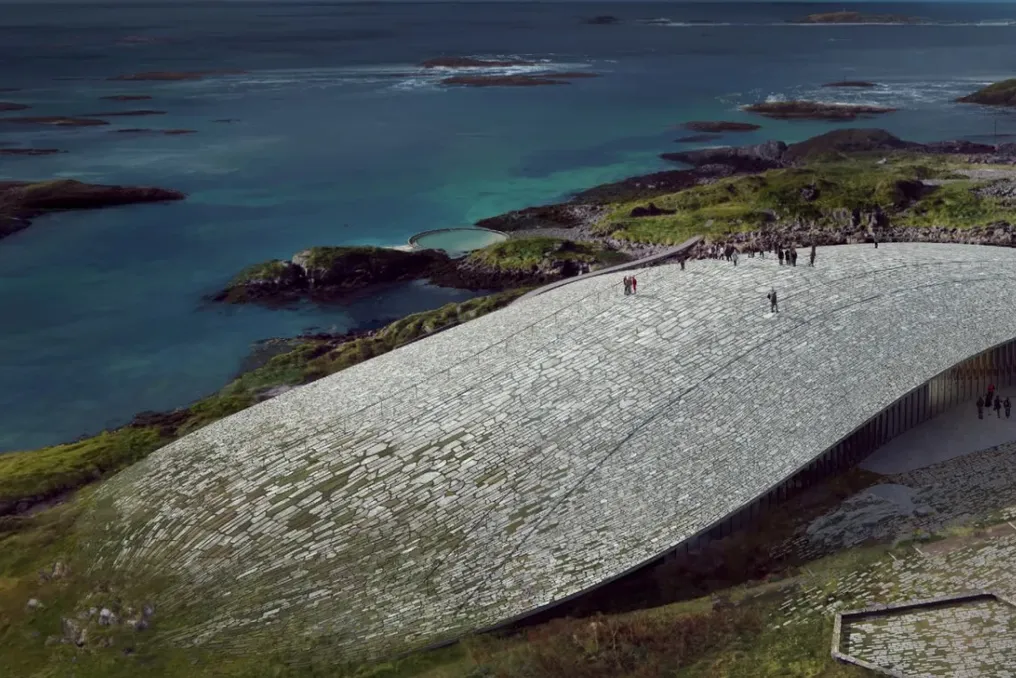
Norway, a country that was once deeply involved in whaling, has changed its attitude towards these giant animals over decades. Although the country has not completely abandoned this controversial activity, it has become a benchmark in research and conservation thanks to efforts to transform this culture. Now, a new museum, scheduled to open next year, aims to link marine life tourism with raising awareness about the importance of these species to the ecosystem.
The new space, appropriately named The Whale, is under construction in northern Norway, on Andøya island, approximately 300 km north of the Arctic Circle. The opening is set for the first week of June 2027, a time when the region is in the height of summer, marked by endless hours of light and the famous midnight sun.
The project, conceived in 2014, began to be realized about ten years later, once state funding for the work was finally secured. The project is overseen by the studio of Danish architect Torte Mandrup, who was selected after an international competition in 2019.
The architecture of The Whale itself is a landmark: it is designed as a concrete 'shell' serving as a facade and roof, stylized like the back of a whale rising from the water, but it can also be seen as a hill from which visitors can observe the landscape. Facing the sea, the structure provides panoramic views of the waters—in one of the places often cited as one of the best in the world for whale watching.
The location is particularly advantageous because the museum is being built opposite the Bleiksdjupet underwater canyon, an area where the depth suddenly increases from 200 to over 2000 meters over a relatively short distance. This sharp slope, combined with regional ocean currents, guarantees the ideal temperature level and nutrient availability to attract marine mammals such as whales themselves.
The museum will focus on telling the story of whale biology, as well as the history of Norway's relationship with these animals—from times of unregulated hunting to the present day, when the country strives for conservation and scientific research to support the species inhabiting its coast.
Although the museum is far from Oslo (the municipality of Andenes, where The Whale is located, is nearly 1500 kilometers north), the region is accessible by domestic flights, with Tromsø and Bodø being the main transport hubs for air travel. Bus routes and ferries are also planned to facilitate movement.
In addition to the exhibition and viewing areas for real whales within the museum structure, immersive experiences that the exhibition should include, such as life-sized orcas and halls with recordings of whale songs, will draw attention to further connect visitors with the underwater world of these animals.
The opening of The Whale to the public is scheduled for June 4, 2027, but tickets for advance visits will go on sale beforehand. Ticket sales will begin in Europe in the autumn, starting in September 2026. Although confirmation of operating hours and prices is still pending, preliminary information indicates ticket prices around 540 Norwegian Krone (approximately 297 Brazilian Reals) and operating hours varying by season: from May to August, months of more sun, it is expected to open from 9:00 to 22:00; in other months, operation will be from 10:00 to 18:00.