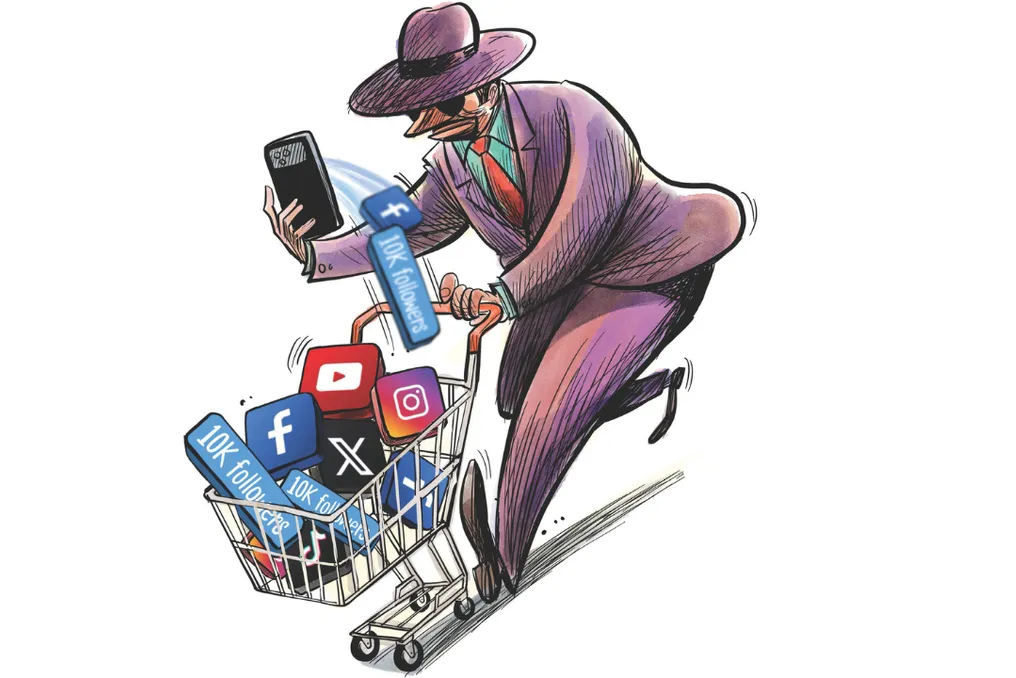
Social media accounts can be bought or sold. Although some may blame bots, there are offers on the market, such as the sale of an Indian Instagram account with 7,000 followers for an amount equivalent to 6.7 lakh rupees, which has the description 'Rajputi reel uploaded' and 54 posts over its existence.
Although this price seems inflated, it is not entirely unprecedented. For about a decade and a half, social media accounts, not just followers, have been bought and sold on gray markets. The growth of the influencer economy contributed to this, as the audience became monetizable, giving followers and engagement tangible value. However, at the same time, bots made followers cheap, and account creation became mass-market.
People are able to recognize fakes, even if they don't care. Therefore, when an account looks plausible—with a small number of followers, awkward posts, and rare viral spikes—it becomes a valuable acquisition. If someone buys an account for legitimate purposes, such as launching a new brand, it can accelerate the process of monetization and access to other closed features.
In cases of illegal purposes, such as fraud, the account history provides faster and easier credibility. On one platform, buyers can sort accounts by price, number of followers, and audience concentration area. For example, a profile stating 'I am from Patna, Bihar' offers a '3M Indian Facebook page for sale' for $4,500, which is about 4.3 lakh rupees. Meanwhile, there is a decrease in page views.
The same seller also offered a children's focused Facebook page with '10k followers organic views' for $150. This page has the largest audience in India (39%) and offers two advantages: access to Facebook content monetization and the ability to rename the page for a new identity. The cost of this small account is ten times lower than that of a large one, looking only at the number of followers.
This demonstrates that it is not just the number of followers that is being sold. History, audience, activity, monetization potential, and repurposing potential often matter much more. For instance, the original email address is valued because it can become part of the account recovery chain, and buyers fear that the previous owner might reclaim it.
Specialized Trading Platforms
Today, selling your social media account is significantly easier than it was ten years ago. The market has moved beyond disorganized websites and forums. There are specialized platforms for buying and selling accounts that feature a high degree of organization.
SeBuDA, where the Instagram account for 6.7 lakh rupees is listed, serves as an example of such a platform. Here, a buyer can filter accounts by price, number of followers, country and city of audience concentration, gender, category, and age of the account, as well as by the presence of an original email address. The listing card often includes audience demographics, analytics, recent posts, and engagement metrics, as well as the seller's history and escrow records. Accounts can even be added to a comparison list.
Fameswap, existing since 2013 and becoming one of the largest specialized platforms, uses a pricing determination mechanism. Market analysis data shows that YouTube accounts publishing reviews and educational videos are the most expensive (median request exceeds $60 per thousand subscribers). For TikTok, the optimal category is cryptocurrency and NFT (around $40), and for Instagram, technology and science ($19).
Another major market, DealBaron, has an even more formalized process. When a seller lists an account, the site automatically extracts basic data and requires confirmation of control by placing a generated code. Buyers can view seller ratings and transaction history, make binding offers, and follow the transfer process specific to DealBaron after the deal begins.
SWAPD, another major market operating since 2017, resembles a forum more, but transactions there are strictly controlled and carried out 'under constant human supervision,' rather than through automated checkouts. SWAPD claims to vet listings before publication and requires sellers making qualified deals to undergo KYC identity verification.
Most of these markets either offer or require the use of escrow, where the buyer's funds are held by the platform or service until the account is transferred. This mechanism simplifies inventory formation for sellers and helps buyers find exactly the type of account they need. Furthermore, it may be wiser for a buyer to purchase several small accounts rather than investing all funds in one page with a huge audience, so that the entire investment is not lost in case of account suspension or recovery.
India remains the leading country among buyers on these trading platforms after the USA.
Why Does It Seem Suspicious?
Firstly, most social media platforms whose accounts are bought and sold prohibit this. Instagram and X explicitly forbid this practice. TikTok does not allow it without permission, and Facebook does not. YouTube allows the transfer of rights to a branded account, but not exactly as happens in these sales. This does not make account selling illegal, but most of this activity takes place on gray markets, which violates platform rules, although it is not inherently a crime; nevertheless, what buyers or sellers do with the account can be criminal.
Secondly, it is obvious that these are not markets populated by people selling one old account they no longer use. Many sellers list packages of several accounts (for example, one seller once claimed to have an 'unlimited supply' of active Instagram accounts). Markets have sometimes actively intervened to block the sale of stolen accounts.
The first large-scale academic study of such social media markets, published in 2025, found over 38,000 accounts listed for sale across 11 different platforms, with total requested values exceeding $64 million. The study revealed evidence that 'these markets facilitate fraudulent activities, such as bot farming, account harvesting for future fraud, and fake engagement.' It was established that 'the ecosystem of buying and selling social media profiles facilitates the work of cybercriminals on a large scale, easing the acquisition of accounts for launching various cybercriminal actions.'
Out of nearly 11,500 accounts available for sale, researchers were able to examine that almost 3,800 contained fraudulent schemes—with nearly 19,000 posts related to crypto fraud, phishing, counterfeit goods and services, impersonation, and other types of fraud. 30% of 'sold accounts' that could be dated were created before 2020, 'using their longevity to evade detection.'
Researchers also found signs that accounts were intentionally created for resale: they were assigned plausible names, biographies, and locations, and then developed with enough followers and activity to appear as authentic and naturally used accounts, rather than obvious fakes. Some sellers appeared to manufacture these accounts as commodities, replacing listings with new ones when others disappeared.
A study of YouTube accounts sold on one trading platform in August 2026 also showed that channels were not always bought for what they originally were. Over 1,000 of approximately 4,600 tracked channels—23%—were repurposed, their usernames, titles, and descriptions were changed to something fundamentally new. However, the change of identity, strangely enough, did not lead to audience attrition. In the 12 weeks following repurposing, the 'average number of subscribers increased—often significantly,' possibly because, as researchers noted, 'most users remain uninterested in changes and continue to be subscribed.'
FT reported in August that this trade has formed its own supply chain: suppliers acquire accounts, flippers resell them, and editors help transform them into something new. In one case, an Instagram account with 390,000 followers was sold for $6,000, and its new owner reported earning about $2,000 in sponsorships and sales in the first two weeks alone.
India Continues to Emerge
The 2025 study showed that among accounts whose public profiles indicated a location, India was the second most common country after the USA. When another group of researchers studied the closely related business of selling followers, likes, and other engagement in 2024, India was also one of the largest centers in this field. Researchers found that starting this business was easy, and English-speaking Indian operators could easily enter the global market, similar to operators from other 'former British colonies' such as Bangladesh, Nigeria, Malaysia, or from the former US colony, such as the Philippines.
However, they admitted that they knew 'very little' about the differences between countries. On major trading platforms, India is a major source of traffic. Data from the analytical platform Semrush for July 2026 shows that India provided the third largest traffic to SeBuDA and the similar platform SocialTradia, as well as the second largest traffic to SWAPD and Fameswap. Discussions on SWAPD actually constantly concern Indian sellers (e.g., how they lower prices) and buyers (e.g., how they can increase the value of accounts with a predominant Indian audience). The situation is so 'Indian' that a seller of an account on Reddit wrote in a January listing: 'Indian buyer preferred because payments are simply easier via UPI.'
SWAPD itself reported in March of this year that India was on par with the USA in the largest group among its 40 most active operators. India is clearly becoming a significant part of this market.