Symbols have always been present in architecture, manifesting in carved stones, interwoven fabrics, ceiling and wall paintings, door hardware, and everyday items, carrying the beliefs, rituals, and stories of their originating cultures. In modern environments, designers maintain this dialogue with space, reviving historical symbols and adapting them through new manufacturing techniques, materials, and architectural forms.
The Ruyi Knot serves as a notable example. For centuries, this intertwined motif has been part of Chinese knot tradition, representing concepts such as harmony, continuity, and wishes for good fortune. Its geometry, characterized by soft curves, has been applied to ceremonial pieces and decorative objects, proving that cultural references can enrich the vocabulary of design beyond mere ornamentation.
The Art of Chinese Knots as Design Inspiration
This inspiration led to The Knot, a modern sanitary metal fixture for bathrooms, developed by the Hong Kong-based design office AB Concept in partnership with Dornbracht. For architects and interior designers, cultural references go beyond simple visual elements; they inject narratives into common objects, linking function to identity, ritual, and memory.
AB Concept, founded by Terence Ngan (architecture) and Ed Ng (interior design), is known for incorporating local traditions, nature, and cultural context into contemporary interiors across Asia, Europe, and the Middle East. This philosophy guided the design of The Knot, which is an evolution of the Dornbracht Coya collection, viewed through the lens of one of China's oldest symbols.
The art of Chinese knots is an ancient craft with over two millennia of history. What began with practical knots in clothing and accessories evolved into a symbolic and decorative practice, used in family celebrations, weddings, festivals, and religious rituals. Over the centuries, each knot pattern gained specific meanings, being offered as wishes for prosperity, longevity, protection, and happiness.
The Meaning of the Ruyi Knot
Among the most well-known is the Ruyi Knot. The word 'ruyi' is often translated as 'as you wish,' establishing the knot as a traditional emblem of good luck, blessings, and a balanced life. Its continuous and intertwined structure has no visible beginning or end, expressing the concept of infinity through a single uninterrupted line.
For Ed Ng, this motif provided a way to translate this cultural symbolism into an everyday object. He explains that he seeks inspiration from cultural symbols or natural patterns because their meanings can be communicated through very simple forms. For him, this creates a direct analogy with the water cycle, which is eternally renewable. Thus, the Ruyi Knot functions as a metaphor for something constantly flowing and interconnected with everything.
The inclusion of this symbolism in interior design reflects an interest in spaces that accommodate daily rituals. Bathrooms, in particular, have ceased to be merely functional areas to become environments linked to well-being, calm, restoration, and peaceful routines. Materials, lighting, and objects are chosen both for the atmosphere they create and for their technical performance.
This vision aligns with Feng Shui, the Chinese philosophical practice of arranging environments to promote balance between humans and the spaces they occupy. Literally meaning 'wind and water,' Feng Shui is based on principles of proportion, orientation, materiality, and the circulation of qi (vital energy). The Ruyi Knot is an auspicious motif in Chinese culture and is widely used in Feng Shui as a symbol that favors the positive flow of qi, harmony, and good luck. Transforming this motif into a sanitary fixture converts a daily action into part of a ritual.
As AB Concept describes the project's intention, this reinterpreted motif transforms the handle into a daily tactile ritual—being the first and last object touched daily—incorporating a sense of deep delicacy to wish the best in daily life.
From Braided Fabric to Polished and Brushed Metal
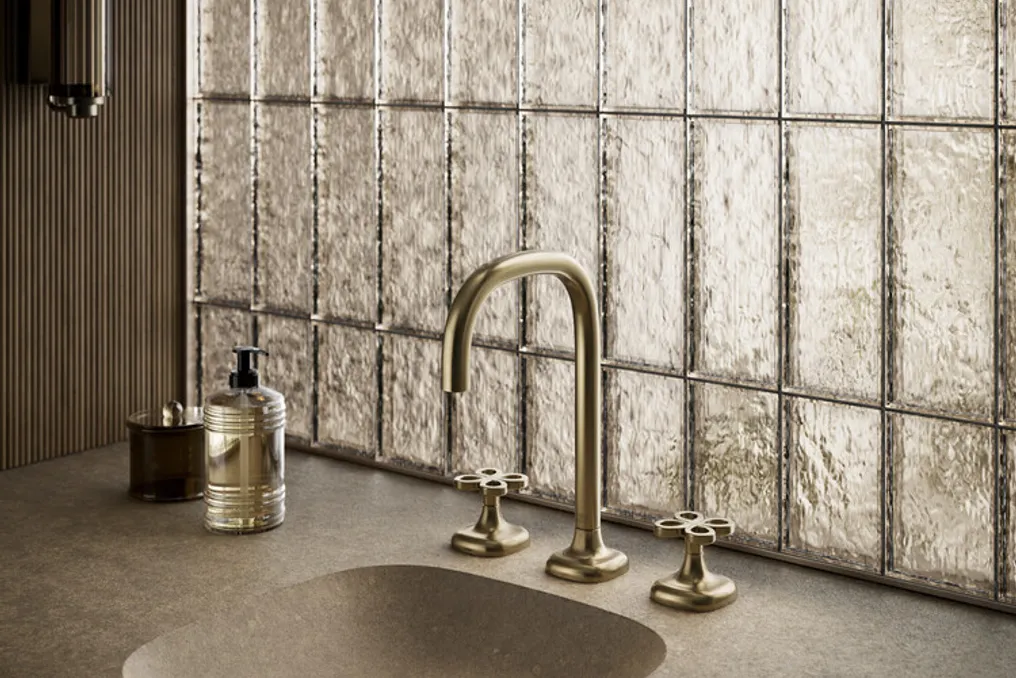
In collaboration with Dornbracht, AB Concept translated the soft geometry of a braided cord into the handles of the Coya mixer collection, originally designed by Sieger Design. Instead of replacing the identity of the Coya line, the new design expands its language of circles and squares using four symmetrical loops arranged around a square center.
The resulting handle maintains the rhythm of the original knot while adding a sculptural form with a strong tactile appeal. Each curve serves an aesthetic and ergonomic purpose, guiding the fingers to a natural support without focusing on the mechanics of movement. These choices represent the 'invisible' part of the design process. Ng comments that the sensation is natural and correct, almost imperceptible consciously.
Converting the softness of a woven knot to high-precision metal required an equally detailed manufacturing process. The clover geometry, fine rays, and intersection curves of The Knot could not be completed with standard automated production alone. Dornbracht reports that each handle is individually polished or brushed by hand before the final finish, allowing skilled artisans to perfect the transitions of this complex geometry. Thus, the production process integrates with the design itself, interpreting an ancient textile technique through modern metallurgy.
Many of the most interesting advancements in product design arise from experimentation. Collaborations and limited editions allow for exploring ideas outside of usual collections, testing new connections between matter, symbolism, and manufacturing. Dornbracht's Atelier Editions were created with this objective, uniting designers with the brand's manufacturing excellence to reimagine everyday objects under new cultural and formal lenses. The Knot, developed with AB Concept, is the second edition of this series, succeeding the The Rock model of 2025.
For architecture and interior design professionals, projects like The Knot demonstrate how symbols rooted in artisanal traditions transform into design tools that influence memory and experience. The result is an everyday architectural component that carries both functionality and a cultural narrative, highlighting how contemporary design continues to unite people, traditions, and spaces.