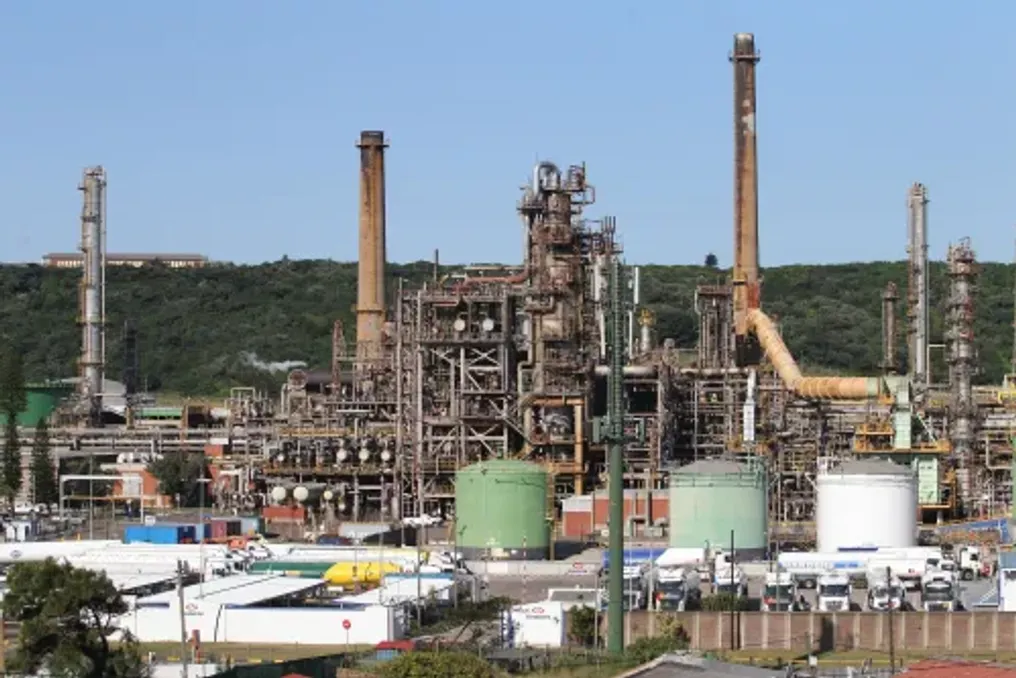
According to the Reserve Bank's statement, South Africa's shift towards importing refined fuel has increased the country's expenses, potentially reducing the oil import bill by 76 billion rand between 2021 and 2024.
The Reserve Bank noted that the economy's dependence on imported petroleum products exposes it to significant external risks. Over the last decade, oil refining capacity in South Africa has sharply declined as several refineries have closed or been converted into import terminals. Currently, operational capacity stands at about 250,000 barrels per day, compared to an installed capacity of approximately 720,000 barrels per day for processing crude oil, coal into liquid fuel, and gas into liquid fuel.
The Reserve Bank added that the closure of refineries has led to an approximate 20% decrease in oil-related industrial production since 2019, displaced around 5,400 direct and indirect jobs, and prompted companies to postpone investments. In contrast, regional and global competitors are increasing capacity through new mega-refineries, which strengthens South Africa's reliance on imports and underscores the need for a coordinated policy response to restore the resilience of the energy system.
The Reserve Bank also pointed out that the shift towards imported refined fuel has altered the structure of oil imports in South Africa. On average, between 2014 and 2024, refined petroleum products cost 12% more than crude oil. The Bank calculated that if refined petroleum products constituted no more than 25% of the total oil import volume, the country could have reduced its oil import bill by 76 billion rand over four years (2021–2024), representing an average reduction of 6.1%.
The higher cost of imported refined fuel also makes South Africa more vulnerable to fluctuations in global oil prices. As stated in the report, when global oil prices rise, the import bill increases more sharply than with domestic crude oil refining, which worsens the trade balance and current account.
In plans to reduce import dependency, it was previously reported that the South African government is taking decisive steps to lessen reliance on imported petroleum products, aiming to accelerate legislation and expand local refining capacity. Minister Gweed Mantshe, speaking in Parliament while presenting the Department of Mineral Resources and Energy budget for 2026/27 earlier this year, stated that the country remains overly dependent on imported fuel, making it vulnerable to global price shocks and supply disruptions.
Mantshe emphasized that for a country with significant mineral and oil potential like South Africa, it is unsustainable and unjust to remain exposed to external supply shocks. He added that the constant focus on developing the oil extraction industry and expanding refining capacity remains valid, despite pressure from some environmental groups. He concluded that energy security is not a theoretical debate but an economic necessity and a national imperative.