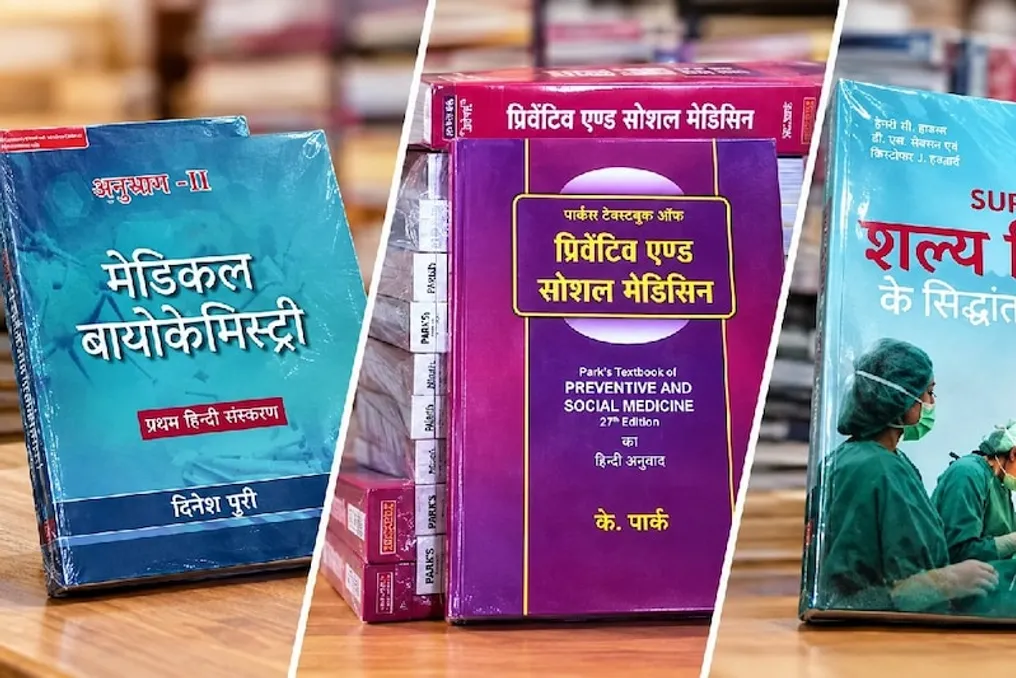
Discussions about the importance, promotion, and support of the Hindi language intensify during Hindi Diwas celebrations. However, the reality of attempting to make Hindi the language of higher education in Madhya Pradesh differs from stated goals. In 2022, Madhya Pradesh became the first state in the country to announce the start of MBBS studies in Hindi. Medical textbooks were prepared and published in Hindi, which was presented as a significant step toward integrating Hindi into higher education.
Nevertheless, four years later, questions arise about the fate of these publications. A large portion of the books that were supposed to be in the hands of students in medical colleges and libraries are now gathering dust in warehouses. Technical English books were translated into Russian, expert fees were paid, and printing costs were incurred. Publishers invested heavily in preparing these materials, but the lack of demand has resulted in capital being frozen in storage.
The publisher family from Bhopal, Manish Jain, has been in the book business since 1962. When they were commissioned by the government in 2022 to publish medical books in Hindi, they viewed it as the beginning of a new market for technical education in Hindi. They invested about 12–13 crore rupees and released approximately 5,000 copies. However, four years later, the situation has changed: according to Manish Jain, about 2,500 books worth approximately 9 crore rupees are still unsold in the warehouse. The decrease in demand from medical colleges has hindered the release of new batches, forcing the publisher to return to working with English-language textbooks.
The problem is not limited to financial losses for publishers. Among the announcements regarding the start of engineering and medical courses in Hindi, the most pressing issue concerns the preferences of the students themselves. For them, not only obtaining a degree matters, but also prospects for further study, employment, and career growth. Since English dominates at the postgraduate level, in scientific research, medical journals, and in the global academic environment, students face a choice: study in Hindi or in the language necessary for building their future careers.
Statistical data from Madhya Pradesh also demonstrates serious difficulties with this experiment. While Hindi instruction began in 2022, in the 2024–25 academic year, no student took the Hindi exam. In the 2025–26 academic year, only about 10 percent of all medical students chose to take the Hindi exams. Thus, the experiment, which was presented as a major revolution in higher education in Hindi, has extremely limited student participation.
Representatives of student organizations claim that they are not against the language but are making pragmatic decisions regarding their future. If knowledge of English is required after studying in Hindi for further education and participation in major competitive events, students initially choose English. This indicates that the challenge facing medical and engineering education in Hindi is not merely a shortage of literature, but an entire ecosystem problem.
University leaders also raise critical questions. Professor Dr. Ashok Khandelwal, custodian of Madhya Pradesh University of Medical Sciences in Jabalpur, admits that medical literature in English is very strong, whereas the foundation in Hindi is still insufficiently solid. Nevertheless, he notes that medical literature in Hindi is gradually developing and will improve in the future. He draws an analogy to how medical literature started with Greek and faced difficulties expanding into English, asserting that Hindi is undergoing a similar transitional phase.
The main question on Hindi Diwas is this: should Hindi be considered only a language of speeches, slogans, and government programs? Or should it become the language of employment, medicine, engineering, research, and global competition? Simply publishing a book does not make Hindi the language of higher education. Until students want to read it, teachers will not feel comfortable with it, all scientific literature will not be accessible, and paths to employment and research will not be clear, its use in Hindi will remain incomplete. If the books launched in 2022 are gathering dust in warehouses by 2026, then along with celebrating Hindi Diwas, we must answer the question: why are students not engaging with this experiment in higher education?