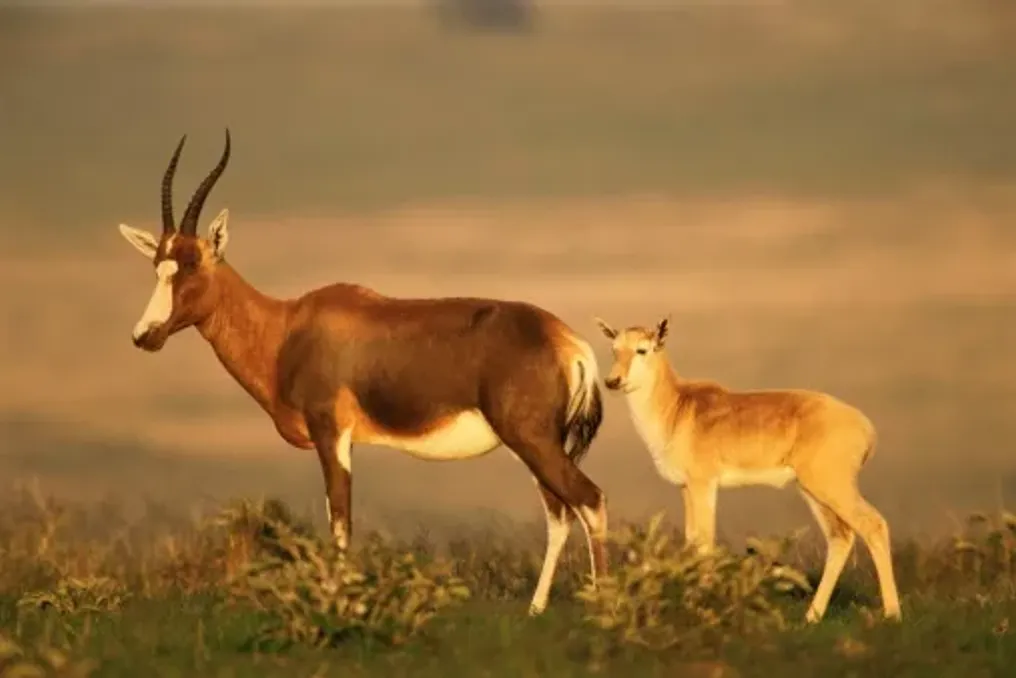
Wildlife stories from South Africa often focus on endangered species, but there are also species with a completely different history. Thanks to the creation of protected areas, private conservation initiatives, animal relocation, habitat protection, and land-use changes, many South African species have managed to achieve significant population recovery.
These five species demonstrate population growth, although further conservation remains a critically important task.
The Cape Mountain Zebra Came Remarkably Close to Disappearing
The subspecies, once widespread in the Western and Eastern Cape, was reduced to fewer than 80 individuals in the 1950s due to poaching and habitat loss. At its lowest point, the population was estimated at around 30 animals distributed across three small groups.
Thanks to protection and careful management, the situation began to change. The Mountain Zebra National Park became particularly important as animals from there were used to establish new populations elsewhere. The recovery subsequently spread beyond national parks, as private landowners also began protecting Cape Mountain Zebras, forming additional populations and providing the subspecies access to more suitable habitats.
By 2014/15, surveys recorded over 4790 Cape Mountain Zebras across 75 populations in the Western and Eastern Cape, including animals on both formally protected and private lands. This recovery was significant enough for the Cape Mountain Zebra to be listed as 'Least Concern' on the national Red List of South Africa. Nevertheless, challenges remain related to small populations, limited genetic diversity, and hybridization.
The conclusion is that wildlife protection does not always mean keeping it within one fence; private conservation areas and associated populations also play an important role.
The Bontebok Is One of South Africa's Most Striking Antelopes, But Its Survival Once Depended on a Very Small Number of Animals
Overhunting pushed this species to the brink of extinction. The remaining population was protected by Cape farming families, and when the Bontebok National Park was established near Bredasdorp in 1931, there were only 22 animals left. These early conservation efforts gave the bontebok a chance to recover. Animals from this protected population were later relocated to other reserves, contributing to the formation of new groups.
Today, bonteboks are found in both protected areas and on private land, and they have also been introduced into areas outside their original range. Their story serves as a reminder that some successes in South African wildlife conservation began not in large national parks, but on farms where landowners decided to protect the vanishing animals.
Recovery still faces difficulties. The bontebok remains vulnerable nationally, and among the issues addressed by conservation specialists are habitat loss, population fragmentation, and concerns about hybridization.
Blesbok's Recovery Is Particularly Striking Because It Shows How Dramatically Wildlife Numbers Can Change When Land Use Changes
Historically, blesbok were widely distributed across the Highveld grasslands and parts of the Karoo. Intensive hunting for meat led to a sharp decline, and by the end of the 19th century, only about 2000 animals remained in South Africa. Since then, the species has achieved remarkable recovery, especially on private land.
Blesboks have been translocated to ranches and protected areas across the country, including areas both inside and outside their historical range. According to SANBI estimates, the minimum mature population exceeds 54,000 animals in protected areas and ranches, based on 2010s counts. This makes the blesbok an interesting example of how the growth of private conservation areas has changed the fate of some South African species. It is also a reminder that a species can become relatively common again without returning exactly to its original distribution. Translocations for species conservation helped create populations in places where blesbok historically did not exist.
Conclusion: Land-use change can sometimes benefit wildlife, especially when agricultural or ranching land is converted into managed habitat for wild animals.
The Black Rhino's Story Is More Complicated, But Its Recovery Is Still Remarkable
Across Africa, the black rhino population declined by an estimated 97% between 1960 and the mid-1990s, mainly due to poaching. The continental population reached a minimum of about 2410 animals in 1995. Since then, the numbers have increased thanks to intensive protection, translocations, and efforts to expand the species' range. South Africa remains an important conservation hub. More recent SANBI data shows that the black rhino population in the country is approximately 2065 animals, while the continental population reached an estimated 6448 individuals by 2023. Some conservation measures also included reintroducing black rhinos to areas where populations had disappeared. Moving animals between protected areas helps expand the species' range and improve genetic diversity. However, this recovery comes with a serious caveat: black rhinos remain threatened. Poaching continues to pose a major problem, meaning their recovery depends on constant protection and management.
Conclusion: Population recovery can be real, yet fragile. For some species, conservation is an ongoing process, not an endpoint.
The Cape Vulture Is Perhaps the Least Obvious Comeback on This List
These large birds are often associated with dramatic cliffs and open landscapes where they feed on carrion. Like other vultures, they face threats such as poisoning, habitat changes, and collisions with infrastructure. However, there is encouraging news. The latest regional assessment of South African birds notes that the Cape Vulture has been downgraded from 'Endangered' to 'Vulnerable,' a result of conservation efforts promoting population recovery.
Protecting nesting sites was an important part of the work, alongside efforts to reduce poisoning and other human-related threats. BirdLife South Africa still classifies the Cape Vulture as 'Vulnerable' and emphasizes that vultures across the country are under significant pressure. Poisoning is particularly dangerous, as several birds can die after consuming the same contaminated carcass. Thus, the Cape Vulture represents a slightly different kind of recovery: it hasn't just moved from the 'Endangered' category to safe, but conservation actions have improved its prospects to the extent that its official threat category has changed.
Conclusion: Success in conservation can sometimes mean slowing the decline, recovering colonies, or reducing the risk of extinction, rather than just a significant population increase.
These five animals have very different stories, but they share a common thread: conservation efforts yield results when people change the situation on the ground. For the Cape Mountain Zebra and the Bontebok, population recovery was achieved through protection and animal relocation. The Blesbok benefited from the expansion of conservation areas and private conservation. The Black Rhino's recovery depended on intensive protection and relocation to suitable habitats. And in the case of the Cape Vulture, the focus was on protecting colonies and reducing threats like poisoning. None of these stories mean the work is finished; many of these animals remain at risk from habitat loss, genetic problems, poaching, or other anthropogenic pressures. However, their recovery demonstrates that nature conservation truly works.