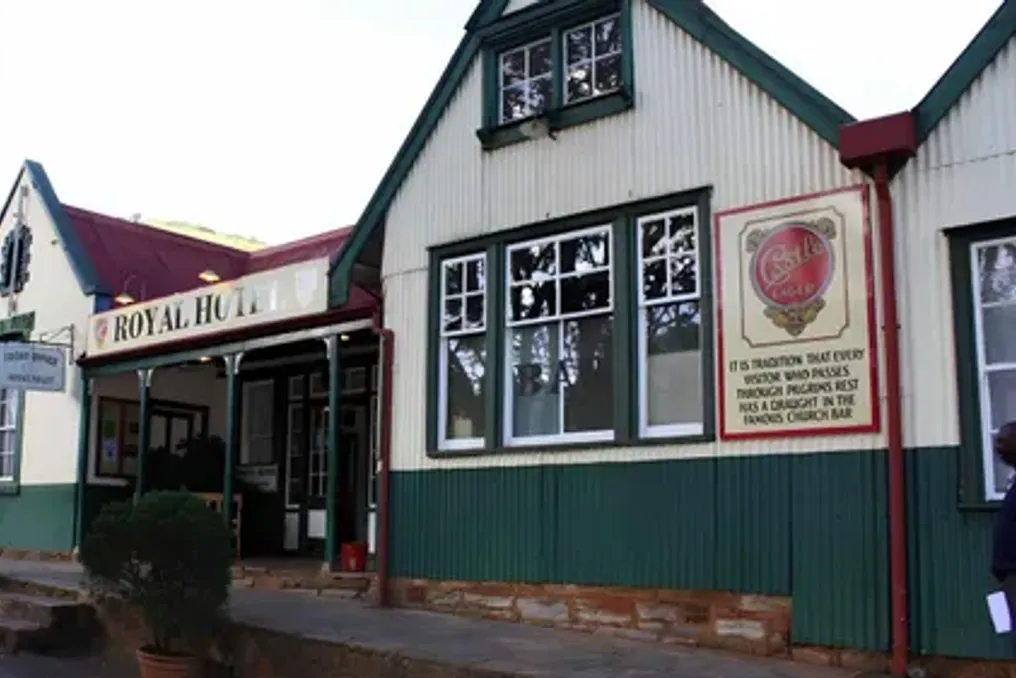
The 132-year-old Royal Hotel in Pilgrim's Rest currently stands vacant, representing the most recent instance of difficulties plaguing the historic tourism town over the past decade, leading to business closures and job losses.
Recent media coverage indicates that the latest effort to find an operator for the Royal Hotel has failed, as none of the submitted proposals met the required tender criteria. However, this situation is part of a longer history of issues spanning more than ten years.
The Royal Hotel has been a fixture in Pilgrim's Rest since the gold-rush period. According to Artefacts, an online resource detailing South African architectural and historical data, George Edward Roy constructed the hotel in 1894 after arriving on the Pilgrim's Rest goldfields as a 19-year-old in 1877.
Even the hotel's pub has a unique history; Artefacts notes that it was initially the Roman Catholic chapel belonging to St Cyprian's School in Cape Town. This chapel was later taken apart, transported through Maputo, and reassembled as part of the Royal Hotel.
Major battle
The challenges faced by Pilgrim's Rest concerning its state-owned commercial properties date back even further. A significant conflict arose in 2012 when the provincial administration put leases for businesses operating on these properties up for tender.
Existing merchants were instructed to vacate, which included individuals who had maintained businesses in Pilgrim's Rest for many years. Some of these traders pursued legal action to prevent their eviction, resulting in the North Gauteng High Court pausing the evictions until the tender procedure could be reviewed.
This dispute subsequently drew the attention of the then-Public Protector, Thuli Madonsela. Her subsequent investigation led to the publication of the 'Poisoned Processes' report. In this report, she determined that the method used to grant shop leases was both unlawful and inappropriate, characterized by 'gross irregularities and maladministration.'
The identified problems included deficiencies in the bid committee procedures, inaccurate scoring, and a lack of verification regarding whether potential tenants could sustain viable businesses.
Leave now
Madonsela also found that the 30-day notice period given to current tenants was inadequate for established businesses to finalize their affairs and make equitable arrangements for their staff.
She concluded that the entire process had negatively impacted business proprietors and the Pilgrim's Rest community, thereby jeopardizing the viability of the area as a heritage and tourism spot. Consequently, the government committed to canceling the affected agreements and restarting the process.
Despite these actions, the town continued to face hardships. By 2018, reports documented businesses remaining empty and employment opportunities diminishing amidst ongoing uncertainty surrounding lease agreements.
The town's caravan park, which previously hosted visitors, had been without a renter since 2015 and was deteriorating, even though the provincial government repeatedly attempted to secure an operator, but the tenders received were non-responsive.
In April of the current year, local residents voiced complaints that business closures were linked to delays in lease awards, although the provincial government asserted that revitalization efforts were underway.
Royal struggles
The Royal Hotel itself experienced internal issues prior to its present closure. By 2021, warnings surfaced that numerous jobs were at risk after the hotel reported consecutive financial losses amounting to R770,702 and R3.14 million.
Kruger on Sabie assumed management of the hotel in September 2022 and kept the existing workforce, but this led to a labor disagreement. Earlier accounts suggested the operator wished to implement a shift system because they could no longer support the current staffing structure. The relationship deteriorated, causing Kruger on Sabie to withdraw.
As of December 2024, the provincial government stated that the Royal Hotel employed 35 permanent staff members who had continued operating the business after the former tenant reportedly stopped functioning without compensating employees or providing notice, before Kruger on Sabie took over and subsequently departed.
The December 2024 announcement seemed to offer a resolution. Following discussions involving the Department of Public Works, Roads and Transport, Kruger on Sabie, the Mpumalanga Regional Training Trust, and organized labor, the government announced that the department would undertake renovations on the Royal, allowing Kruger on Sabie to resume management, with operations scheduled to restart on March 1, 2025.
They didn't
When SABC News visited Pilgrim's Rest in April this year, the hotel remained shut. Residents informed the broadcaster about the shuttered businesses, high unemployment rates, and reduced tourist traffic.
The department mentioned it was in the process of selecting an operator, but the most recent bidding round yielded no qualified applicants—this follows the caravan park tender, which also received only non-responsive bids eight years prior.
Godfrey Talana of SACCAWU Mpumalanga stated that he was unaware of the Royal Hotel dispute when contacted by IOL on Monday, but he indicated that a formal report on the matter might be released soon.
The Royal Hotel is not the sole property the government is attempting to lease out. It is seeking operators for other commercial spaces in Pilgrim's Rest as part of its strategy to boost the town's tourism economy, while simultaneously recognizing a deficit in tourist lodging.
Thirteen years after the Public Protector issued a warning that the management of Pilgrim's Rest properties was detrimental to businesses, the community, and the town's status as a tourist destination, the government is still engaged in the search for tenants for its assets.