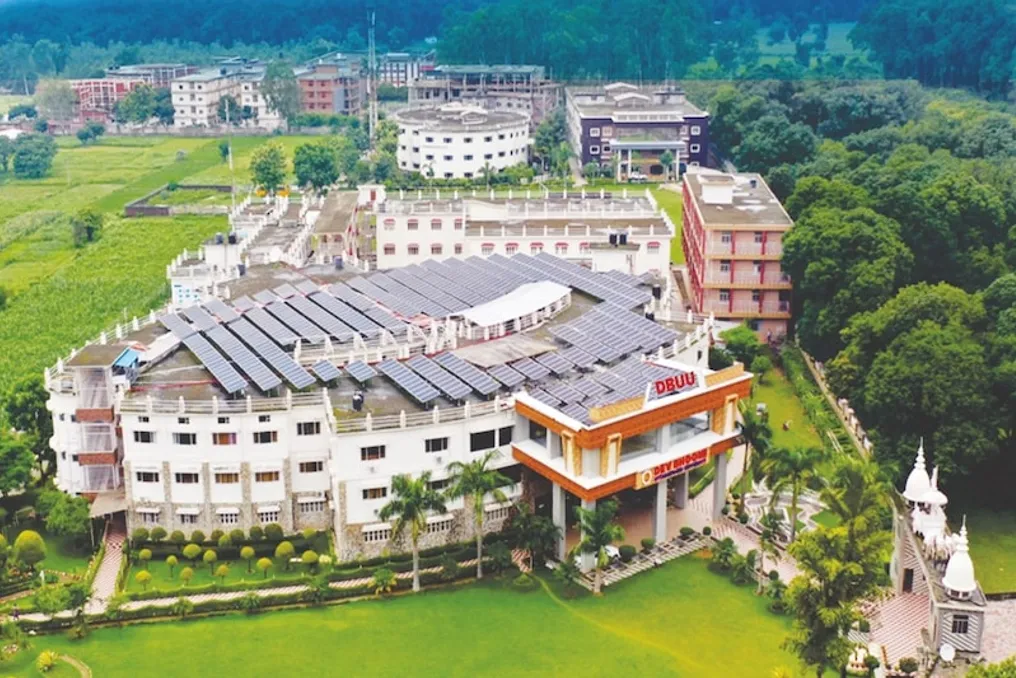
The 66th annual International Congress and Scientific Forum of AMI, held at Devarbhoomi University (DBUU) in Dehradun, served as a significant platform to strengthen dialogue between the academic community and industry in the fields of science, research, and innovation. The conference focused on microbiology, modern technologies, and interdisciplinary research, gathering scientists, researchers, educators, and industry experts from both within the country and abroad.
The main theme of the event was 'Education, Innovation, and Next-Generation Microbiology Research for Economy, Energy, and Environment.' The purpose of holding the conference was to enhance collaboration across various fields of science and technology, link research to real-life problems, and strengthen partnerships between educational institutions, industry, and research organizations.
The participation of ISRO Chairman, Dr. V. Narayanan, enhanced the significance of the conference. During an online meeting with him, important aspects of space science, technology, research, and innovation were discussed. This participation helped elevate the conference beyond narrow microbiology, connecting it to a broader spectrum of science and emerging technologies.
Dr. V. Narayanan stated that by 2040, the country's space flight program would match the level of any leading global power. He noted that factors contributing to India's transformation into a major space power include satellite technology, its application, and robust ground infrastructure. Addressing students, he emphasized that the new generation of scientists bears a great responsibility for the bright future of the nation.
At the 66th annual AMI International Congress, scientists, researchers, and experts from around the world shared views on topics related to microbiology, research, and innovation. Specialists from countries such as the USA, India, Germany, and South Africa participated in the event.
Among the prestigious institutions whose experts attended the conference were the University of Tennessee, University of Texas at El Paso, Johnson & Johnson, University of Chicago, Tshwane University of Technology (South Africa), Universitätsmedizin Göttingen (Germany), and Max Planck Institute (Germany). From India, participants included scientists and researchers from major institutions such as DRDO, BIRAC, IIT Roorkee, IIT Bombay, IIT Delhi, JNU, University of Delhi, IISER Bhopal, ICAR, and CSIR. This diversity of expert participation provided a broad platform for academic and research dialogue.
The involvement of corporate sector specialists became an important part of the vision of the DBUU industry and academia. Industry experts such as Mr. Abhinav Gambhir from Microsoft, Mr. Manoj Bhutani from Google, and Mr. Sanjay Kathuria from Google Cloud India introduced students and young professionals to key aspects concerning technology, changing industry needs, and career prospects. These experts were highlighted on the DBUU website as part of the university's 'From Corporation to Classroom' network.
Furthermore, the participation of Mr. Adarsha Srivastava and other industry representatives played a vital role in bridging the gap between academic knowledge and practical industry experience.
It was particularly noted at the conference that traditional laboratory research in areas like microbiology will be insufficient in the future. The use of Artificial Intelligence (AI), data analytics, and computational tools will help make research faster, more accurate, and more efficient.
Experts discussed the growing importance of technologies in areas such as AI-based diagnostics, data literacy, forensic and synthetic microbiology, vaccine development, and disease prediction.
The conference offered young scientists and researchers in the country an extensive opportunity to present their research and new ideas. Experts encouraged young researchers to work on projects that might start small but could have a significant impact on society and industry.
This event also underscored that the role of higher education institutions is no longer limited to issuing degrees; universities must play an active role in research, innovation, industry linkage, and solving social problems.
The hosting of the 66th AMI conference at DBUU demonstrates the growing scientific-industrial collaboration of the university. Priority in the university's research and innovation ecosystem is given to interdisciplinary research and industry collaboration. By bringing together scientists from different countries, industry experts, and researchers, the conference created an opportunity for students to engage with global ideas and research. This is why the 66th AMI conference turned out to be not just an academic event, but an important platform uniting research, technology, industry, and young talent.