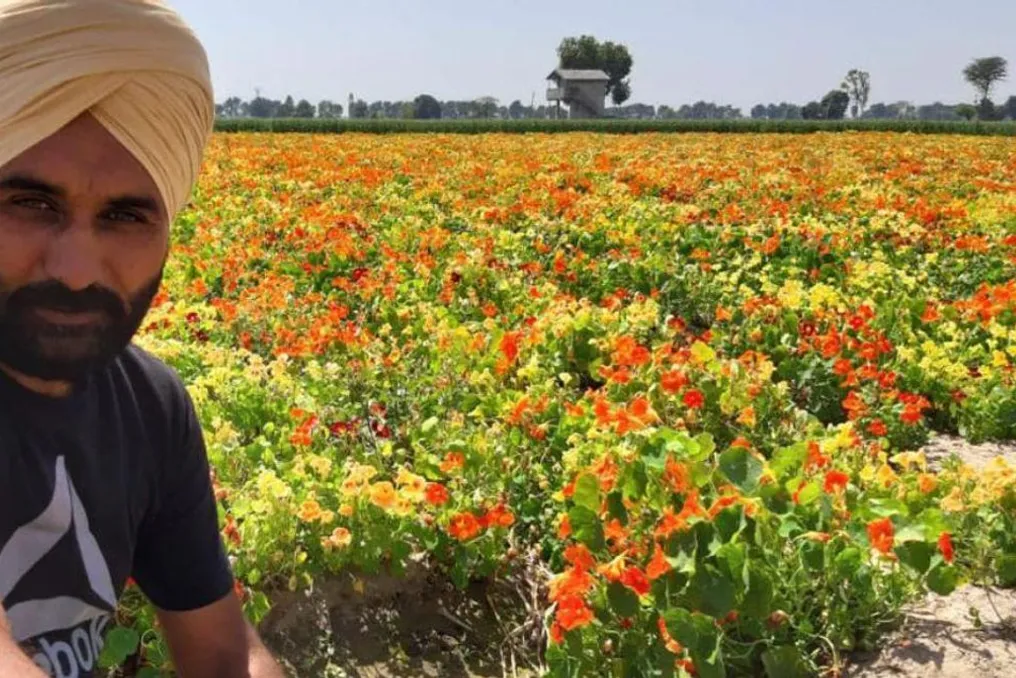
Gurvinder Singh Sohi, who grew up among wheat fields in Punjab, decided in 2008 to utilize the region's favorable climate for the benefit of farmers by switching from growing wheat to floriculture.
At the age of 45, he told The Better India that his family had been cultivating wheat and rice for generations, but farmers were facing difficulties in earning a decent income. He noted that floriculture can generate two to three times higher income than traditional wheat farming.
Sohi emphasized that Punjab's climate is ideal for most crops, and the sandy loam soil with a pH of 7 to 7.5 is favorable for growing flowers. This is why he became the first farmer in his area [Fatehgarh Sahib] to decide to engage in flowers instead of wheat.
Currently, on 22 acres of land in his village Nanawal, he cultivates 40 different varieties of exotic flowers, including calendula, gladiolus, delphinium, and others. In a five-month season, he harvests about 10 tons of flowers, which brings him an income of 1 lakh rupees per acre.
Failure in everything to succeed in one thing
While most of his cousins moved to countries like the USA and Canada in search of work, Gurvinder remained attached to his village. He did not set goals to work in the corporate sector and stopped his education after the 12th grade. He shared that he never showed interest in higher education but wanted to succeed and establish himself while living in the village.
After completing the 12th grade in 1993, he worked various odd jobs: as a salesman, tea trader, mushroom and poultry farmer, and also sold sweets and modified luxury jeeps. However, according to him, he failed in all these professions due to a lack of enthusiasm and inability to enjoy the work.
Fifteen years later, in 2008, his life changed when he started floriculture. He learned from a friend that the Punjab Horticulture Department offered subsidized Dutch gladiolus seeds. He decided to try, and the department provided him with 10,000 bulbs free of charge. Since he needed land, he asked his father for help. His father was initially angry, believing he was not taking the work seriously because Gurvinder often abandoned ventures after two or three years.
Nevertheless, his father allowed him to conduct an experiment on two plots (about 0.25 acres). Gurvinder planted the bulbs, and within 90 days, they began to bloom. He sold the first batch in local markets and earned about 3 rupees per stalk. Dutch gladioli are among the most common ornamental flowers in the world, and due to their seven-day shelf life, they represent an economically viable agricultural product for farmers. Encouraged by the successful experiment and potential profit, he expanded the flower cultivation area to one acre the following year.
Subsequently, he began introducing other varieties of flowers from countries such as Europe and Israel, gradually increasing the cultivated area to 22 acres.
Modernizing floriculture with machinery
Despite finding happiness in floriculture, this occupation had its challenges. He noted that gladiolus bulbs resemble onions, and previously they were planted manually in beds, ensuring the pointed end was directed upwards. This process was slow and labor-intensive.
He discovered that foreign farmers use machines on large fields for planting. Many farmers in India believed that if the bulbs were not planted strictly according to instructions, they would not grow, and they thought machines would do it incorrectly. However, after research, he found this to be a misconception.
Since there was no suitable planting machine in the local market, Gurvinder decided to build one himself. It took three years to develop a unique machine that helped plant flower bulbs and reduce time and costs for farmers. During this time, he also received a grant of 12 lakh rupees from the Punjab Agricultural University.
Explaining the features of the machine, Gurvinder said that a tractor is used to operate this semi-automatic machine. It is equipped with a circular plate with holes through which flower bulbs are dropped onto the beds. Previously, 30 workers spent a whole day planting bulbs on an acre. Now, five people can plant bulbs in just two hours, saving 40,000 rupees per acre in labor costs.
Seeing the success of the machines on his farm, other farmers approached him with questions. In addition to the planting machine, he also developed machines for tilling and sorting. To date, he has sold eight such machines for prices ranging from 60,000 to 1.6 lakh rupees to farmers in Punjab, Haryana, Uttarakhand, and Himachal.
Furthermore, he has free-trained over 2000 farmers from across the country, including Leh, Himachal, Uttar Pradesh, and Rajasthan, in exotic flower cultivation methods. He wishes for more people to engage in floriculture and double their income, so the training is conducted free of charge.
Gurvinder received national recognition for his agricultural innovations in 2019, and recently, about two months ago, he was honored at the state level by Chief Minister Bhagwant Mann. He shares that he cannot describe his feelings in words, recalling the times when he was ridiculed for never settling on one job. Today, however, everyone, including his family, values him, and people associate his name with the village of Nanawal, which brings him pride.