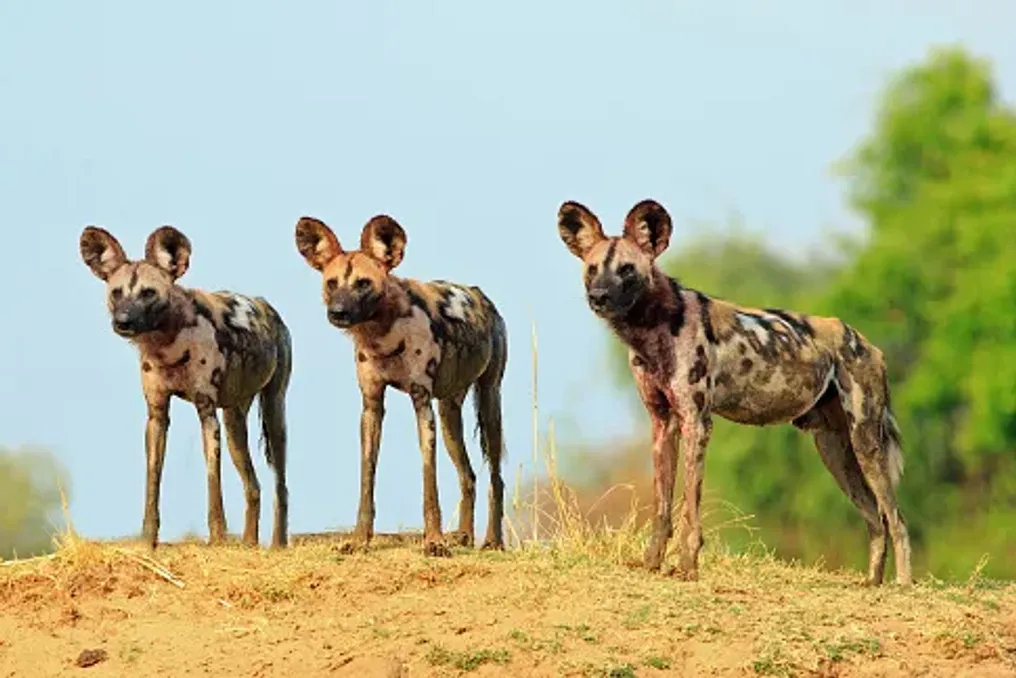
Three wild dogs from Zambia covered a distance of over 4000 kilometers in search of new territories and partners, which researchers consider the longest migration among African mammals.
These three males, known as the Maiyukuyuku males, traveled 4126 km over nine months after leaving their native pack in Kafue National Park in mid-2025. This route is approximately the distance between Cairo and Cape Town and highlights the critical importance of preserving ecological corridors between protected areas, according to scientists.
According to Mongabay, this is also the longest recorded migration for the African wild dog (Lycaon pictus).
Initially, the three males moved east from Kafue National Park, then headed north towards the towns of Kitwe and Ndola. Later, they turned around and continued moving east into the Luangwa River valley, where about 400 wild dogs live. By April 2026, the dogs reached a wildlife management area located between South Luangwa National Park and Lower Zambezi.
Researchers believe the males may have occupied new territory in this area, although further study is required to obtain more complete information about the pack that joined them and their current movements.
Matt Becker, Executive Director of the Zambia Predator Care Program and co-author of the study, told Mongabay: 'This is the longest movement of an African mammal in history, as well as the longest migration of wild dogs.'
The results were obtained during a study that tracked 19 packs of wild dogs using GPS collars. All packs moved either within or around seven national parks in Zambia.
Four packs also approached the borders of Zambia with Angola, the Democratic Republic of Congo, Malawi, and Zimbabwe. These movements demonstrate how far wild dogs can travel in search of food, territory, and potential partners. Researchers note that these movements also suggest that wild dog populations in parts of Southern and Eastern Africa may be more interconnected than previously thought. Similar long-distance movements have been recorded in Botswana, Tanzania, and Zimbabwe.
Preserving these connections can be vital for the survival of this endangered species. Nyambe Nyambe, Executive Director of the secretariat managing the Kavango-Zambezi Transfrontier Conservation Area, stated: 'If we preserve and continue to improve these connections, many species, such as wild dogs, will be able to succeed.'
The KAZA Transfrontier Conservation Area covers parts of Angola, Botswana, Namibia, Zambia, and Zimbabwe and represents one of the largest connected conservation landscapes on the continent.
Long journeys do not always end well. One of the dogs tracked by researchers, a female coded EWD-1355, traveled over 2300 km after leaving South Luangwa National Park with her two sisters in 2021. Her path went through Mozambique, after which she died from a snare in a wildlife management area in southern Zambia.
Traps are often set to catch animals like antelopes for meat. Wild dogs are particularly vulnerable because they may stay near injured members of their pack instead of abandoning them. According to Becker, one incident can result in several dogs being caught and killed.
The study highlights the problems faced by wild dogs as the landscapes they depend on increasingly overlap with human settlements, agriculture, and other forms of land use. Becker emphasized that conservation efforts must go beyond protected areas and consider how local communities can benefit from wildlife and associated natural landscapes. Such methods include nature-based ecotourism and sustainable, legal ranching.
Becker noted to Mongabay: 'We don't need to separate people and nature. We can have these large, extensive, interconnected territories that are beneficial for both us and nature.'
For the wild dogs of Zambia, the extraordinary journey of the Maiyukuyuku males clearly shows how much space they need to survive and find new opportunities in the region.