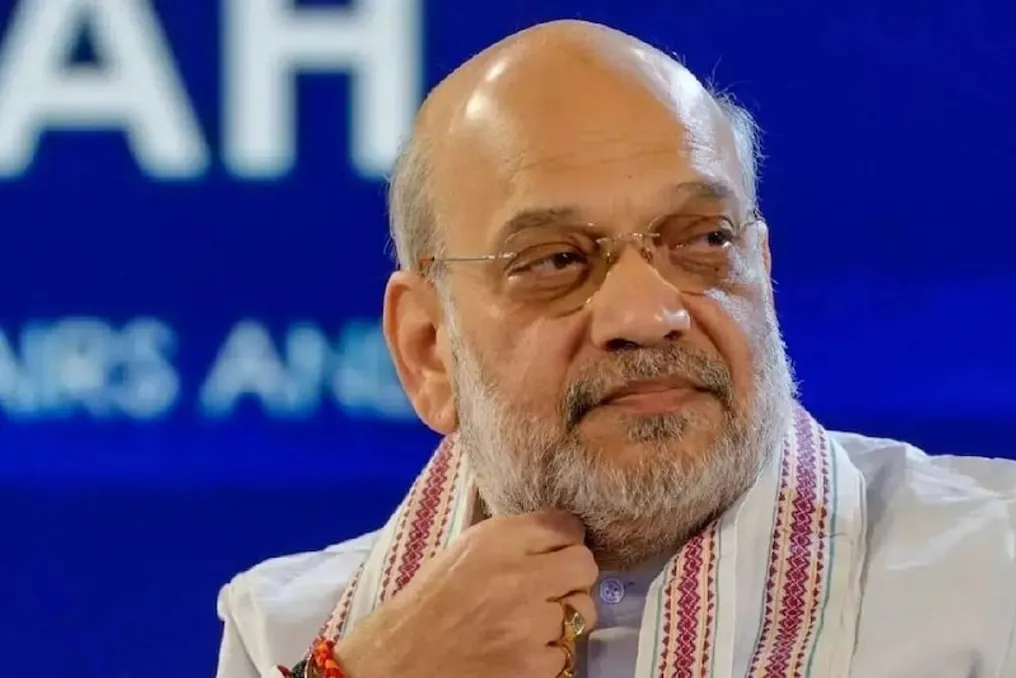
Amit Shah states that regional languages are India's strength, and Hindi is the link between them
Read more
Aaj Tak
www.aajtak.in

Amit Shah states that regional languages are India's strength, and Hindi is the link between them

During the celebration of Hindi Diwas, Home Minister Amit Shah delivered an important message regarding Indian languages. He emphasized that India's linguistic diversity is not a weakness but its greatest strength. According to Shah, every language in the country carries with it history, folk traditions, and a unique perspective on life.

He noted that multilingualism strengthens the idea of India's 'unity in diversity.' Shah believes that language is not just a means of communication but the memory and self-awareness of a society. However, he clarified that Hindi does not compete with other Indian languages but serves as an important bridge for friendly dialogue among them. The development of Hindi will only be significant if all Indian languages are respected, preserved, and promoted.

Citing Swami Dayananda Saraswati, Mahatma Gandhi, and Netaji Subhas Chandra Bose, Amit Shah highlighted the national role of Hindi. He personally shared his opinion: 'My mother tongue is Gujarati, but Hindi is the language that connects ordinary people in every corner of the country.'

Shah reminded that on September 14, 1949, the Constituent Assembly adopted Hindi as the official language of the Union. He also mentioned that during the independence movement, the concepts of Swaraj (self-rule), Swadeshi (self-sufficiency), and Swabhasha (mother tongue) gave new energy to the national consciousness. Furthermore, he stated that under the new education policy, the mother tongue is placed at the center of learning. Currently, engineering and medical education is conducted in Indian languages, and competitive exams are also held in many such languages.

The minister noted that in the age of technology, Indian languages are not lagging behind but are experiencing a golden age of technological development. Shah mentioned the 'Bhartri' tool, based on artificial intelligence, which simplifies communication between Indian languages. He also mentioned the digital dictionary 'Hindi Shabd Sindhu,' containing over 827 thousand entries, which has become an important resource. In Shah's view, AI and machine translation technologies have broken down language barriers.

Addressing the youth, Shah urged them to learn as many world languages as possible while never abandoning their mother tongue. He strongly requested parents to communicate with their children in their native language. He stated that there is no greater sin than the feeling of insignificance expressed in the phrase, 'I will become small if I speak my own language.' Shah emphasized that language connects us to our mother, the land, history, and culture. He expressed his intention to make Hindi and all Indian languages powerful tools in building a developed India by 2047. In conclusion, he mentioned the 150th anniversary of the creation of 'Vande Mataram' and noted that this anthem should be remembered as a song that made language a weapon of freedom.

Similar stories

Kumar Vishwas criticized Swara Bhaskar's statements on Jauhar, stating that history cannot be erased
Read more
www.aajtak.in

Kumar Vishwas criticized Swara Bhaskar's statements on Jauhar, stating that history cannot be erased

Swara Bhaskar's comments regarding Sanjay Leela Bhansali's film 'Padmavat' caused a wide resonance. Bhaskar linked the self-immolation (Jauhar) of Princess Padmavati and 800 women to indecency, claiming they felt like a vagina.

This dispute is not subsiding, and now the poet Kumar Vishwas, without naming Swara, reminded people of the glorious history of Rajasthan, calling it 'ignorant and foolish' (jāhil aur jamūre).

Kumar Vishwas emphasized that the pride and sacrifices of Rajasthan's history cannot be destroyed by any film, story, or a few hours of content. He urged people to focus more on teaching their future generations the correct history instead of getting angry at others.

Speaking about the history and heroism of Rajasthan, Kumar Vishwas stated: 'I repeat, this is a sacrifice written in blood, because of which even the land of Rajasthan resembles sandalwood.' He added that creating a two-hour film, writing any stories, or extracting any fragments from the proud heritage of Rajasthan and its people cannot affect a single particle of this history, provided we continue to tell people the true story.

Kumar Vishwas's stance was clearly aimed at the ongoing discussion about history and the portrayal of historical events in cinema. He noted that if society does not tell its descendants historical precedents, then getting angry at others' words in the future will be useless.

He advised people to concentrate on educating their youth about history instead of paying attention to such individuals. Kumar Vishwas continued that if you yourself do not tell these precedents to your generations, if you do not pass this history on to future generations, then those he called 'foolish and ignorant,' who 'read nothing, knew nothing, loved nothing of the land,' and who interpret the country's history and culture while sitting on the 19th floor, whether in Bombay or elsewhere, you will get angry at them. Therefore, it is much more important to teach your generation history than to pay attention to them.

During his speech, Kumar Vishwas gave a personal example. He recounted how he takes his family to historical places and explains the history of those places to the children. He mentioned that he personally visits places like Haldighati and Vrindavan, telling them where and by whom freedom was won.

Referring to the history of Maharani Pratap and Haldighati, he said that if someone wants to understand the struggle for personal dignity and respect, they should visit a small room in Kumbhalgarh where Maharana Pratap was born. He explained that in that era, war was not only about freeing one Maharani but also about the fight for personal dignity and self-respect. He added: 'We do not challenge anyone's dignity. We show hospitality.'

Kumar Vishwas also urged people to visit the historical sites of Rajasthan. He advised against going to Bangkok, Hong Kong, or Las Vegas, but instead traveling through Rajasthan and worshipping every shrine. Furthermore, he recommended visiting the Andaman Islands to see the history related to the struggle for independence. He mentioned that one should see the pistol used by Chandra Shekhar Azad in India.

In conclusion, Kumar Vishwas reiterated that it is more important to tell one's history to the next generation than to argue about it on social media or get angry at any film. His message was to teach one's generation the true history.

Vijay condemned Udhayanidhi Stalin's remarks regarding offensive language towards women
Read more
timesofindia.indiatimes.com

Vijay condemned Udhayanidhi Stalin's remarks regarding offensive language towards women

The Chief Minister of Tamil Nadu, C Joseph Vijay, intensified his criticism of the opposition leader in the Tamil Nadu assembly, Udhayanidhi Stalin, on Monday. The criticism was prompted by alleged remarks made by the latter towards an actress.

Vijay stated that if insults are directed at women, the law will be applied in full.

Popular