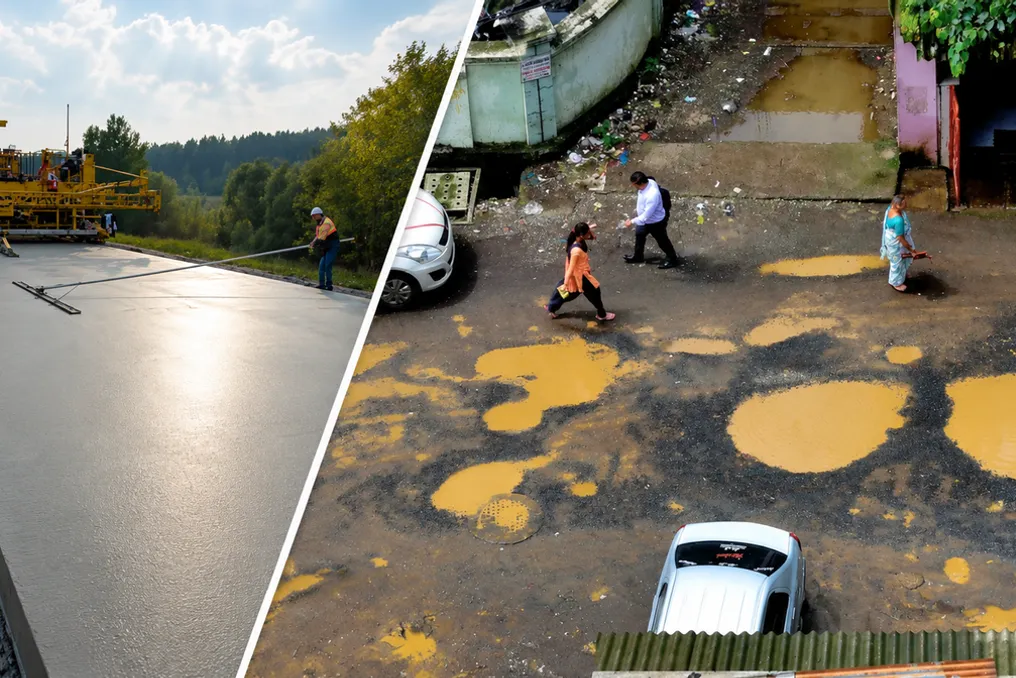
For a long time, the road between Mudigedu and Sanjamala, located in the foothills of the Nandyal district, suffered constantly during the monsoons. Trucks carrying limestone for regional cement plants and slabs from granite quarries passed over this section daily. By the time the rains started, the road surface was covered with cracks, ruts, and deep potholes capable of swallowing a scooter wheel.
This stretch passes through the Banaganapalle constituency, which has long faced problems due to intensive freight traffic. On July 4, 2025, the Andhra Pradesh Roads and Buildings Department launched a pilot project using the technology of reinforcing asphalt with Danish fibers. This idea was imported from Denmark and is already being used on the runways of Heathrow Airport, in Dubai's highways, and along the A7 motorway in Germany.
The pothole problem in India is serious, as thousands of accidents are linked to them annually. The Supreme Court once noted that Indians die from bad roads more than from terrorist acts, prompting states to seek stronger alternatives to ordinary bitumen.
Fiber borrowed from Danish experience
The technology was developed by Danish Fibres A/S, which has been perfecting reinforcing fibers for over 40 years. The company received a patent in 1985 for fibers to control explosive load, and later expanded its application to reinforcing concrete and asphalt worldwide.
Their Wiking asphalt fibers combine aramid—a high-strength material used in body armor—with polyolefin, forming a mesh structure inside the asphalt mixture. When added to hot bitumen in a quantity of less than one kilogram per ton, the fibers evenly distribute tensile stress across the entire road surface, preventing its concentration in a single point where a crack usually begins.
Independent tests presented by the manufacturer show that rut depth has decreased by more than 50%, and the fibers maintain stability across a very wide temperature range, resisting cracking even at temperatures around -26°C, which significantly exceeds the climate requirements of Rayalaseema.
Reasons why officials are betting on durability
For Andhra Pradesh, the appeal of this technology lies in its obvious durability. Officials expect the reinforced section to last 50% longer than a traditionally built road, which will reduce the frequency of repairs and lower the state's long-term maintenance costs.
The department's chief engineer reported that Danish Fibres took on the test section in Banaganapalle. If the technology shows good results during the monsoons, it is planned to be scaled up to a wider network of state roads, thus testing global materials instead of relying solely on conventional bitumen mixes.
The Nandyal district has become a center for cement and granite processing, leading to an increase in heavy cargo flow on roads not originally designed for such loads. This is why officials chose this section first, viewing it as a stress test before allocating funds for wider implementation.
Although this is not the first experiment with potholes in the country, and likely not the last, India already has its own solutions. A chemistry professor from Tamil Nadu once developed a method of melting crushed plastic waste into bitumen to strengthen rural roads, which is now used in more than 11 states. Additionally, a social enterprise from Bengaluru used corrugated mats made of recycled plastic for accelerated road construction with less water consumption. Startups are applying artificial intelligence to map potholes across entire cities, and students from Andhra Pradesh created electronic devices for local pothole repair.
A distinguishing feature of the Danish trial is that it aims at prevention, not repair, stopping cracks from appearing before they turn into craters that make travel dangerous during the monsoons for two-wheeled vehicles, ambulances, and school buses.
Officials involved in the launch described the road as a test that will be expanded across the state after its effectiveness is confirmed. Currently, the department is closely monitoring this section during the upcoming monsoons—it is a true test for any Indian road before its large-scale adoption.
A plan worthy of attention beyond Andhra Pradesh
This cautious approach—testing a globally proven material on a small, heavily loaded section before allocating public funds—is noteworthy in itself. Indian roads chronically face the same issues as in Banaganapalle: overloaded freight transport, water saturation during monsoons, and maintenance budgets that favor temporary patching over prevention.
Other states facing similar pressure, whether in Rajasthan's quarry zones or Odisha's transport corridors, would receive a data-backed and tested model instead of another unverified claim if the pilot project proves successful. In a country where road failures are usually addressed by resurfacing rather than reinforcement, Banaganapalle offers a quieter example: first conducting thorough testing on a loaded section, and then adopting global engineering practices that truly prevent potholes.
For a state striving to shed the reputation of cratered rural roads, this would be a genuine, quietly designed victory—one village road at a time, and perhaps a model that the entire country will begin to observe.