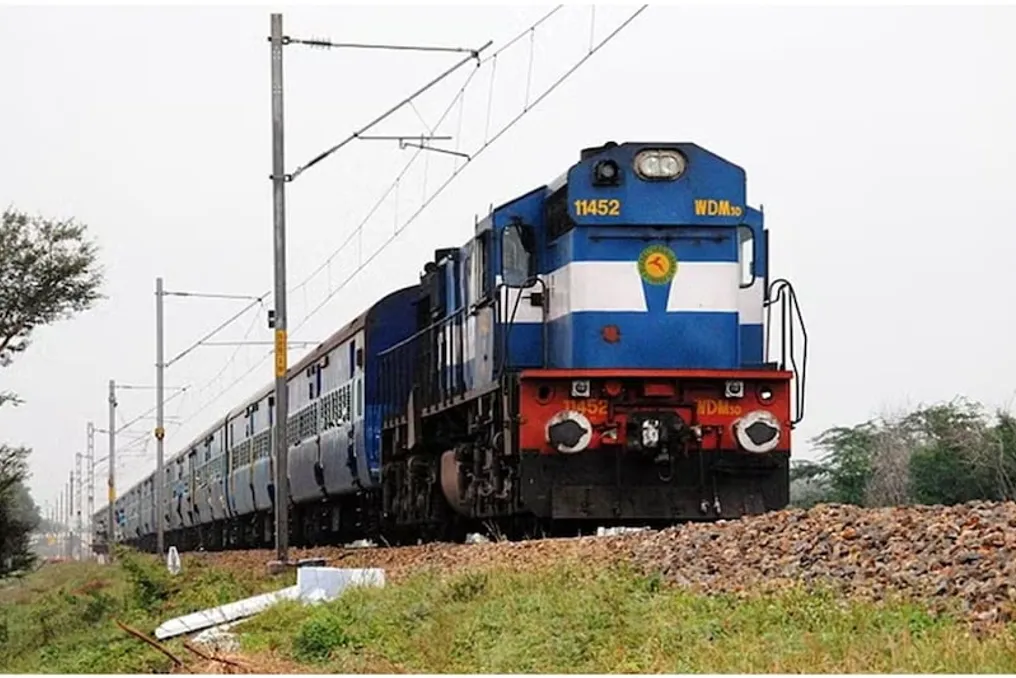
For passengers traveling from New Delhi to Mumbai, rail travel may become significantly faster in the future. The railway company is preparing to increase train speeds on this route to 160 kilometers per hour. The goal is to reduce the journey time between New Delhi and Mumbai to approximately 12 hours. In this regard, the railway is continuously modernizing necessary infrastructure elements such as tracks, electrification, signaling, and other systems.
The latest information on this project came from the Agra division, where a new 2x25 kV AC substation (TSS) was commissioned on September 7. This work is part of the 'Mission Raftaar' program and aims to prepare the Palwal-Mathura section on the New Delhi-Mumbai route for high-speed train operation.
The distance between New Delhi and Mumbai is about 1427 kilometers. Currently, the fastest train on this section is the Pune AC Duronto express, which covers this distance in approximately 15 hours and 24 minutes. The Tejas Rajdhani express arrives in Mumbai in about 15 hours and 40 minutes, while the August Kranti Rajdhani takes around 16 hours and 50 minutes.
The railway is modernizing an 84-kilometer (RKM) section between Palwal and Mathura, covering about 336 kilometers of tracks (TKM). Work is being carried out at multiple levels on this stretch to create the necessary foundation for future high-speed train operation up to 160 kilometers per hour. These works include changes to Overhead Equipment (OHE), installation of super masts and auxiliary conductors (AEC), strengthening traction and power supply systems, improving signaling and telecommunication systems, as well as depot reconstruction and other civil and mechanical works. Specifically, efforts are currently focused on AEC work, mast installation, and station zone commissioning on the Mathura-Bhuteshwar (MTJ-BTSR) section.
A reliable and powerful power supply system is critical for operating high-speed trains. A TSS substation has been commissioned under this direction. Additionally, the Kosiklan, Mathura, and Sholakan substations have already been commissioned. Final testing of the Brindavan substation is currently underway, and final testing of the Kotwan substation is planned to be completed by September 15. The Hodal and Ajhai facility commissionings are scheduled for September. The goal is also set to prepare the Rundi-Palwal traction substation by September 25. The connection of the Rundi substation and the power line to the grid is planned for October.
This entire modernization program will rely on the SCADA (Supervisory Control and Data Acquisition) system. After its launch, the traction power supply network will be controllable and manageable remotely from the Agra control center. This will allow the railway to monitor the entire power supply network from one location, simplifying system control and enabling prompt response in case of problems.
The modernization affects not only the tracks and power supply but also the Mathura and Bhuteshwar depots. Depot reconstruction is an important part of the speed increase project. Phase II involves work on a new feeder line, the fourth line, and connections in the Bhuteshwar depot. According to the railway, these key works are expected to be completed by September 30, 2026.
