Housing Affordability Analysis: What Two Average Salaries Can Buy in South Africa
Read more
IOL
iol.co.za

Housing Affordability Analysis: What Two Average Salaries Can Buy in South Africa

The question of what kind of home two average salaries can afford in South Africa is more complex than it first appears. Banks consider both the borrower's remaining funds after expenses and the debt-to-income ratio when assessing creditworthiness.

Theoretically, two people earning an average salary in South Africa could afford housing similar to that purchased by first-time buyers. However, the ability to secure and comfortably live with a mortgage loan are two different processes.

According to the PayInc Net Salary Index, which tracks the income of about 2.1 million workers, the average net income for a South African in July was R21,642. Combining the incomes of two such workers results in a monthly household income of R43,284.

Shergeran Naidu, Head of Stakeholder Engagement at PayInc, noted that the average nominal net salary increased by 0.2% compared to June and by 2.2% compared to the previous year. Nevertheless, salary growth has slowed: over the first seven months of the current year, nominal net salary has only grown by 1.6%, compared to 3.7% in 2025.

Independent economist Eliza Kruger commented: 'While the continued growth in nominal net salary is encouraging, the overall picture shows that wage growth remains moderate.'

What Banks Consider

Banks typically analyze both the amount left to borrowers after all expenses and the repayment ratio relative to income, with monthly mortgage payments generally limited to about 30% of gross monthly income. Based on this, the calculation must start with the net salary of R21,642 from PayInc.

Using the South African Revenue Service tax tables for 2026/27, taking into account tax deductions and employee contributions to the Unemployment Insurance Fund, an employee receiving R21,642 take-home pay should earn around R25,000 per month before tax, assuming no other deductions or tax benefits.

Two such salaries provide a hypothetical household with a gross income of approximately R50,000 per month. Applying the 30% benchmark means the bank may approve a mortgage payment of around R15,000 per month.

A R1.5 Million Property

At the current prime lending rate of 10.5% and assuming a 20-year loan at the prime rate, this allows for a loan amount of approximately R1.5 million. This amount is close to what first-time buyers actually pay. BetterBond indicates that the average purchase price for a first-time buyer is R1.4 million, which is 19% higher than in the third quarter of 2023.

Current listings in Johannesburg priced around R1.5 million allow for the purchase of a three-bedroom apartment in Fourways, a three-bedroom townhouse in Eden Glen, or a three-bedroom house in Founders View. Moving east towards Kensington, the same price of R1.5 million secures a three-bedroom house on a 495 m² plot, while in Rosettenville, listings include three-bedroom houses on plots exceeding 500 m².

In Durban, the same sum of R1.5 million covers significantly more space. Current offerings include a three-bedroom house with 2.5 bathrooms in Doncliff on a 1,866 m² plot and a five-bedroom house in Bluff, while a sea-view property at this price is offered as a multi-unit investment.

In Cape Town, R1.5 million buys much less space. Current listings at this price include a 70 m² two-bedroom apartment in Lansdowne, a 56 m² two-bedroom apartment in Costa da Gama, and a 65 m² two-bedroom apartment in Marina da Gama. A two-bedroom apartment is also advertised in Sonnedblom for R1.5 million.

Mortgage applications are also up 11.3% compared to the fourth quarter of 2023, although BetterBond notes that several factors have slowed activity in the housing market this year, including the increase in the prime rate from 10.25% to 10.5% in May. Furthermore, banks are approving applications more frequently. BetterBond's mortgage approval rate reached 64.5% by the end of August.

What the Household Sees

The calculation looks different when the mortgage payment is deducted from the money actually deposited into the couple's account. A payment of approximately R15,000 consumes about 35% of their total net income of R43,284, leaving them with about R28,000 per month. These funds must cover taxes and fees, electricity and water, groceries, transport, insurance, medical expenses, children's needs, existing debts, and all other household expenses.

A down payment may also be required. BetterBond reports that banks have increased deposit requirements in the first two months of the third quarter, although average deposits remain 7.3% below the level of two years ago.

Nevertheless, housing affordability has improved for many South Africans. BetterBond stated: 'Excluding homebuyers aged 21 to 30, these ratios are lower than ten years ago, signaling an improvement in housing purchase affordability for most age groups.'

For buyers aged 41 to 50, the ratio of average house price to income has decreased by 27% from 2021 to 1.76, meaning the average property costs about 1.76 times their annual income. The average housing price continues to rise.

No Disposable Income

However, the improvement in housing affordability is countered by weakening purchasing power. The PayInc Real Net Wage Index recorded its first monthly increase in nine months in July due to falling inflation, but real net wages remained 2.2% below the level of a year ago. Kruger noted: 'Purchasing power remains weaker than a year ago, and this ongoing decline has implications for household spending and consumer confidence.'

Meanwhile, housing prices continue to climb. Statistics South Africa recorded an annual inflation rate for residential property prices at 7.9% in April, including a rise of 11.2% in the Western Cape and 4.8% in Gauteng.

Stefan Potgieter, CEO of BetterHome Group Mortgage Origination and BetterBond, stated: 'There are some encouraging signs in the market, from improving mortgage approval rates to a stronger labor market and continued growth in housing prices. Although buyers remain sensitive to interest rates and deposit requirements, affordability has improved for many South Africans.'

Potgieter added that these trends indicate a market where opportunities remain for those ready to take the next step toward homeownership.

Similar stories

South African households face pressure due to job losses and rising debt
Read more
iol.co.za

South African households face pressure due to job losses and rising debt

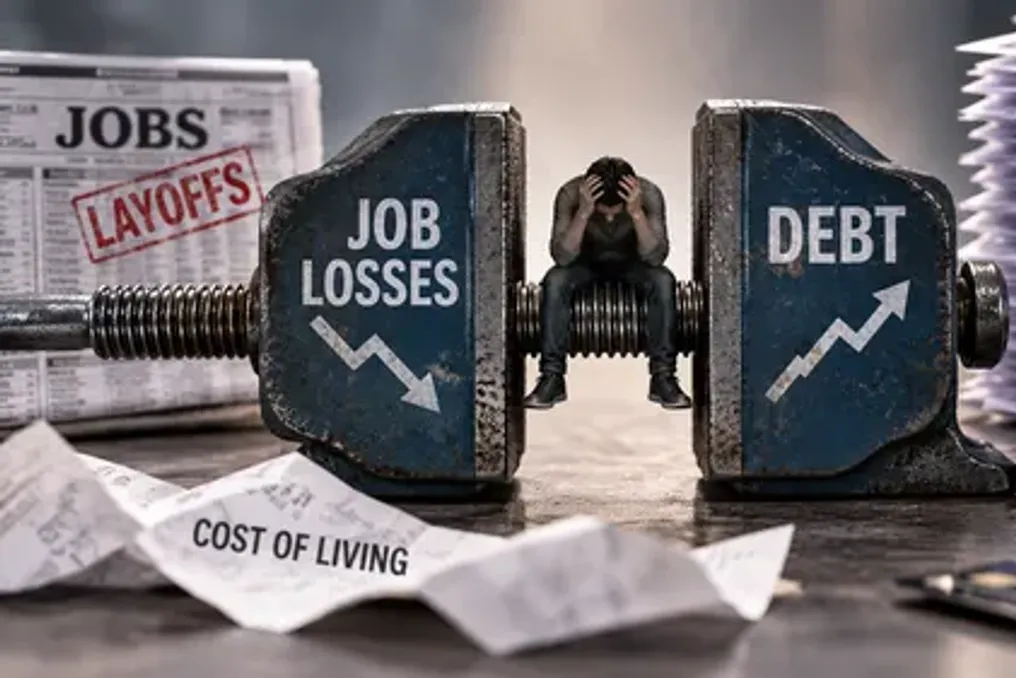
Households in South Africa are facing dual pressure from job losses and increasing debt burdens. According to new data, 190,000 jobs were lost in the formal sector in the first quarter, and even high-earning individuals are increasingly seeking assistance due to unmanageable debts.

The latest Altron FinTech Household Resilience Index (AFHRI), published on Wednesday, showed that household financial health remained stronger than a year ago, supported by lower interest rates. However, the situation weakened during the quarter due to pressures on employment, private sector wages, and consumer spending.

The index indicates that the loss of 190,000 jobs in the formal sector was one reason for the sharp rise in life insurance policy surrenders. Life policy surrenders increased by 24.3% year-on-year and by 3.9% quarterly.

Altron FinTech Manager, Johan Gellatly, noted that employment is a key factor in the current state of household finances. He stated: 'Employment in the formal sector dropped by 190,000 in the first quarter, and this number drives the rest of this index. This is why life policy surrenders rose by more than 24% year-on-year, and why household income and expenditure decreased during the quarter, despite an improvement in the overall picture year-on-year.'

Lack of funds

Gellatly added that households are not in difficulty due to overspending, but rather due to a lack of working people. He emphasized: 'Until this economy creates formal jobs on a large scale, any growth recorded by the index is borrowed against the next shock.'

The index notes that surrendering a life policy can provide an immediate cash influx after job loss, but at the cost of a long-term financial safety net. Furthermore, the AFHRI report warns that early surrender may incur additional tax obligations and fees, which reduce the final payout.

This employment shock occurred despite some improvement in household financial health compared to a year ago. Lower interest rates helped improve the ratio of household income to debt expenditure by 5.9% year-on-year, while real household consumer spending grew by 2.6%, and real disposable income by 1.1%.

However, the quarterly picture was significantly weaker: according to the index, household consumption fell by 9.1%, private sector wages decreased by 5.1%, and real disposable income shrank by 9.7%.

Earning more, paying more

The pressure is not only felt by households that have lost income. Separate data from Debt Solutions 4U shows that even people earning significantly above the minimum wage are resorting to debt restructuring because their debt payments exceed their salary capacity.

In an analysis based on 1,913 debt review applications, one of five applicants earned over R15,000 per month, and one of eight earned over R20,000. The scale of debt increased sharply with income: those earning between R20,000 and R30,000 had a median unsecured debt of R121,134.

Simply more debt

Debt Solutions 4U debt counsellor, Rowan Bridgs, believes that higher income has effectively given consumers access to a higher debt ceiling, meaning a larger salary does not necessarily protect a person from excessive indebtedness. Bridgs noted: 'The debt that puts higher-income earners in difficulty is not accumulated in small amounts in clothing stores. It comes in large instruments issued based on a good credit history.'

Of 7,393 analyzed unsecured accounts, personal loans accounted for 59.2% of accounts and 61.7% of the outstanding balance, or R61.4 million out of R99.6 million. More tellingly, the median debt review applicant was already dedicating 57.8% of net monthly income to repaying unsecured debt before considering mortgage or car loans.

More than half, specifically 54.9%, spent over 50% of their net income servicing unsecured debt. Thus, over half of the debt review applicants spent more than 50% of their net income on repaying unsecured debt.

Buying on credit

Altron's own transaction data provides another view of this pressure. Gellatly reported that the company monitors changes in debit and credit card transactions among its clients, as such shifts can indicate how consumers are financing their expenses. He explained: 'If credit card purchases are rising, it means people are having problems because they are spending money they don't actually have and hope to pay it back next month.'

Altron does not see individual products purchased by consumers. Its transaction data contains information such as the value and geographical location of payments, while retailers retain details of the customer's basket contents.

Credit products

Nevertheless, Gellatly noted that general spending patterns indicate that households are increasingly concentrating their funds on essential goods. 'People are spending money on necessities to support their families' lives and nutrition.'

AFHRI warns that higher fuel prices and rising unemployment are threats to household resilience, while production is struggling, foreign tourist arrivals have declined, and construction remains sluggish. Retail, agriculture, vehicle sales, mineral exports, and investments in energy and logistics may offer some support, but the index gives the greatest weight to formal sector employment and remuneration.

Fuel price hike in South Africa creates financial pressure on households
Read more
iol.co.za

Fuel price hike in South Africa creates financial pressure on households

Drivers in South Africa are facing a sharper increase in fuel prices, which took effect on September 2nd. These increases place additional strain on an economy already struggling to maintain stability, complicating the achievement of the National Treasury's modest growth forecast of 1.6% by 2026.

The current price situation is as follows: Petrol 93 and Petrol 95 have increased by 1.34 rand per liter. Meanwhile, wholesale prices for diesel fuel rose by 2.94 rand and 3.15 rand per liter, respectively, and the wholesale price for kerosene increased by 2.13 rand per liter. Domestic prices are now 26.76 rand for Petrol 93, 26.92 rand for Petrol 95, 29.11 rand for diesel fuel 500 ppm, 30.05 rand for diesel fuel 50 ppm, and 20.89 rand for wholesale kerosene.

Although some families may be able to cope with this shock, most will not. One of the main factors behind the sharp rise in fuel prices is the conflict between the US and Iran, which shows no signs of easing despite periodic peace talks. The recovery of fuel prices remains a distant prospect.

Furthermore, 17.8 million households in South Africa are expected to face a cumulative price increase due to these fuel surges. While the average household income is 17,030 rand per month, the median income is only about 7,981 rand, meaning half of all households earn less than this amount. The Consumer Price Index (CPI), compiled by Statistics South Africa (Stats SA) and published in June, showed continued consumer price growth, further reducing purchasing power.

Since food already accounts for a significant portion of low-income families' budgets, repeated fuel price increases, which affect the cost of production and transportation of goods, could intensify pressure on food prices and reduce the funds available to families for other essential needs.

Consequences of global pressure

Dr. Mpho Lenoke, senior lecturer at the School of Economics in the Faculty of Economic and Management Sciences at the North-West University (NWU), notes that the increase in fuel prices, driven by global economic pressure, will lead to higher transport costs and prices for essential goods, with the greatest burden falling on low-income households.

South African Households Face Cost of Living Crisis Due to Rising Essential Goods Expenses
Read more
iol.co.za

South African Households Face Cost of Living Crisis Due to Rising Essential Goods Expenses

Households in South Africa are experiencing severe difficulties managing monthly budgets as expenses for utilities, transport, and food consume an increasing share of their income, turning the cost of living crisis into a struggle for survival for families.

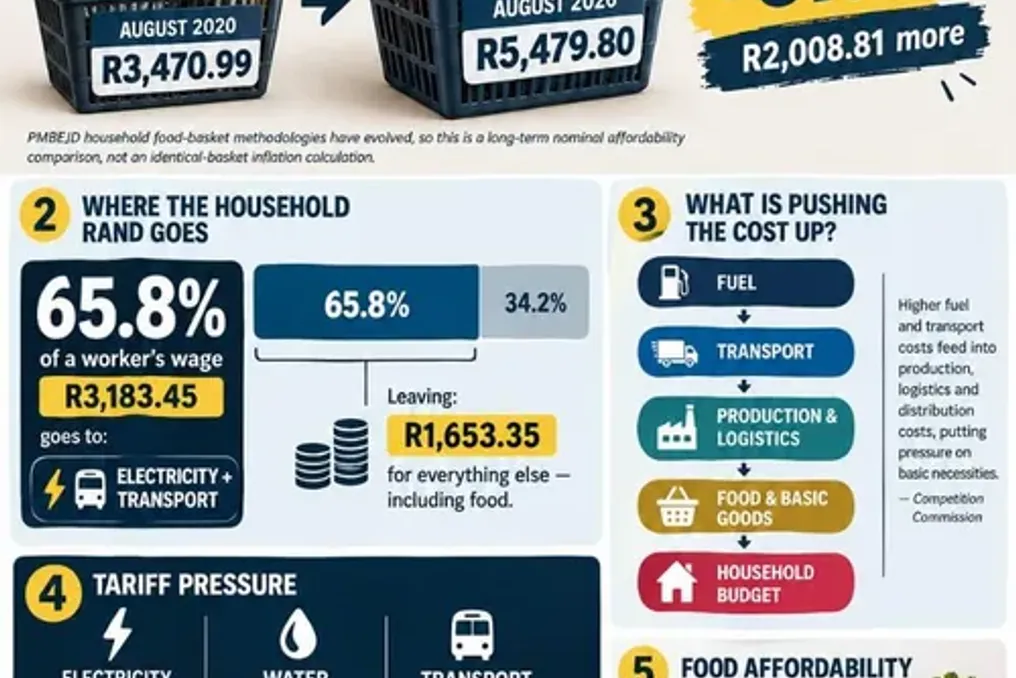
Recent data on household affordability demonstrates this problem, despite a seemingly lower overall inflation rate. In August, the average cost of a food basket was R5 479.80, according to the Pietermaritzburg Economic Justice and Dignity Group (PMBEJD). Although this amount was 0.9% lower than in July, it remained 1.8% higher than a year ago. Of 44 tracked products, 19 increased in price, while 25 decreased.

The group's director, Marvin Abraham, notes that families do not receive income but rather allocate money across fixed expenditure items: food, electricity, and transport. They first pay for the most essential things that cannot be avoided.

Abraham emphasizes: 'Households do not receive income and do not allocate fixed amounts for food. First, they pay for absolute necessities: rent or mortgage, electricity, transport.' He adds that the food budget only appears after these basic expenses are covered, and purchases are made with the remaining funds, which often leads to buying smaller quantities and less nutritious food.

The group's calculations show how little is left of 'what remains.' In August, R3 183.45 was spent on electricity and transport, accounting for 65.8% of a worker's salary, leaving R1 653.35 for food and other necessities. Thus, the affordability crisis is related not only to the price of bread, chicken, or maize meal, but also to the competition between several unavoidable expenses for the same income.

The Competition Commission's report for August 2026 also highlights the current pressure, warning that fuel price shocks have consequences far beyond petrol stations. The Commission points out that the first half of 2026 was characterized by a 'significant increase in fuel costs,' driven by geopolitical tensions and disruptions in global oil supply chains, exacerbated by exchange rate pressure.

The Commission notes that the rise in fuel and transport costs has spread not only to commuting but has also increased production, logistics, and distribution costs across the economy, putting upward pressure on essential goods. The Commission believes that the task is to balance the financial sustainability of vital services with the burden on households, especially when tariffs rise faster than inflation, and vulnerable populations do not receive effective support.

For workers, the problem boils down to whether income can keep pace with rising prices. Abigail Moyo, a representative of the United Association of South Africa (UASA) union, stated that households are already on the brink of collapse. She added that the rise in fuel prices will only intensify the financial pressure on ordinary South Africans whose budgets are already severely strained.

Moyo argued that the solution cannot be to expect workers to absorb the increased costs themselves. She noted that the adjustment of fuel prices is the reason why UASA and its members in the sugar sector went on strike to fight for wage increases and benefits that match inflation. She called on the government to review fuel pricing mechanisms, including fuel and excise taxes, and employers to recognize inflation-linked salary indexing as necessary for workers' survival amid the rising cost of living.

Pensioners feel particular pressure. At SASSA offices in Wentworth, Durban, pensioners are demanding an increase in the old-age grant to R5 000 per month, arguing that the current amount does not cover basic living needs. The maximum old-age grant is R2 400 per month, and for recipients over 75 years old, it increases to R2 420. Pensioner Quinton Eri describes the situation as extremely difficult: 'We barely make ends meet on R2400. Our water bill keeps going up. We go to Sasa, and then sometimes we sit here for two or three days because they don't work. Life has become a huge struggle. You can't even afford to buy the food you eat. The food we buy is not enough. So we worry about where the next meal will come from.'

He also noted that even buying meat has become a luxury, as people are forced to eat chicken because they cannot afford mutton or beef. Social activist Jean Chodry stated that pensioners are forced to cope with the responsibilities of supporting other family members. He insisted that pensions should be doubled at least, as besides themselves, they care for grandchildren, have utility bills, rent, and groceries.

A petition launched by Jay C Alex titled 'Support South African Pensioners to Restore Dignity and Respect' has gathered over 33,000 confirmed signatures calling for increased support for pensioners struggling with food, medicine, and electricity shortages.

The consequences extend to children. The group calculated that the basic nutritious basket for a family of seven cost R6 597.25 in August, and the average cost of providing one child with a basic nutritious diet was R961.96, while the child grant is R580. Abraham warned that when households are forced to sacrifice nutrition, the consequences go far beyond the monthly grocery bill. He described it as an intergenerational poverty trap that starts right at the table of young children under five. For him, relief cannot come solely from lowering food prices; a significant impact on the quantity of food purchased will come from reducing electricity and transport costs.

Popular