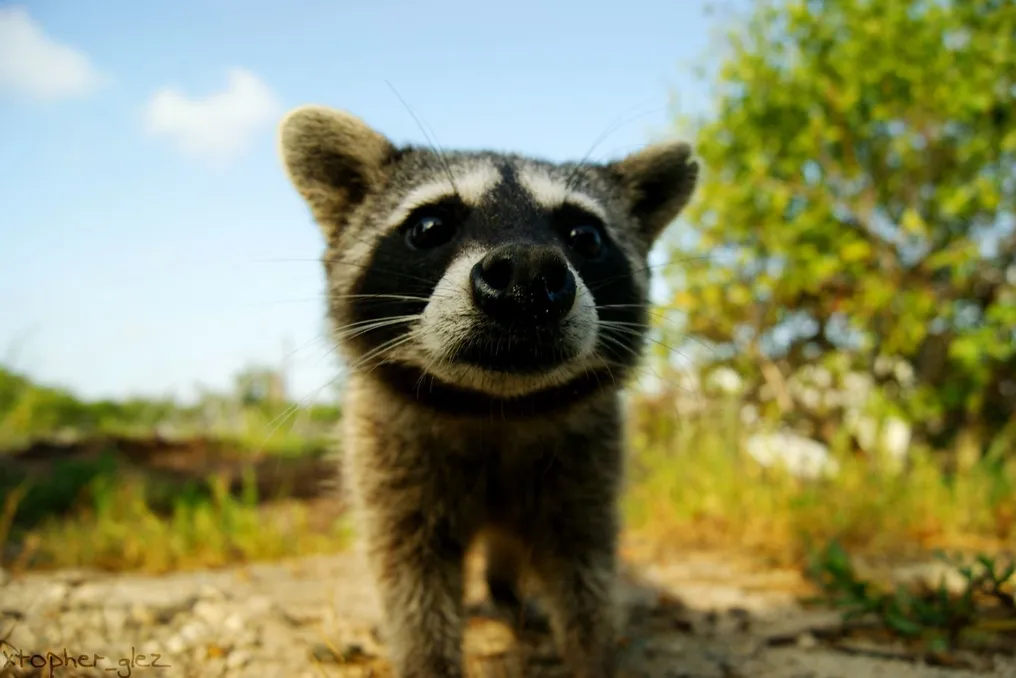
On the Mexican island of Cozumel, located in the Caribbean Sea, lives the pygmy raccoon, a remarkable and rare creature. Although similar to the common raccoon, this small mammal is distinguished by its yellowish-gray fur, black spots around its eyes, and a dark band on its throat. Currently, the species faces a critical situation, with estimates indicating that only about 200 individuals remain in the wild.
The existence of the pygmy raccoon is restricted to the island of Cozumel, a place globally known for its coral reefs, clear waters, and as the main stopover point for cruise ships in Latin America. It is common for these animals to be seen scavenging through trash cans looking for food scraps among tourists.
However, in January of this year, tourists witnessed unusual behavior. A young raccoon chose to ignore the food waste in a trash can and instead picked up a receipt. It then carried the piece of paper to a bowl of water, where it repeatedly dipped it and rolled it in the sand until it formed a cohesive sphere. After creation, the animal remained there, interacting with its own artifact, which is equivalent, in human terms, to making its own toy.
A subsequent study, published in the journal Wild, revealed that this act was not an isolated event. The habit appears to be a capacity passed between members of a family of pygmy raccoons. This finding represents the first documented evidence of what is called 'material culture' within the Procyonidae family, which includes raccoons, coatis, and opossums.
The concept of 'material culture' refers to the physical objects that a group produces, uses, and leaves behind; in the animal kingdom, this can include tools, clothing, toys, or even furniture. Generally, these items are learned through observing other members of the same species.
Researchers observed exactly this pattern of behavior in Cozumel. The younger sister was the first to learn how to make her own balls. The mother also tried to replicate the process but soon abandoned the activity. The authors suggest that the maternal abandonment might be related to consuming a daisy shortly before, which would have diminished her abilities.
In one of the detailed records in the article, the research team saw the two sisters playing 'football' with each other and with the mother. However, the family trajectory had a melancholic end. Shortly after the invention of the toy, the first raccoon became seriously ill and died. One of the possible causes for the animal's sudden death was malnutrition and toxic contamination caused by a new tourist complex nearby, which had damaged part of the raccoon's habitat.
With the loss of the raccoon, scientists feared the end of this tradition, since material culture depends on individuals who possess the necessary knowledge for its maintenance. However, days later, the surviving sister repeated the procedure: she used a hamburger wrapper found in the trash, moistened the object, and pressed it against the sand, thus starting to play with her new ball. The team is now eagerly awaiting to see if this skill will continue to spread among the pygmy raccoons.