Resource management such as water, air quality, and heat mitigation is often planned by large-scale systems that do not always reflect people's daily experiences. While drainage networks are hidden beneath roads and air pollution is monitored at the municipal level, the impacts of these conditions are felt more intimately: while waiting for transport under the sun, traversing flooded streets, or seeking refuge in squares under intense heat.
Rising temperatures make this topic particularly urgent. With the warming of cities, public spaces such as streets, parks, and circulation areas become places where architectural planning can mitigate exposure through the incorporation of shade, vegetation, ventilation, and water management.
The presented projects operate on a much smaller scale. They focus on collecting and filtering rainwater, purifying contaminated air, or cooling overheated public areas, using structures sized so that people can physically interact with them—whether by sheltering under them, passing through them, or remaining inside them. These environmental systems are kept visible through coverings, vegetation, filters, and reservoirs, integrating climate infrastructure into the daily use of spaces.
Making the water cycle visible
The Yaku project integrates stormwater management in an actively used public space. Developed by the firm El Sindicato Arquitectura in Isla Tortuga Park, north of Quito, this 27-square-meter module combines elements of shade, seating, vegetation, and water infrastructure into a single design.
Rainwater falling on the steel roofs is channeled, passing through porous volcanic stones, to a landscaped infiltration area. In this area, filtering substrates and an underground reservoir aid in water retention, returning some of it to the soil. The technical system is kept sufficiently visible to be understood from the park, transforming runoff into part of the structural experience.
Yaku's urban contribution lies in uniting this hydraulic function with an already established public use. The park gains greater capacity for runoff capture and infiltration, while the intervention provides resting spots, protection from sun and rain, and vegetation in an area already frequented by citizens.
Yaku was conceived as a modular prototype, capable of being replicated in other locations. Although an individual module manages only a limited amount of water, its reproducibility indicates how stormwater infrastructure could be distributed in smaller parks and public spaces throughout the city. Furthermore, the local community participated in the project's development through community engagement meetings, connecting the prototype to the park's regular users.
Treating heat and air as a material condition
Although heat and air pollution are less perceptible than stormwater runoff, their effects are felt instantly. Three initiatives in Bangkok, Logroño, and London directly address these conditions through small structures designed to accommodate human presence.
In Bangkok, the Safezone Shelter, created by Shma Company Limited, was erected for Bangkok Design Week 2020 as a small refuge from excessive heat and polluted air. Fans force air through vegetation, filtration, and cooling systems before releasing it into the occupied area, providing a cooler and cleaner breeze.
The relevance of this pavilion lies in the fact that air treatment integrates into the space itself. The filtration system is arranged around seating, shade, and vegetation, making the environmental benefit experienced during the use of the location. A service typically restricted to interiors is implemented in a public area, creating a small zone of purer and cooler shared air.
On an urban scale, this action expands environmental control to locations that traditional construction methods rarely reach. A shelter with air filtration can offer momentary relief to people waiting or moving outdoors, introducing a function usually associated with enclosed buildings into public space.
The Shade, Breeze, Cooling project, developed by the noof group, employs shade, airflow, and fine mist in a public waiting area in Logroño. As the mist evaporates, it absorbs heat from the surrounding environment, generating a localized cooling effect. The location is strategic, placing the intervention where people naturally stop, cross, and wait, making cooling part of an existing urban routine. The impact is immediate, reducing exposure during brief periods when someone remains stationary or seated outdoors.
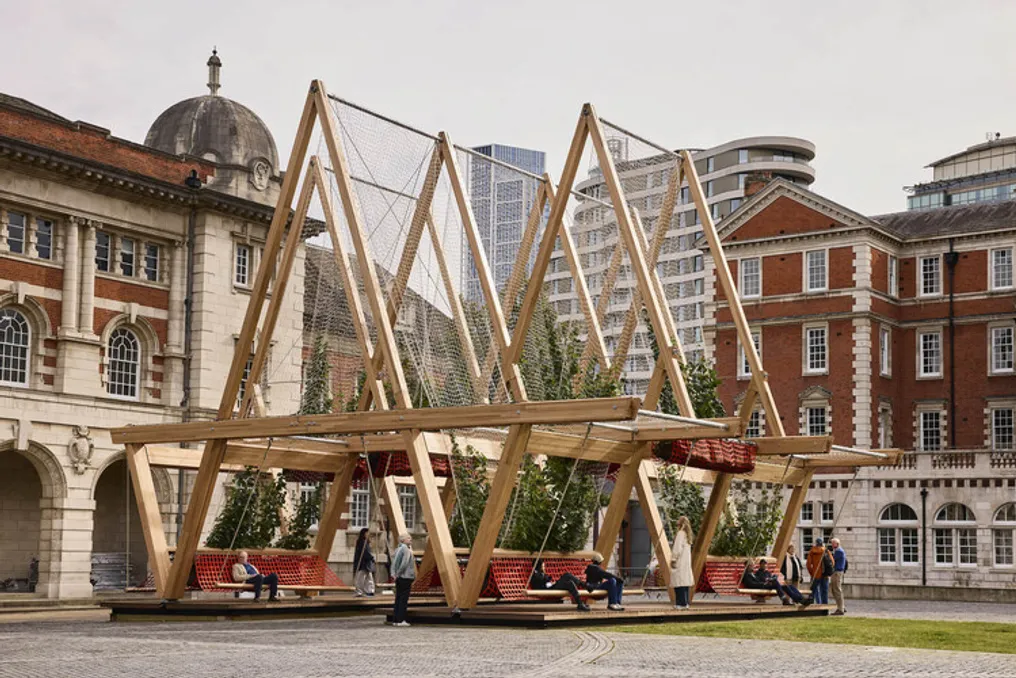
In London, the Vert—designed by Diez Office, OMC°C, and American Hardwood Export Council—combats heat using vegetation. Installed at the Chelsea School of Art during the London Design Festival, the modular wooden structure supports climbing plants on suspended nets, forming a vegetative canopy intended to protect people underneath. It is estimated that this vegetation can cool the surrounding air by up to eight degrees Celsius, offering significantly more shade than a young urban tree. This gives the structure a vital role in areas with little mature tree canopy or where tree development will take years.
These three projects illustrate the potential of climate infrastructure when it acts directly on the conditions experienced on the streets. A filtration pavilion can extend clean air beyond an enclosed environment; a misting structure can make a waiting area more tolerable during heatwaves; and a vegetative canopy can provide shade where mature vegetation is absent or still in its initial stages.
The value of these projects lies in their location. Corners, traffic areas, squares, and other waiting points may hold someone for only a few minutes, but it is precisely in these moments that heat and poor air quality become difficult to manage. Small-scale structures can concentrate environmental performance exactly at these points of greatest exposure.
Acting at the street level
It is important to note that none of these four projects alone solves the challenges of water, heat, or air quality in a city to the magnitude these problems manifest. A 27-square-meter stormwater module does not replace a complete drainage network, an air filtration shelter will not eradicate urban air pollution, and a single vegetative canopy will not cool a metropolis during a heatwave.
The importance of these works lies in a distinct scale of intervention. Each project inserts an environmental function directly into an existing pattern of use. Stormwater management becomes part of a park; air filtration transforms into a seat; and evaporative cooling and living shade integrate into places where people already wait or spend time.
This changes how infrastructure presents itself in public space: it becomes visible, accessible, and intrinsically linked to the characteristics of a specific location. Additionally, it can reach parts of the city where dedicated large-scale climate infrastructure would never be able to get.
The complexity lies in how these prototypes articulate with the larger systems surrounding them. Their reduced scale limits the reach of a single unit, but simultaneously allows environmental functions to reach specific parks, sidewalks, circulation zones, and waiting points. Thus, the urban potential of these projects fundamentally depends on how these interventions will be adapted and distributed across various urban points.
Taken together, they demonstrate what climate infrastructure can achieve when it reaches the scale where environmental conditions are effectively experienced: whether through coverage over a bench, air inside a shelter, shade over a waiting area, or soil receiving precipitation under a park.
}, 2. {