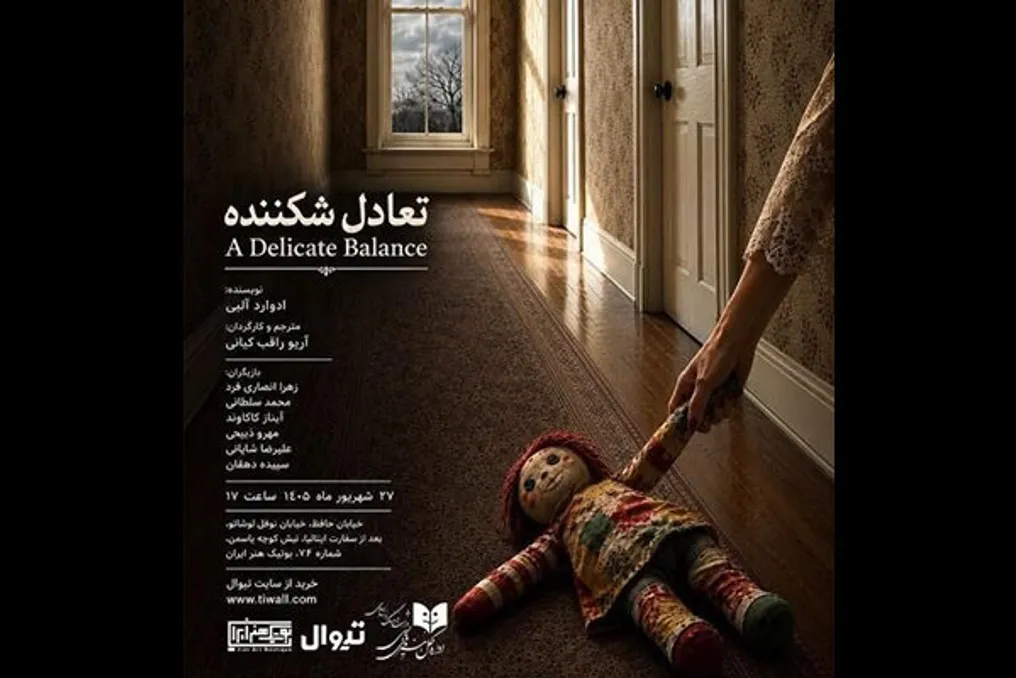
Iranian director to present Edward Albee's play 'Fragile Equilibrium'
Read more
Tehran Times
www.tehrantimes.com

Iranian director to present Edward Albee's play 'Fragile Equilibrium'

Iranian director Ariu Rakeb Kiani plans to stage a reading of the acclaimed American playwright Edward Albee's play 'Fragile Equilibrium' at the Iran Art Boutique gallery in Tehran on Friday.

The production will feature actors Zahra Ansarifard, Mohammad Soltani, Aynaz Kakavand, Mahru Zabihi, Alireza Shayani, and Sepide Dehkhan.

'Fragile Equilibrium' is a three-act work written between 1965 and 1966 and first performed in 1966. It won the Pulitzer Prize for Drama in 1967, making it the first of three such awards Albee received throughout his career.

The play primarily takes place in the home of a wealthy suburban couple, where family conflicts, emotional isolation, fear, marriage, and the fragile mechanisms people create to maintain a sense of stability are explored.

The central plot focuses on Agnes and Tobias, a middle-to-upper-class couple over fifty, whose seemingly comfortable life is disrupted by the arrival of Agnes's witty but alcoholic sister, Claire, who becomes a permanent guest in their home. Agnes often ponders the possibility of losing her sanity and the difficulty of maintaining order in a house where everyone carries emotional trauma and unspoken resentments. Meanwhile, Tobias continues to suffer from the death of their young son many years ago, which continues to affect his marriage and relationship with his wife.

The family's unstable routine is interrupted by the unexpected visit of Agnes and Tobias's old friends, Harry and Edna. This retired couple experiences fear of an undefined and inexplicable threat. Unable to precisely describe their horror, they ask Agnes and Tobias to let them stay. Their arrival immediately sparks conflict, especially because Agnes and Tobias's daughter, Julia, returns home after the collapse of her fourth marriage.

Julia, aged 36, feels bitterness and disappointment upon discovering that Harry and Edna have taken her former bedroom. Already dissatisfied with her parents and deeply unsatisfied with her life, she becomes increasingly hostile towards the unexpected guests. Her anger exposes long-standing tensions within the family, while Claire's drunkenness and sharp remarks add another layer of discomfort to the house.

As Harry and Edna settle in, the question of their continued stay becomes harder to ignore. Julia insists they leave, while Edna argues that she and Harry have the right to stay due to their close friendship with Agnes and Tobias. The conflict reaches a tense point when Julia returns armed and demands that the couple leave. Despite this, Edna insists that they belong in the house and are willing to stay if necessary.

The family members gradually confront the reasons for Harry and Edna's visit, as well as their complex relationships. Agnes recalls the death of her son and the painful decision Tobias once made to prevent another pregnancy. Suspicions also arise regarding Tobias's past infidelity, revealing how much unresolved pain is hidden beneath the carefully maintained surface of the family.

After a sleepless night, Tobias finally speaks with Harry about the situation. Harry admits that if circumstances were reversed, he and Edna might not have taken Agnes and Tobias into their home, despite their friendship. Tobias admits that he doesn't actually want them to stay but believes that as friends, they have the right to be there. In the end, Harry and Tobias begin packing the couple's belongings back into the car.

The play concludes with Agnes's reflections on the fragile balance governing their lives. Her thoughts suggest that darkness, fear, and emotional instability are inevitable components of human existence, while light represents a temporary return to order. Albee leaves the characters—and the audience—in a state of suspension between these opposing forces, emphasizing how easily the delicate structures of family and social relationships can be disrupted.
Similar stories

Review of Current Art Exhibitions in Tehran Galleries
Read more
www.tehrantimes.com

Review of Current Art Exhibitions in Tehran Galleries

A number of art exhibitions featuring the works of Iranian artists in various formats—painting, graphics, and multimedia—are currently taking place in Tehran galleries.

What is on display in Tehran's art galleries

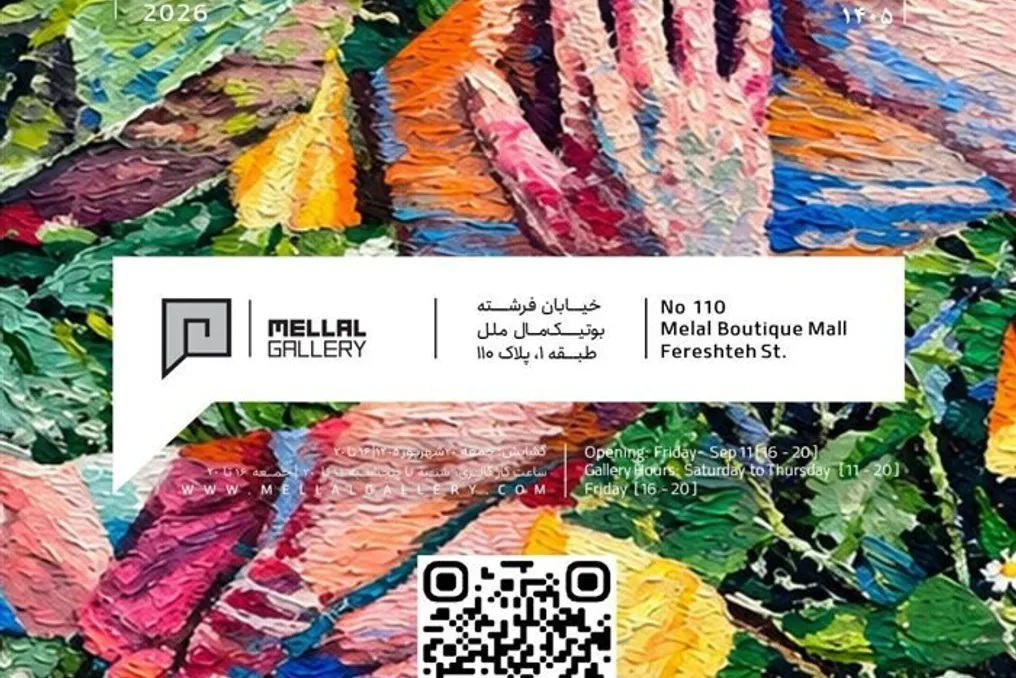
The Melal Gallery is hosting an exhibition of paintings by a group of Iranian artists titled 'Between Earth and Sky.' This exhibition will be available to visitors until October 9th and is located at the Melal Cultural Center in the Keytarie district.

The Sharif Gallery is showcasing an exhibition of paintings by Mostafa Emami, titled 'Dream of Peace.' This exhibition runs until September 18th and is located at Mahrouzade Street, 11, Shariati Avenue, near Quds Square.

Sonia Salemi is presenting her latest paintings at an exhibition in the Vaali Gallery. The exhibition, titled 'Monument and Other Works,' will conclude on September 22nd and is held at the gallery located at Hoddami Street, 72, Vanak Square.

Kader Mansouri is exhibiting his recent paintings at the Bavan Gallery. The exhibition will run until September 28th and is located at the gallery at Abdo Street, 7, next to Larestan Street, Motahari Avenue.

Marjan Tomar's collection of paintings is featured in the Homa Gallery exhibition titled 'Until Tomorrow.' This exhibition will last until September 22nd and is located at the gallery at Sanai Street, Alley 4, House 8, Karim Khan Avenue.

The Keyman Gallery is hosting an exhibition of paintings by Maria Esteki titled 'Between Two Worlds.' The exhibition will run until September 20th and is located at the Gallery at Ahgari Street, 10, in the Elakhiyeh district.

The White Line Gallery is displaying drawings by Parjama Parsi in an exhibition. The exhibition will run until September 22nd and is located at the gallery at Parvin Street, 22, near Jame Jam Street, Vali-e Asr Avenue.

The Liam Gallery is showing sculptures and paintings from a group of artists in an exhibition titled 'Ishtar 2.' This exhibition will run until September 25th and is located at the gallery at Fati Shakaki Street, 118, near Salmas Square.

Paintings and photographs by Pegah Bahador and Amir Isfandiari are currently viewable at the O Gallery exhibition titled 'Freshly Cut Flowers.' The exhibition will continue until September 22nd and is located at the gallery at Shahin Street, 8, Sanai Street.

Iranian Children's Theatre Festival Announces Sections and Opens Submissions
Read more
www.tehrantimes.com

Iranian Children's Theatre Festival Announces Sections and Opens Submissions

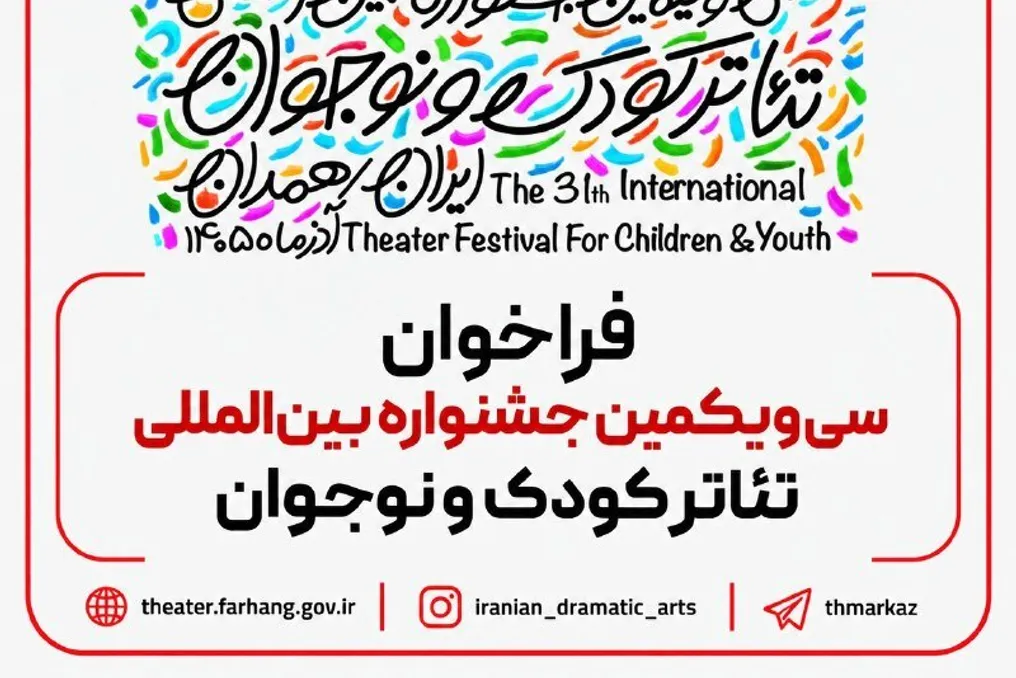
An invitation has been published for submissions to the 31st International Festival of Theatre Art for Children and Youth of Iran. The festival is scheduled to take place from November 29 to December 4 in the city of Hamedan and will be overseen by Iranian theatre figure Marzieh Borumand.

The event operates under the slogan 'The well-being of today's children is the well-being of tomorrow's Iran' and will feature eight different categories. These include competitions for theaters for toddlers, children, and youth, as well as sections for street and alternative performances, dramaturgy, international productions, international theatre, academic seminars, and experience exchange sessions.

The festival accepts both previously staged and premiere-ready productions. The competition for toddler theatre places special emphasis on the active participation of young audiences in the performance process, the use of understandable imagery and language, and an appropriate running time. Up to seven productions will be selected, with preference given to those suitable for presentation in kindergartens, play centers, educational institutions, and similar venues.

Competitions for children and youth will also accept up to seven productions each. The section dedicated to street and alternative forms will cover theatrical works presented outside traditional theatre halls, accepting up to seven productions. The dramaturgy competition focuses exclusively on the theme of 'water and its significance for sustainable development, the resilience of Iran's land, and the necessity of water resource conservation.' Participants must provide a one-page synopsis along with their plays; previously staged or published works are not eligible for entry.

Furthermore, a non-competitive guest section will be organized, featuring productions selected by the festival director. Specialized festivals of children's and youth theatre may nominate their best works for consideration in this section. The international theatre section is intended for productions created by non-Iranian theatre groups.

Submissions to all sections must be made online via the festival website icy.theater.ir, attaching the required documents. Submissions will only be accepted during the specified registration period. Video recordings of performances can be uploaded via Google Drive links. These videos must be of sufficiently high quality for the selection committee to clearly assess the production and its artistic details; the festival secretariat does not impose specific requirements on filming methods.

For registration in all sections, written permission from the playwright, translator, or publisher is mandatory. Any production lacking the required permission at any point will be disqualified. The festival secretariat recognizes only the production's director as its artistic owner and leader of the participating group. Only complete video recordings of productions are accepted for the competitive sections. Each applicant may submit a maximum of two productions, but they can only participate with one work and in one section at the final festival.

Works that have participated in previous editions of the festival will not be accepted unless they have undergone substantial and obvious changes in staging structure, scenography, set design, or other artistic elements, and an updated version is presented. Registration begins on September 6 and ends on October 17. The deadline for submitting plays for the dramaturgy competition is November 1, and the results of advancing productions to the next stage are planned to be announced on November 1.

The International Festival of Theatre Art for Children and Youth of Iran is one of the country's major cultural events dedicated to theatre for younger audiences. Held annually, the festival brings together Iranian and international theatre groups, providing a platform for productions created for toddlers, children, and youth. In addition to competitive categories, it includes international and guest performances, street and alternative theatre, dramaturgy, as well as educational and research programs, aiming to promote creativity, cultural exchange, and new approaches to theatre for the younger generation.

Popular