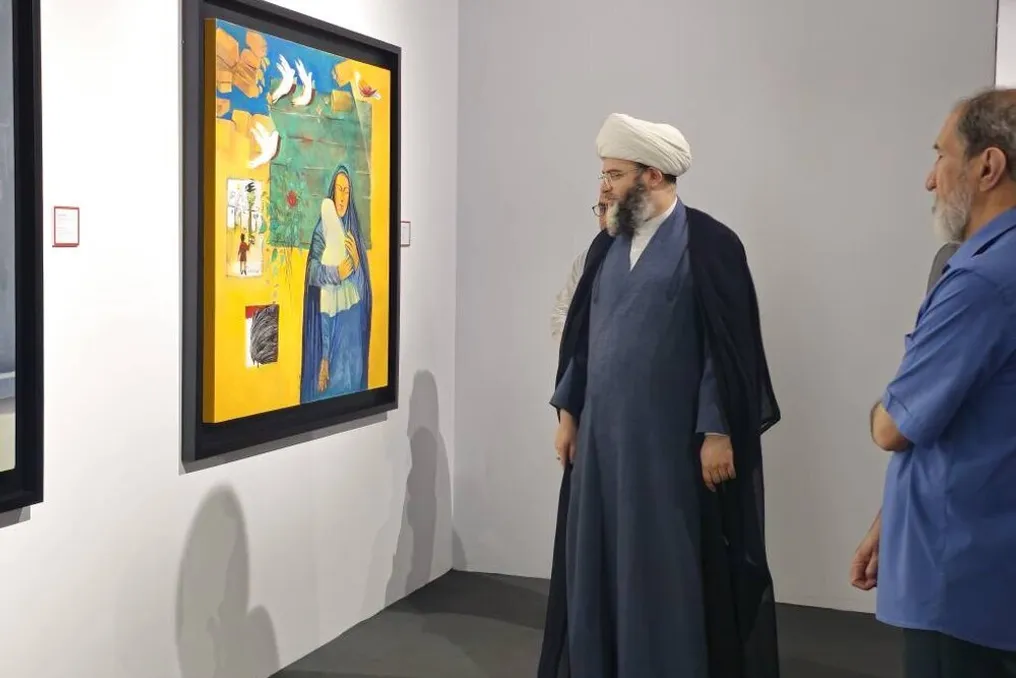
Hojjatoleslam Mohammad Qomi, head of the Iranian organization for the dissemination of Islamic ideology, visited the group exhibition 'Minab School' on Saturday, which was held at the Art Bureau in Tehran. During his visit, he called for artworks dedicated to the tragedy in Minab to be presented internationally.
During his visit, he met with several participating artists, discussing their works and views on the events related to Minab. The artists explained the methodology of their work and stated their needs and requirements for more effective creation and display of works concerning this topic.
Hojjatoleslam Qomi expressed gratitude to those who contributed to the organization of the exhibition, as well as to the artists who created works focused on Minab. He stated that he values the efforts of the organizers and those working on the Minab theme, emphasizing that dedicated artists are expected to continue their creative work on this subject.
He also highlighted the importance of support and subsequent follow-up for such artistic projects. Qomi described artistic approaches to war crimes as an effective way to raise awareness and influence public opinion globally. He noted that the Art Bureau is responsible for supporting such works, but its main priority is ensuring the effective and proper international presentation of materials related to Minab.
He particularly stressed that these works should be shown in places such as the United Nations and institutions that are sources of important international decisions. Qomi added that the Islamic Organization for the Dissemination of Ideology will do everything possible within its authority to facilitate the international presentation of these works and will seriously address this issue.
The 'Minab School' exhibition features works by a group of Iranian artists who have reflected on the tragedy in Minab through various artistic forms and perspectives. Among the featured artists are Behzad Shisegaran, Cyrus Mokaddam, Holam Ali Taheri, Mortaza Asadi, Kazem Chalipa, Ali Nedai, Hassan Yakuti, Abdolhamid Ghadirian, Mostafa Gudarzi, Nasser Saifi, Jamshid Hakikatshenas, Seyed Masoud Shojai Tabatabai, Kamyar Sadeghi, Seyed Ali Mirfatta, Mahyar Charmchi, Mostafa Korbani, Hossein Einibakhsh, and Mohammad Ali Naderi.
The exhibition is currently running at the Art Bureau gallery and will last until September 22. It is open to visitors daily from 9 am to 8 pm.
It should be recalled that on February 28, the Shajareh Tayebe girls' school in Minab, Hormozgan province, became the site of a devastating massacre after the United States and Israel began their strikes on Iran. While dozens of girls and boys aged 7 to 12 were starting lessons, the school was hit by a missile strike that caused the building to collapse, burying children and teachers under the rubble. Iranian authorities confirmed the final death toll at 168 people, with at least 95 injured, making it one of the most horrific incidents in the early days of the conflict.
Despite attempts by US and Israeli authorities to distance themselves from this massacre, while images of the tragedy were circulating on social media, detailed forensic and digital investigations revealed a completely different picture. An analysis conducted by Al Jazeera's digital investigations unit using satellite imagery over more than a decade and recent video clips showed that the school was clearly a separate civilian object, isolated from any neighboring military targets for at least ten years. Furthermore, witness testimonies and satellite analysis confirmed that the school was struck by three separate, deliberate attacks, leaving no doubt about the nature of the attack.
The international community is facing a growing body of evidence regarding responsibility for this atrocity; investigations by leading global publications, including The New York Times, BBC Verify, CBC, and NPR, have concluded that the United States is responsible for the strike. These findings raise fundamental questions about the information used to justify the bombing, as the nature of the strike indicates a targeted attack on a civilian educational institution. The tragedy at Minab School now serves as a grim testament to the enormous human cost of aggression and is becoming a focus for those demanding international accountability.