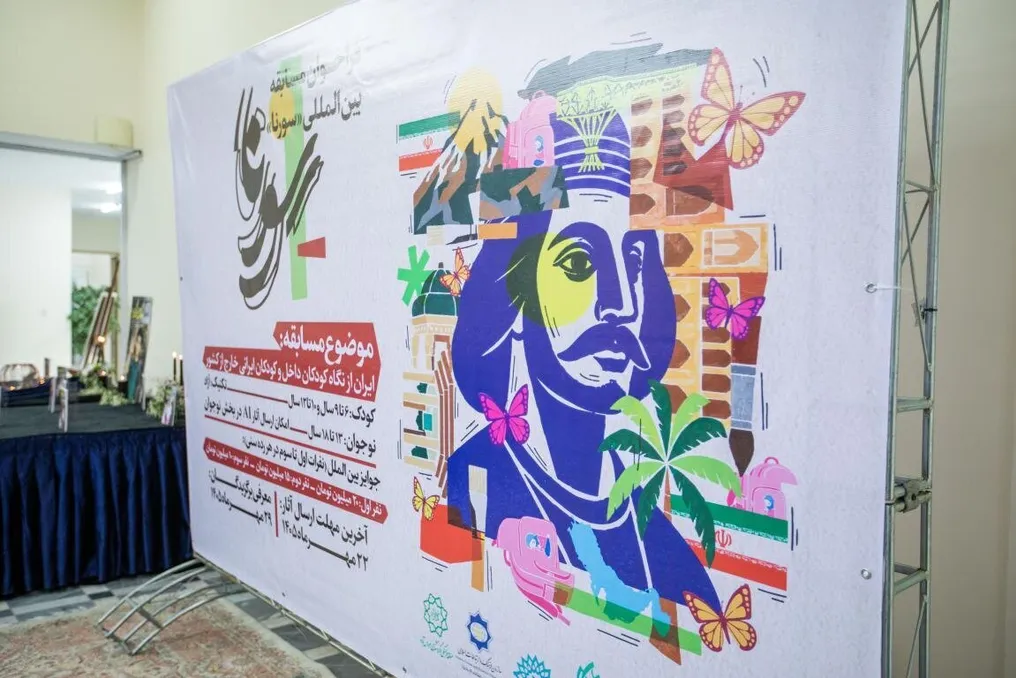
The opening ceremony and press conference for the Sorena International Painting Competition took place in Tehran. The theme of the competition was set as 'Iran through the eyes of Iranian children, both inside and abroad, as well as children from around the world.'
The event was held on Sunday at the Islamic Culture and Relations Organization (ICRO).
The competition is organized with the participation of the Abbasabad Cultural and Tourism Zone, the General Directorate for the Affairs of Iranian Diaspora at ICRO, the Artistic Bureau of the Islamic World Organization, and the Kian Iranian Smart Technologies Development Group (iGap messenger). According to the ILNA agency, the main focus of the competition is on the children killed at Shajare Tayyibeh School in Minabe.
Several representatives spoke at the conference: Sayyed Mohammad Hossein Hejazi, CEO of the Abbasabad Cultural and Tourism Zone; Hojjatoleslam Ali Ahadi, CEO for the Affairs of Iranian Diaspora at ICRO; Hossein Divsalar, Deputy for Scientific and Cultural Cooperation Development at ICRO; Ali Janbaz, CEO of Soureh Omid at the Artistic Bureau; and Rabiei, deputy of the iGap messenger. They provided clarifications regarding various aspects of this event.
Hojjatoleslam Ahadi emphasized that Iranians living abroad remain part of Iranian society, and their participation in the country's cultural life is of great importance. He noted that many of these compatriots live outside Iran for educational or work reasons, and many programs have been planned in recent years to maintain and strengthen their ties with their homeland.
Ahadi also reported that the first esports league specifically for Iranians abroad was developed and launched in recent weeks, expressing hope that such initiatives will contribute to promoting Iranian culture and art.
Mohammad Hossein Hejazi added that if the potential of Iranian art, the role of children in the future of the country, and the issue of peace and the unjust war against Iran need to be highlighted, then the children of Minabe are a vivid example for expressing these ideas.
Ali Janbaz, for his part, stressed the need to include this event in world memory, asserting that this tragedy must be recorded as one of the serious crimes of the United States against humanity. He warned that if such events are not properly documented and monitored, there is a risk of recurrence, and the efforts of Iranians abroad played an important role in globalizing the crime against the children of Minabe.
Janbaz continued that one cannot remain only at the stage of mourning in the face of this incident; action must be taken. He stated that painting, as one of the international languages, can play an important role in immortalizing this story, and the innocent and oppressed story of the children of Minabe can be presented in international judicial bodies.
Rabiei, deputy of the iGap messenger, discussed the possibilities of the messenger covering the Sorena competition, noting that with 30 million installations and seven million active users, iGap is capable of conveying the message of this event to a wide range of Iranians both inside and outside the country.
Hossein Divsalar continued the meeting by drawing attention to the role of narrative in shaping historical memory. He emphasized that history consists not only of a series of events, but often the way an event is told can be more important than the event itself. He warned: 'If the narrative of an event is not addressed, over time the positions of the oppressor and the oppressed, the victor and the vanquished, may change, leading to a different perception of reality.'
Divsalar noted that a large number of young schoolchildren were affected in Minabe, which distinguishes this incident from many other historical examples. He compared it to Hiroshima or the Vietnam War, where women and children died, but they were not the sole target of the attack, whereas in Minabe, the children in the school became a direct target of the crime.
He also stated that Iran is not an aggressive country, but defends itself and its homeland against threats, and having defense capabilities is critically important for the country. Emphasizing the importance of soft power, Divsalar noted that today both military might and soft power are important, being equal components of a country's authority. He concluded that Iran possesses a vast cultural heritage, and cultural diplomacy can present the image of a strong Iran to the world alongside military power. He specifically highlighted that the Sorena event is named after a child killed in Minabe and can effectively reflect some of the US crimes against Iranian children internationally.
The Sorena International Painting Competition provides cultural and monetary prizes for winners, and judging will be carried out by the Artistic Bureau for children and adolescents. Organizers announced that the selected works will be exhibited in various countries after evaluation, and an exhibition of the competition's works will also take place at the Tabiat Bridge.
At the end of the ceremony, a poster for the event was presented.
It should be recalled that on February 28, the Shajare Tayyibeh Primary Education School in Hormozgan province became the site of a devastating massacre when the United States and Israel began their strikes on Iran. While dozens of girls and boys aged 7 to 12 were starting lessons, the school was hit by a missile strike that collapsed the building, burying children and teachers under the rubble. Iranian authorities confirmed the final death toll—168 people, with at least 95 injured, making it one of the most horrific incidents of the first day of the conflict.