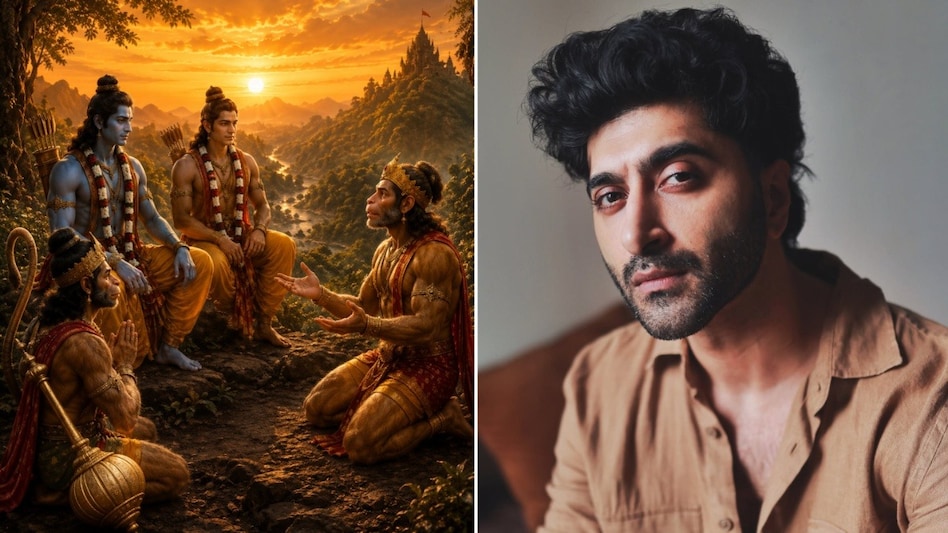
First song from the film 'Ramayana' to be released for Ganesh Chaturthi, featuring Arijit Singh's voice
Read more
Aaj Tak
www.aajtak.in

First song from the film 'Ramayana' to be released for Ganesh Chaturthi, featuring Arijit Singh's voice

Fan anticipation is ending with a major and exciting update regarding one of Bollywood's most awaited films—'Ramayana: Part 1'. Ranbir Kapoor, Sai Pallavi, and Yash will star in this grand production.

The producers have announced the release of the first musical track on the occasion of the sacred festival of Ganesh Chaturthi, significantly boosting public interest. The film's musical journey will officially begin, with the theatrical premiere scheduled for Diwali 2026.

According to an official announcement from the creators, on Ganesh Chaturthi morning at 7:30 AM, the poster for the film 'Sita Raam' will be unveiled. Immediately following this, viewers will see the first scenes of the first musical piece, titled 'Jai Jai Ram.'

The creators believe that any good endeavor should be accompanied by a sacred invocation, which is why the start of this musical journey is set for this special festival.

The film's soundtrack promises to be exceptional, as it features outstanding figures from the industry. The music for the song 'Jai Jai Ram' was composed by Oscar laureate A. R. Rahman, and the lyrics were written by the renowned poet Dr. Kumar Vishwas. The songs will be performed by Shreya Ghoshal and Arijit Singh.

The film 'Ramayana', which is being shot with the participation of Namit Malhotra, is directed by Nitish Tiwari. In the film, Ranbir Kapoor plays Lord Rama, Sai Pallavi plays Mata Sita, and Yash plays Ravana. This track and poster will be released on the official channels of T-Series and 'World of Ramayana'. The first part of the film will be released in international cinemas during Diwali 2026.

Similar stories

Film 'Hanuman ANSH' Challenges 'Ramayana': Success Based on Story, Not Budget
Read more
www.aajtak.in

Film 'Hanuman ANSH' Challenges 'Ramayana': Success Based on Story, Not Budget

The Bollywood industry is currently witnessing a contrast between two films. On one hand, 'Ramayana,' considered one of the most ambitious projects in Indian cinema, attracts attention due to the participation of major stars such as Ranbir Kapoor, Yash, and Sai Pallavi, as well as a huge budget. On the other hand, the film 'Hanuman ANSH,' made for only about 2 crore rupees, lacks superstars, a multi-billion dollar budget, or global support on par with Hollywood.

Nevertheless, the small picture demonstrated such success at the box office that it is now being discussed in the context of big-budget films.

'Hanuman ANSH,' inspired by the life of Neem Karoli Baba, initially showed slow pace at the box office, opening with approximately 10 lakhs. However, gradually audience interest grew, and box office collections began to rise rapidly. According to reports, the film collected around 193 crore rupees in 35 days. This means the film earned income approximately 96 times its budget, causing a stir in the film industry. Usually, a film's strength is considered to be major stars, a large budget, and active promotion, but 'Hanuman ANSH' refuted all these notions.

The main feature of 'Hanuman ANSH' was the absence of support from major Bollywood or South Indian cinema stars. The film is based on the spiritual journey of Neem Karoli Baba, and its strength lay in the story, faith, and word-of-mouth of the audience. Public interest in the picture grew so much that it earned around 61 crore rupees in the fourth week, maintaining good standing into the fifth week. Thus, the film did not rely on star power to attract an audience on day one, but gradually won the trust of the viewers.

On the other side is Nitesh Tiwari's 'Ramayana.' In this film, Ranbir Kapoor plays Lord Rama, Sai Pallavi plays Sita, and Yash plays Ravana. The film is planned to be released in two parts and was created keeping a global audience in mind. The budget of 4000 crore rupees caused the most resonance. However, the situation here is somewhat different: Yash clarified that 4000 crore covers not only the expenses for the first part but also the costs for the release and promotion of both parts, especially those related to global and Hollywood promotion. Therefore, calling it simply 'a production budget of 4000 crore for one film' is incorrect, but it is obvious that the stakes in 'Ramayana' are extremely high.

The real challenge for 'Ramayana' lies not in box office collections, but in expectations. Since 'Ramayana' has not yet been released, it would be premature to say that it failed to meet its budget. The first episode of the film is scheduled for release in November 2026. Nevertheless, the pressure on the film is palpable. When the figure of 4000 crore is attached to the picture, stars like Ranbir Kapoor and Yash appear, and we are talking about Hollywood-level visual effects and global distribution; audience expectations automatically increase. Now, for the film to succeed, it will not be enough just to be good; viewers will demand that the scale announced in the budget be visible on screen.

Social media reactions to the teasers and trailers of 'Ramayana' were mixed. Some viewers highly appreciated the scale and visual effects, while others questioned the VFX and characters. Even after the trailer's release, the image of Ravana by Yash and the role of Rama by Ranbir continued to be actively discussed. Despite the huge interest in the film, there is another problem—a mountain of expectations. It is here that 'Hanuman ANSH' unintentionally poses a difficult question to 'Ramayana.'

The box office success of 'Hanuman ANSH' sends a direct signal: audiences buy stories and emotions, not always the budget. If a film costing 2 crore rupees can approach 190 crore, this is not just a victory for a low-budget picture; it is a serious question to the idea that the bigger the budget, the higher the probability of success. In recent years, many examples of low-budget films achieving success have emerged, but the case of 'Hanuman ANSH' is unique because the film did not initially create much hype. It slowly won the hearts of the viewers and then secured its place at the box office.

Thus, 'Hanuman ANSH' is not exactly a direct competitor to 'Ramayana' in terms of box office, as the scale, budget, cast, and vision of these two films are completely different. However, an interesting confrontation has arisen between them on an ideological level. One film asserts: 'We have a scale of thousands of crores.' The other says: 'We only had a story, faith, and audience trust, and look where we got to.' The real test awaits 'Ramayana' after its premiere. If Ranbir's and Yash's film can connect its grand scale with the feelings of the viewers, then...

2

Actor Suhail Nayyar to play Sugriva in the film 'Ramayana'
Read more
www.aajtak.in

Actor Suhail Nayyar to play Sugriva in the film 'Ramayana'

The first trailer for the film 'Ramayana,' which is scheduled for release on Diwali, has recently been released. In this film, actor Suhail Nayyar will appear alongside Ranbir Kapoor, Sai Pallavi, and Yash. According to the plot, Suhail Nayyar will portray the character of Sugriva, Bali's younger brother.

According to the epic 'Ramayana,' Sugriva was the younger brother of Bali. Although some legends suggest that Sugriva's father is the Sun god and Bali's father is the god Indra, the Ramayana itself states that both brothers were orphans. They were raised in the ashram of the sage Gautama along with Anusuya and Gautama himself. One day, the monkey king Vrisharad and his companions came to the ashram. Since they had no children, they expressed a desire to take these two as adopted sons. Gautama decided that the future of Sugriva and Bali would be better if they took the form of monkeys, and he entrusted them to Vrisharad. After this, both were transported to Kishkindha, which was extremely rich in nature, abundant with trees, fruits, and natural resources. Upon arriving at the new place, Sugriva and Bali began to live in abundance.

Vrisharad paid special attention to the upbringing of Bali and Sugriva, teaching them not only physical fitness but also necessary knowledge of war and state administration. Kishkindha was a kingdom of monkeys, and its borders were constantly threatened by demons and bloodsuckers, requiring constant vigilance from Vrisharad. Over time, Bali became very powerful, and Sugriva reached the same level of strength and skill. Both began to understand their duties and the rules of their kingdom.

Bali and Sugriva jointly maintained Kishkindha as a prosperous state where fruits grew abundantly, and grain supplies were sufficient. It is said that all the monkeys in Kishkindha were vegetarians and did not consume animal meat. After their wedding, Bali and Sugriva planted fig trees and grapevines. Bali's father-in-law, Sushen, was not only a good doctor but also possessed deep knowledge of horticulture and vegetation. Thanks to his advice, agriculture and gardening flourished in Kishkindha.

One day, the demon Dundubi attacked Kishkindha. Bali engaged him in battle alone, while Sugriva followed Dundubi to the cave. The demon hid in the cave, and Sugriva waited outside. Fierce battles raged inside the cave between Bali and Dundubi, the sounds of which reached the palace of Kishkindha. Before his death, Dundubi let out a loud cry, which Sugriva and the inhabitants of Kishkindha perceived as a sign of Bali's demise. Sugriva waited long at the entrance of the cave. When he was sure of Bali's death, he placed a large stone before the cave entrance. Blood also seeped from the cave. After this, Sugriva returned to Kishkindha and began to govern the state, sitting on the throne with his wife and family.

After some time, Bali managed to move the heavy stone blocking the cave entrance and emerged. He did not find Sugriva there. He realized that Sugriva had mistaken him for dead and had taken the throne of Kishkindha. This caused Bali immense feelings of humiliation and anger. When Bali arrived at the palace, he saw Sugriva seated on the throne, surrounded by Ruma and Tara. Bali roared loudly into the palace, ordering everyone to rise from their seats. However, Sugriva had already risen. This further enraged Bali, and he declared Sugriva disobedient and defiant of his orders. In a rage, Bali picked up a mace and began to pursue Sugriva.

Wherever Sugriva ran, Hanuman and his comrades followed, trying to bring him to a safe place. Every time Sugriva tried to return to his palace, Bali resumed his pursuit. To save his life, Sugriva ran across various parts of the land, observing many wonders and places. He even jumped across oceans; when he crossed an ocean, the water appeared shiny like glass. Thus, he saw many parts of the world and gained information about them.

Later, this information proved very useful to Sugriva. When Ravana abducted Mother Sita, Sugriva sent monkeys in different directions to search. Sitting on Mount Rishyamukha, Sugriva told Lord Rama that he had traveled through many parts of the land searching for Sita and seen people leap into the sky, covering great distances. He also informed Lord Rama that Bali continued to pursue him.

Popular