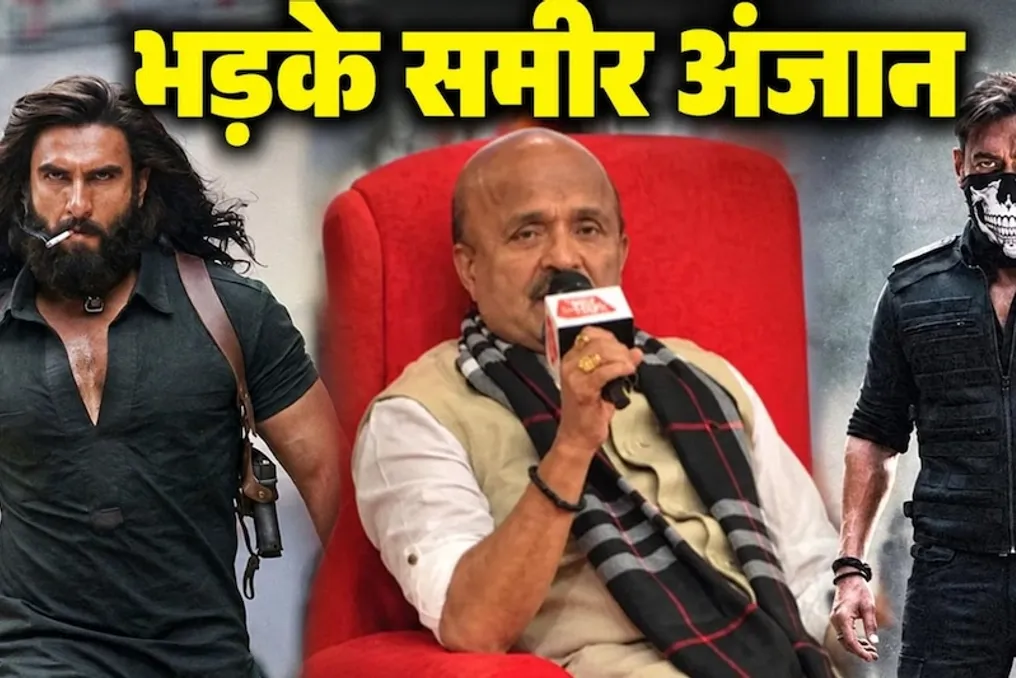
Lyricist Sameer Anjaan comments on the current state of music and criticizes the film Dhurandhar
Read more
Aaj Tak
www.aajtak.in

Lyricist Sameer Anjaan comments on the current state of music and criticizes the film Dhurandhar

Lyricist Sameer Anjaan has sharply criticized the current state of Bollywood music. Mentioning the recent blockbuster film 'Dhurandhar,' he stated that this film has destroyed the quality of music.

In an interview given to Komal Nahta, Sameer Anjaan mentioned that great art lasts a long time, and people would still want to listen to old songs even after a hundred years. He referred to a conversation with a producer who mentioned that only young employees are hired in his office. When Sameer asked when this trend started, the producer replied that it has been going on for the last five to six years.

Sameer clarified that his intention is not to underestimate the talent of the youth, but rather to point out that more benefit can be derived from the collaboration between old and new artists. Giving an example, he mentioned working with Sachin-Jigar on 'FALTU' (2011) and writing songs like 'Altu Jalaltu' and 'Char Baj Gaye Lekin Party Abhi Baaki Hai,' proving that he can work with youthful energy.

He questioned how experienced artists like Anand-Milind or Anu Malik can prove their worth if producers do not give them opportunities. Sameer expressed disappointment that producers only want to work with new people and what positive results have come from this.

Angrily, Sameer also said that Arijit Singh leaving the industry is not surprising because his work had become monotonous, and he was not getting diversity, whereas previously Udit Narayan and other singers received various types of songs. He cited this as the main reason for the decline of music.

Additionally, criticizing 'Dhurandhar,' he said the film pushed music into the background. He urged viewers to watch Ajay Devgn's film 'Chauhan,' where 'Jumma Chumma' plays in the background while all attention is focused on action. He also mentioned that his song 'Hum Pyar Karne Wale, Duniya Se Na Darne Wale' from 'Dhurandhar The Revenge' was remade, but there was gunfire on screen. He admitted that stopping such practices is no longer his father's business.

In this context, Nadeem (Music Director Nadeem Saifi) advised him to remain calm and let the process unfold before intervening. Finally, Sameer praised producers like Aditya Chopra, Karan Johar, and Sajid Nadiadwala, who supported good songs, and asked what has happened to them now.

Similar stories

Film 'Bedari' banned in Pakistan due to similarity with Indian film 'Jagriti'
Read more
www.aajtak.in

Film 'Bedari' banned in Pakistan due to similarity with Indian film 'Jagriti'

In 1956, the film 'Bedari' was screened in Pakistani cinemas. It achieved enormous success, filling all halls. This film, directed by Rafiq Rizvi and starring Ragini and Santosh Kumar, became a blockbuster thanks to its songs, especially the song 'Ao Bachcho Seir Karen Tumko' performed by Salim Razi. The song became extremely popular among children across Pakistan.

However, the film was soon banned. Some viewers felt a strange sensation, as if they had seen this film before, and discovered that not only the plot but also the melodies of the songs were familiar to them. It soon turned out that 'Bedari' was an exact copy of the Indian film 'Jagriti', released in 1954, and 'Jagriti' itself was a remake of the Bengali film 'Parivartan'.

The most interesting connection in this story relates to Ratan Kumar. His real name was Syed Nazir Ali Rizvi, and he was considered a popular child actor in the Bombay film industry. Born in 1941, he began performing at the age of just five. Family friends and writer Krishna Chander gave him the role of a child actor in the film 'Rakh'. After this, Ratan Kumar worked in several famous films, such as 'Boot Polish' and 'Baiju Bawra', before getting the role of Shakti in Satyen Bose's film 'Jagriti'.

When 'Jagriti' was released in 1954, Ratan Kumar was about 13 years old. Two years later, in 1956, he moved to Pakistan with his family. Many relatives of his family had already settled in Pakistan after the partition. Limited job opportunities in India also contributed to the family's decision to move to Pakistan.

After arriving in Pakistan, Ratan Kumar's elder brother, Wazir Ali Rizvi, founded a production company called 'Hayat'. The first film of this company was 'Bedari', and it was here that the story took an unexpected turn. The film 'Jagriti', in which Ratan Kumar himself acted, was recreated in Pakistan under a new title and in a new context.

'Bedari' featured Ratan Kumar in two roles. He played Ajay, whose name was changed to Jaffar in the Pakistani film. Furthermore, the character Shakti from 'Jagriti' was renamed Sabar Ali. Notably, despite the change in names, the essence of the characters was preserved: both Ajay and Jaffar mean 'victory' in Hindi and Urdu, respectively.

However, the similarity between the two films was not limited to the plot and characters. The most striking similarity was in the songs. In 'Bedari', the original melodies and harmonies were largely retained, but the lyrics were altered. Instead of Indian nationalist references, Pakistani nationalist motifs were added.

For instance, the famous song from 'Jagriti' sounded like: 'Ao Bachcho Tumhen Dikhaen Janki Hindustan Ki'. In 'Bedari', this song was changed to 'Ao Bachcho Seir Karen Tumko Pakistan Ki'. Similarly, where the original featured 'Vande Mataram', 'Bedari' used 'Pakistan Zindabad'.

Another song from 'Jagriti' contained the lines: 'De Di Hme Azadi Bina Kadg Bina Dhaal, Sabarmati Ke Sant Tune Kar Diya Kamal'. In 'Bedari', these lines were replaced with 'De Di Hme Azadi Ki Duniya Hui Haran, Ai Kaide-Azm Tera Ehsan Ha Ehsan'. Thus, instead of Mahatma Gandhi, Muhammad Ali Jinnah appeared.

This process was not limited to a couple of songs; in many songs of the film, the original melodies were preserved while the lyrics were changed, replacing the Indian context with a Pakistani one. How was the truth about 'Bedari' revealed?

Initially, the similarity between the two films might have gone unnoticed because there was a ban on the public screening of Indian films in Pakistan at the time. Consequently, most of the Pakistani audience could not see 'Jagriti'. Later, a member of the Pakistani censorship board informed Donna about this situation, noting that Lahore filmmakers created 'Bedari' in 1956, which was a carbon copy of 'Jagriti' in terms of plot and songs, utilizing the ban on the import and public screening of Indian films.

Initially, 'Bedari' enjoyed great commercial success in cinemas. However, after some time, viewers began to realize its true nature, understanding that the film they were watching bore a resemblance to a previously existing Indian film in terms of plot and melodies. Following this, protests against its public screening began, and the situation escalated to the point where the Pakistani censorship board immediately banned 'Bedari' and restricted the screening of its songs.

Did this affect Ratan Kumar's career? For a long time, there have been speculations that after moving to Pakistan, Ratan Kumar sought to establish himself in the local film industry, and perhaps that is why he participated in creating a film similar to 'Jagriti' in a new form. Nevertheless, Ratan Kumar, being a very popular child actor, could not achieve the same level of success as a leading adult actor.
Kumar Vishwas criticized Swara Bhaskar's statements on Jauhar, stating that history cannot be erased
Read more
www.aajtak.in

Kumar Vishwas criticized Swara Bhaskar's statements on Jauhar, stating that history cannot be erased

Swara Bhaskar's comments regarding Sanjay Leela Bhansali's film 'Padmavat' caused a wide resonance. Bhaskar linked the self-immolation (Jauhar) of Princess Padmavati and 800 women to indecency, claiming they felt like a vagina.

This dispute is not subsiding, and now the poet Kumar Vishwas, without naming Swara, reminded people of the glorious history of Rajasthan, calling it 'ignorant and foolish' (jāhil aur jamūre).

Kumar Vishwas emphasized that the pride and sacrifices of Rajasthan's history cannot be destroyed by any film, story, or a few hours of content. He urged people to focus more on teaching their future generations the correct history instead of getting angry at others.

Speaking about the history and heroism of Rajasthan, Kumar Vishwas stated: 'I repeat, this is a sacrifice written in blood, because of which even the land of Rajasthan resembles sandalwood.' He added that creating a two-hour film, writing any stories, or extracting any fragments from the proud heritage of Rajasthan and its people cannot affect a single particle of this history, provided we continue to tell people the true story.

Kumar Vishwas's stance was clearly aimed at the ongoing discussion about history and the portrayal of historical events in cinema. He noted that if society does not tell its descendants historical precedents, then getting angry at others' words in the future will be useless.

He advised people to concentrate on educating their youth about history instead of paying attention to such individuals. Kumar Vishwas continued that if you yourself do not tell these precedents to your generations, if you do not pass this history on to future generations, then those he called 'foolish and ignorant,' who 'read nothing, knew nothing, loved nothing of the land,' and who interpret the country's history and culture while sitting on the 19th floor, whether in Bombay or elsewhere, you will get angry at them. Therefore, it is much more important to teach your generation history than to pay attention to them.

During his speech, Kumar Vishwas gave a personal example. He recounted how he takes his family to historical places and explains the history of those places to the children. He mentioned that he personally visits places like Haldighati and Vrindavan, telling them where and by whom freedom was won.

Referring to the history of Maharani Pratap and Haldighati, he said that if someone wants to understand the struggle for personal dignity and respect, they should visit a small room in Kumbhalgarh where Maharana Pratap was born. He explained that in that era, war was not only about freeing one Maharani but also about the fight for personal dignity and self-respect. He added: 'We do not challenge anyone's dignity. We show hospitality.'

Kumar Vishwas also urged people to visit the historical sites of Rajasthan. He advised against going to Bangkok, Hong Kong, or Las Vegas, but instead traveling through Rajasthan and worshipping every shrine. Furthermore, he recommended visiting the Andaman Islands to see the history related to the struggle for independence. He mentioned that one should see the pistol used by Chandra Shekhar Azad in India.

In conclusion, Kumar Vishwas reiterated that it is more important to tell one's history to the next generation than to argue about it on social media or get angry at any film. His message was to teach one's generation the true history.

Popular