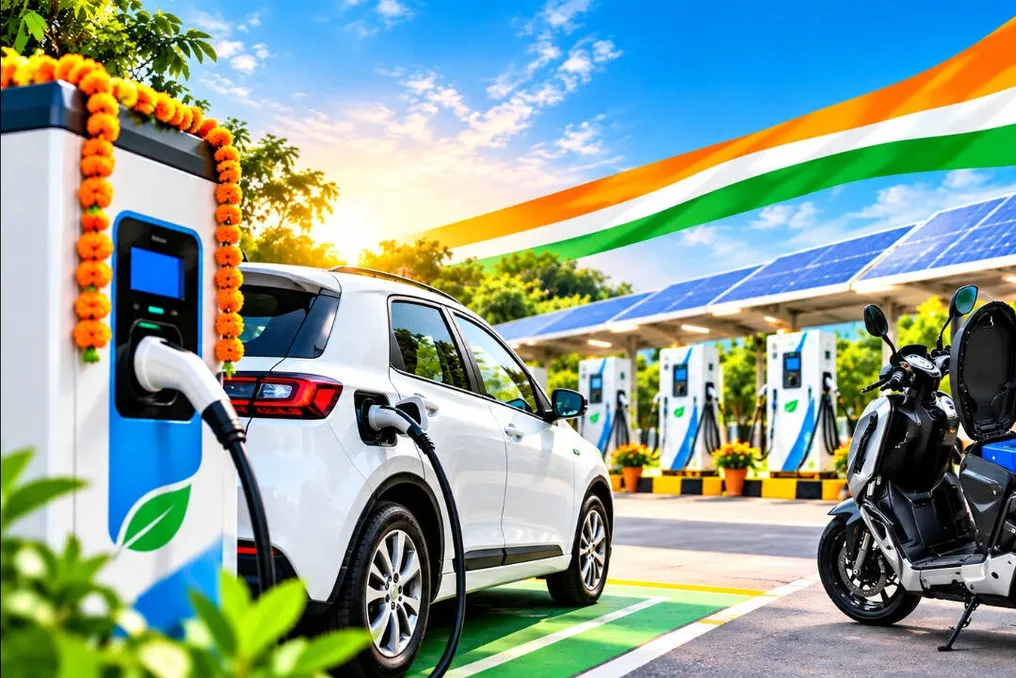
According to a major study conducted by Rubix Data Sciences and based on forecasts from the Confederation of Indian Industry (CII), India will need 13.2 million EV charging points by 2030 to accommodate the growing number of such vehicles.
Siddharth Das, a specialist from Delhi-NCR and a long-time motorcycle enthusiast, decided to replace his gasoline sedan with a new electric SUV, aiming to make his daily commutes 'future-ready.'
As of August 2026, the country had 67,657 public charging stations available, including 1,139 battery swap interfaces. This is significantly more than the 5,000 public charging units at the beginning of 2022 and 29,151 units in December 2025.
The majority of the infrastructure has low power: 48,709 charging units, or about 73 percent, are rated below 30 kW. There are 15,753 charging units in the 30–60 kW range, while 1,513 stations offer fast charging at 61–120 kW. Very few stations provide high power: only 534 charging units deliver 121–240 kW, and just nine stations nationwide offer over 240 kW.
These figures are critical because the charging unit's power determines the speed of an EV recharge. Thus, an extensive network may look impressive on paper, but if most stations are low-power, drivers on long journeys will still have to spend significant time charging.
The article also touches upon various aspects of user experience, including the issue of home charging versus range anxiety, the crisis of operators, empty stations in second and third-tier cities, and the need to develop technical frameworks for heavy freight transport.
LECCS standards (Light Electric Commercial Charging System), which combine AC charging up to 7 kW and low-voltage DC charging up to 12 kW into one standard plug for two- and three-wheeled vehicles according to IS 17017 Part-2 Section-7 and IS 17017 Part-31, are mentioned as a way to increase charging uniformity. Universal sockets, designed for destination charging at places like urban parking lots, support charging from 2 to 22 kW via a standard Type-2 socket with removable smart cables.
However, the main problem is expected in the field of heavy commercial transport and intercity travel, as charging units below 60 kW are generally insufficient for trucks and other heavy vehicles that require fast recharging.