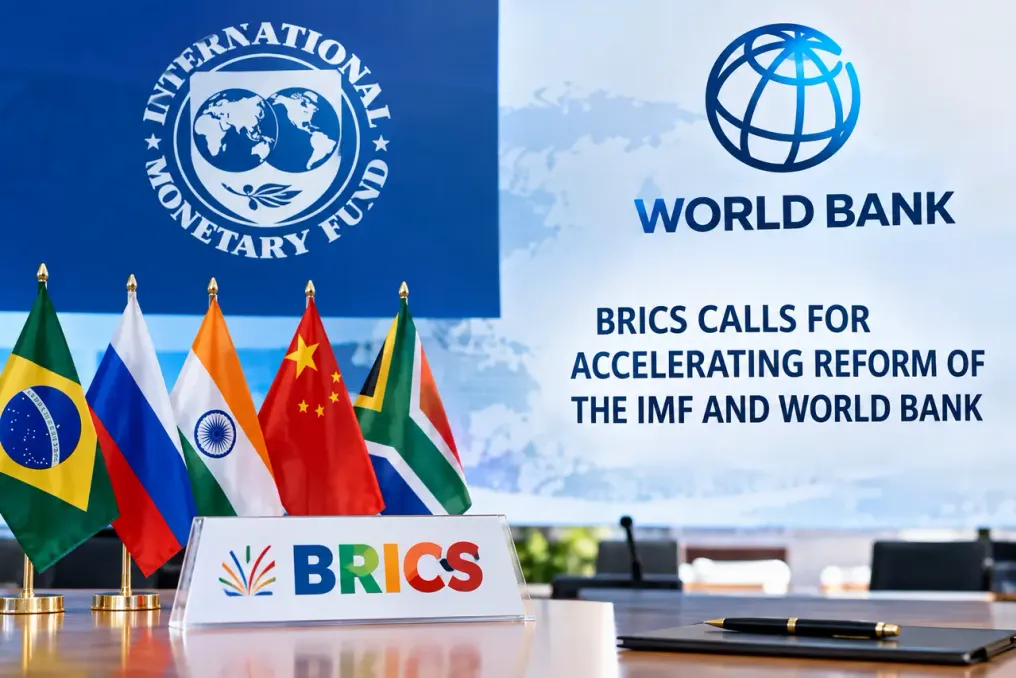
BRICS has once again called for accelerating reforms of the International Monetary Fund (IMF) and the World Bank, emphasizing that the governance structures of these organizations must align with the changing balance of power in the global economy.
This call was made in the New Delhi Declaration adopted at the 18th BRICS Summit. The document notes that reforming global economic governance remains a constant priority for BRICS countries amid the growing share of developing markets and economies in global production and growth.
The BRICS countries stated their intention to continue strengthening internal coordination to ensure greater representativeness, transparency, and accountability of international financial institutions. BRICS leaders reiterated their call to reform the Bretton Woods institutions to make them more flexible, effective, trustworthy, inclusive, fit for purpose, impartial, accountable, and representative.
According to the declaration, the governance structures of these institutions must be revised to account for the transformation of the world economy since their creation, and the voice and representation of developing economies must match their actual position in the global economy.
The declaration also highlighted the need to improve governance procedures, including selecting the leadership of the IMF and World Bank based on professional qualifications through an open and transparent process, which should increase regional diversity and the representation of developing economies in top positions.
Particular attention was paid to the issue of IMF quotas. BRICS reaffirmed its commitment to the previously adopted Rio de Janeiro Vision for IMF quota and governance reform, insisting that the IMF must be a strong, quota-based, and adequately funded central pillar of the global financial security system, especially for the most vulnerable countries.
Leaders called for the immediate implementation of the quota increase agreed upon in the 16th General Review of Quotas, as well as starting work at the earliest possible time on approaches to a more substantial quota reform within the 17th General Review of Quotas.
BRICS welcomed the so-called Diriyah Guidelines on IMF quota and governance reform and confirmed that quota reviews must reflect the relative position of countries in the world economy, increase the share of quotas and voting rights of developing economies, and not occur at the expense of developing countries.
According to the declaration, a new, simple, and transparent quota formula must protect the shares of the poorest members and direct access to IMF resources, rather than restrict it. Voluntary financial contributions must not affect the distribution of quotas, representation in governance, or voting rights.
The BRICS countries stated their readiness to engage constructively with other IMF members to ensure that the 17th General Review of Quotas includes a significant redistribution of quotas and governance reform.
Regarding the World Bank, the declaration described the capital review being conducted in 2025 as an important tool for strengthening multilateralism and enhancing the legitimacy of the World Bank Group as a more effective development financing institution.
In accordance with the so-called Lima Principles, the BRICS countries stated that they will continue to strive for greater voice and representation for developing countries by eliminating their historical underrepresentation through the revision of the capital structure.