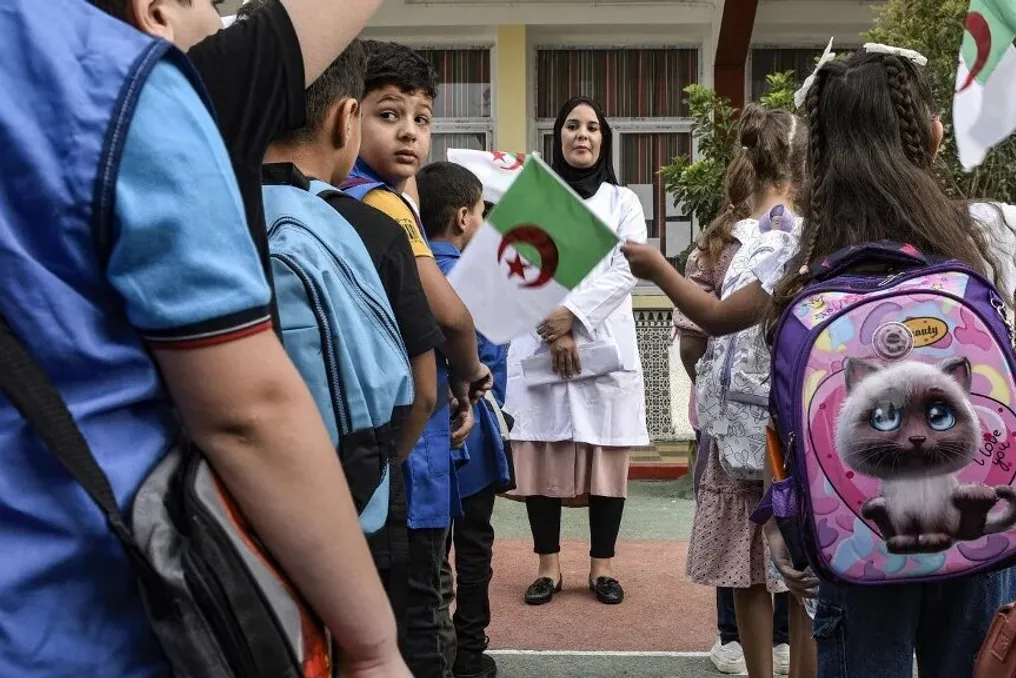
Algeria is seeing a growing priority placed on the English language in its education system at the expense of French, which has sparked significant debate across North Africa.
This academic year, three years after its introduction, English has become the first foreign language taught to students starting from the third grade. The Algerian Minister of Education announced in July that only English will be taught in the third grade, while French will be taught alongside English in the fourth grade.
Until 2023, French was the sole foreign language studied in primary school starting from the third grade. This situation had persisted since Algeria gained independence in 1962. However, following a decision by President Abdelmadjid Tebboune, English, previously taught only in secondary school, was added to the primary school curriculum starting from the third grade, parallel to French.
Tebboune justified the need to study English by stating that it is the language of science and should therefore be taught in schools. Furthermore, the status of English will be strengthened in secondary school through increased teaching hours and a higher coefficient in the end-of-cycle exam. Although the teaching of French in high school has not changed yet, the Minister of Education stated that English will continue to develop.
Public and Union Reaction
Despite the government's statements, teachers' associations have not yet commented. The main teachers' union, Cnapeste, was dissolved by authorities last July for violating rules regarding the right to strike. The union denies the accusations, viewing the procedure as an attempt to neutralize an organization known for its mobilizations. Previously, Cnapeste criticized the promotion of English instruction as a hasty decision, arguing that teachers are insufficiently prepared to handle the subject.
Conversely, the National Federation of Parents' Associations of Students, which generally supports the ministry's position, expressed satisfaction with the reform. They consider English 'the language that provides access to science and technology, and consequently, ultimately, to better opportunities for children's education and employment.'
However, not all parents agree. Rachida Mahi, a 36-year-old engineer from Algeria, regrets the hasty decision, which she believes could have catastrophic consequences for children's education. She worries about her son's future, who starts the third grade and will begin studying English this academic year. She questions how the state can ensure a sufficient number of qualified English teachers in every school.
Mahi, like many Algerians of her generation, speaks very little English because English was only a second language in her education, unlike French, and she received her engineering degree in French. She expresses panic about not being able to help her son with his English homework.
Questions of Ad-hoc Measures
After the end of French colonization in 1962, Arabic was established as the national and official language of Algeria, and as part of the Arabization policy, the linguistic heritage was gradually decolonized. This policy peaked in 1991 with the adoption of a law generalizing the use of Arabic in all spheres of public life and education. Nevertheless, Arabization was not entirely successful.
In universities, only law and social sciences have been Arabized; scientific fields such as medicine or engineering continue to be taught in French due to a lack of suitable educational materials and a shortage of teachers trained in Arabic. Moreover, leading scientific journals remain largely available only in foreign languages—primarily French and English.
President Tebboune decided in 2025 to gradually replace French with English in medical research, calling it a 'sensible' step that will bring Algerian higher education in line with international standards and global scientific research, where English dominates.
Salah Derradji, a specialist in language didactics and former university rector, is skeptical of the new measure. He told MEE that he had long supported the generalization of English in the university and its gradual introduction at other levels of education. However, he warned: 'This project must be carried out thoughtfully. And today it is not.' He believes that the President of Algeria made a 'political decision' and thinks it is impossible to implement such a measure overnight with a 'magic wand'. He added that teachers cannot be trained in a few weeks and sent to classrooms; qualified trainers are needed first.
Sharing his view, Rabeh Sebba, a former professor of sociology and anthropology at the University of Oran, told MEE that 'Algeria does not have the means to teach English—or to teach in English—in schools or universities.' In 2022, preparing to introduce English into primary school, the Algerian Ministry of Education announced a large recruitment campaign for 60,000 teachers targeting university graduates in English language and literature, as well as translation.
This initiative drew criticism from educational trade unions, who condemned the hiring of people without pedagogical experience and who were trained in a hurry. Hamid Hani, a 42-year-old parent from Bejaia, told MEE: 'My daughter, who is entering secondary school this year, still doesn't express herself very well in English. She had the same English teacher for two years—a young woman, inexperienced and incapable of managing a class. This teacher admitted to me at a meeting that she had to manage on her own to find teaching materials and organize lessons.'
Furious, Hani accuses the authorities of playing with children's futures by multiplying 'ad-hoc measures'. Ahmed Tessa, an education specialist and author of a book on the status of the French language in Algerian schools, agrees. He told MEE: 'Frankly, how can one expect quality language teaching when hiring university graduates and sending them to classes without even two years of initial training—the minimum required for good teaching?' Tessa argues that the new measure is an 'ideological, not pedagogical decision.'
Abandoning the French Legacy
The government's announcement triggered a broader discussion about the legacy of French colonialism and Algeria's relationship with France. El Hashemi Jaaboub, a former minister from the Movement for Society of Peace (MSP), a branch of the Muslim Brotherhood, and known for his critical stance towards French influence, argued that delaying the teaching of French is an act of sovereignty, and accused Tessa of serving foreign interests.
The decline in the status of the Molière language in Algerian schools occurs against the backdrop of constant diplomatic tension between Algeria and France, which was heightened in 2024 by President Emmanuel Macron's support for Morocco's claims to sovereignty over Western Sahara. The former Spanish colony, most of which is controlled by Morocco, is also claimed by the Polisario Front, which seeks Saharan independence and is supported by Algeria.
For Abderrzak Macri, former president of the MSP, the changes must be radical. He stated in 2022: 'We must put an end to the colonial legacy of France. Even President Macron speaks more English than French abroad. Today, English is the universal language; it is time for Algerians to embrace it and keep pace with great nations.'
Some far-right and ultra-right media outlets in France criticized Algeria's decision to promote English, viewing it as an attempt to diminish French cultural and political influence in the country. In Algeria, social media conversations indicate that some segments of the population now view French as a colonial remnant that should be discarded. Some even call for a complete ban on teaching French.
However, some political parties, such as the Alliance for Culture and Democracy and the Workers' Party, oppose the reduction in the status of French, arguing that language teaching should be supplementary and not tied to ideological disputes. Sebba, analyzing positions hostile to the presence of French in education, speaks of 'deep, ideologically motivated attitudes.' He notes that some proponents studied in English-speaking universities and consider English an international language, whereas French symbolizes colonial domination.
The book author analyzing Algerians' relationship with the French language rejects the notion that colonial education significantly contributed to the 'Francization' of Algerians, whether culturally or linguistically. At the time of independence, the proportion of Algerian children attending school was small—less than 20 percent. Sebba added that Algerians living under colonial rule perceived French more as a means of social advancement and cultural development. He pointed to the emergence of Algerian literature written in French during that period as evidence. One of the most iconic figures of this period, Kateb Yacine, famously described French as a 'war trophy.'
According to Tessa, this legacy is now under threat. He warns that reducing the status of French will lead to detrimental consequences in many aspects. He is particularly concerned about the drying up of cultural production in French and the erasure of collective memory expressed in this language. The intellectual also warns of Algeria's drifting away from its Francophone geopolitical environment and severing ties with millions of diaspora children and grandchildren, mainly residing in France and Quebec. Currently, according to the Organisation Internationale de la Francophonie, Algeria is the third-largest Francophone country in the world, behind France and the Democratic Republic of Congo. Reports indicate that about 15.6 million Algerians speak French—approximately 33 percent of the population.