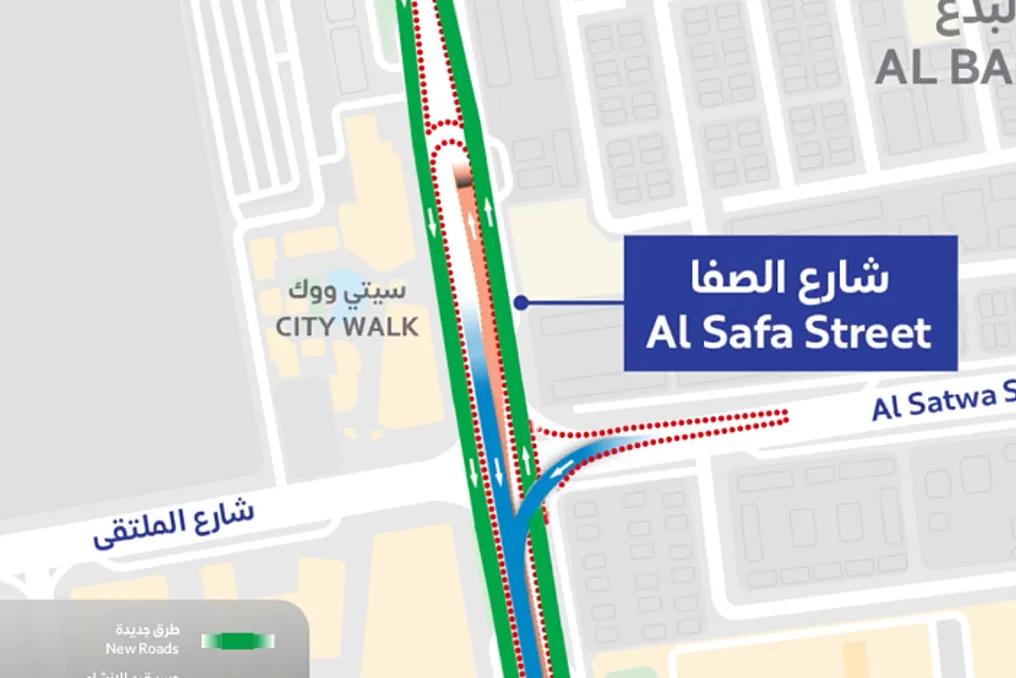
Passengers traveling through the City Walk and Al Safa areas in Dubai are advised to plan their journeys carefully, as traffic changes have come into effect on Al Safa Street.
The Roads and Transport Authority (RTA) of Dubai has officially begun implementing the Al Safa Street Development Project, introducing key traffic changes designed to ensure smooth movement during construction work. As part of the current phase, traffic on Al Safa Street is being diverted in both directions onto new alternative routes running parallel to the development zone.
Improvements are also underway at the intersection of Al Satwa and Al Multaka Streets, where traffic flow around City Walk is being optimized. The existing traffic light between these streets is being replaced to ensure continuous movement.
Improved Access
RTA is expanding entry and exit points, increasing the number of access lanes, and boosting road capacity. Furthermore, dedicated, fully functional U-turns have been added to Al Safa Street, which should reduce travel time, prevent congestion, and enhance road safety.
RTA strongly urges drivers to follow the updated directional signs, adhere to speed limits on bypass routes, and plan their journeys in advance for a comfortable trip.
These changes are being implemented along the transport corridor serving one of Dubai's busiest mixed-use districts, which hosts facilities such as City Walk, Coca-Cola Arena, schools, residential complexes, hotels, restaurants, and commercial centers.
The current diversions are part of a much larger transformation of Al Safa Street. The RTA project covers a section approximately 1500 meters long, extending from the intersection of Al Safa Street with Sheikh Zayed Road to its junction with Al Wasl Street. Upon completion, it is expected that travel time along this corridor will be reduced from 12 minutes to just three minutes.
The street will be widened from three lanes to four lanes in each direction. The larger project includes two bridges and two tunnels totaling about 3120 meters. RTA reports that these improvements will double the road's capacity from 6000 to 12000 vehicles per hour in both directions.
The first bridge will serve traffic traveling from Al Wasl Street towards Sheikh Zayed Road and the Financial Centre Road. This four-lane structure will be approximately 1005 meters long and designed to handle about 6400 vehicles per hour. The second bridge, a two-lane structure measuring about 360 meters, will serve traffic moving from Al Satwa Street towards Sheikh Zayed Road and the Financial Centre Road, with a capacity of about 2800 vehicles per hour.
The project also includes two tunnels. One, approximately 1005 meters long, will be used for traffic moving from Sheikh Zayed Road and Financial Centre Road towards Al Wasl Street. The second tunnel will be located at the intersection of Al Wasl and Al Safa Streets and will extend approximately 750 meters, featuring two lanes in each direction.
The broader road project also considers the needs of pedestrians and cyclists, including dedicated pedestrian walkways and bicycle paths, as well as landscaped areas and urban spaces intended to encourage community interaction. The ultimate goal for residents and passengers is to make this busy stretch of road faster and more efficient while improving connectivity between key points in central Dubai.