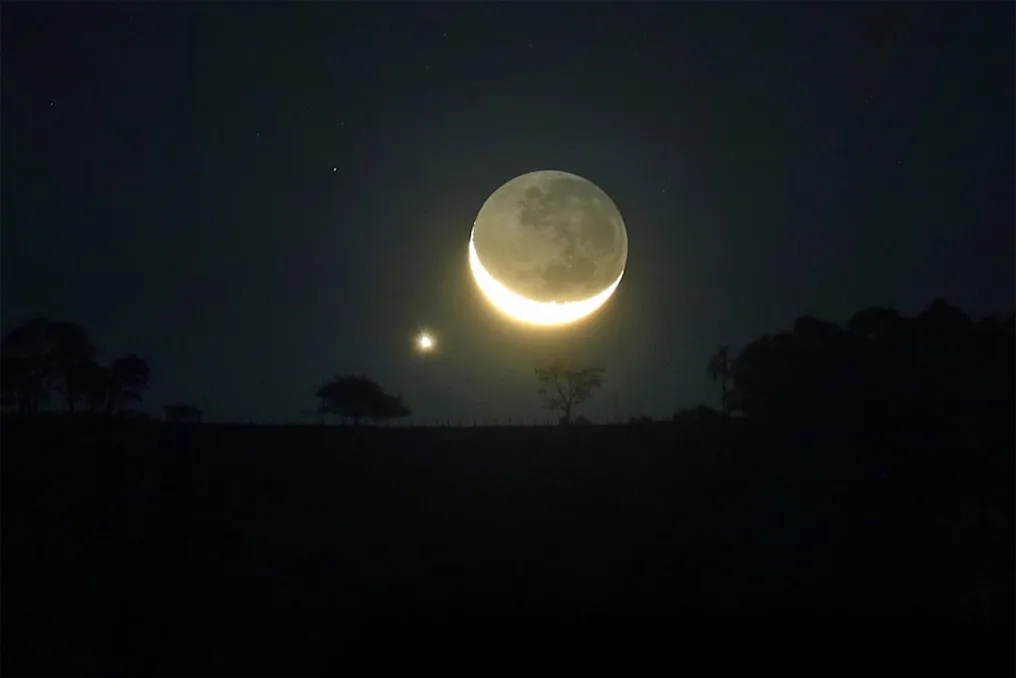
A notable astronomical phenomenon will occur this Monday, the 14th, when the Moon passes directly in front of Venus, obscuring the planet for a period. This event, known as lunar occultation, resembles a planetary eclipse.
According to information from the website In-The-Sky.org, the total duration of this event will be just over four hours, covering the global period between 6:26 AM and 10:42 AM, according to Brasília time. The visibility of the phenomenon will be more concentrated in regions of Europe, Africa, the Middle East, and Asia, within the area marked on the map.
Although Brazil cannot witness the Venus eclipse caused by the Moon, residents of the country can observe the two celestial bodies very close to each other shortly after sunset. In São Paulo, for example, the pair will be visible between 6:08 PM and 8:52 PM, before disappearing below the horizon.
Astronomical data indicates that the Moon will have a magnitude of -10.3, while Venus will have a magnitude of -4.5, and both will be located in the constellation Virgo. It is important to note that the brighter a celestial body, the lower its magnitude value; the Sun, being the most luminous, has an apparent magnitude of -27.
Although they are not close enough to be captured in a single field of view of a telescope, the pair will be observable with the naked eye or using binoculars, located approximately 36° above the western horizon.
Details about the visibility of occultations
Lunar occultations are restricted to a small portion of the Earth's surface. Due to the Moon's proximity compared to other stars, its position in the sky varies according to the observer's precise location, an effect explained by large parallax.
The difference in the apparent position of the Moon viewed from two opposite points on the planet can reach up to two degrees, which is equivalent to four times the diameter of a full moon. This implies that if the Moon is aligned to cover a specific object for an observer on one side of the globe, it may appear up to two degrees away from that object on the opposite side.
The map clearly illustrates the areas where Venus's disappearance is visible (in red) and where its reappearance can be witnessed (in blue). Solid lines indicate locations where the occultation is likely to be seen with binoculars at an adequate altitude. Dotted outlines signal regions where the event occurs above the horizon but may not be perceptible due to excessive sky brightness or the Moon's proximity to the horizon.
Outside these boundaries, the Moon does not position itself in front of Venus at any time, or it is below the horizon during the occultation.