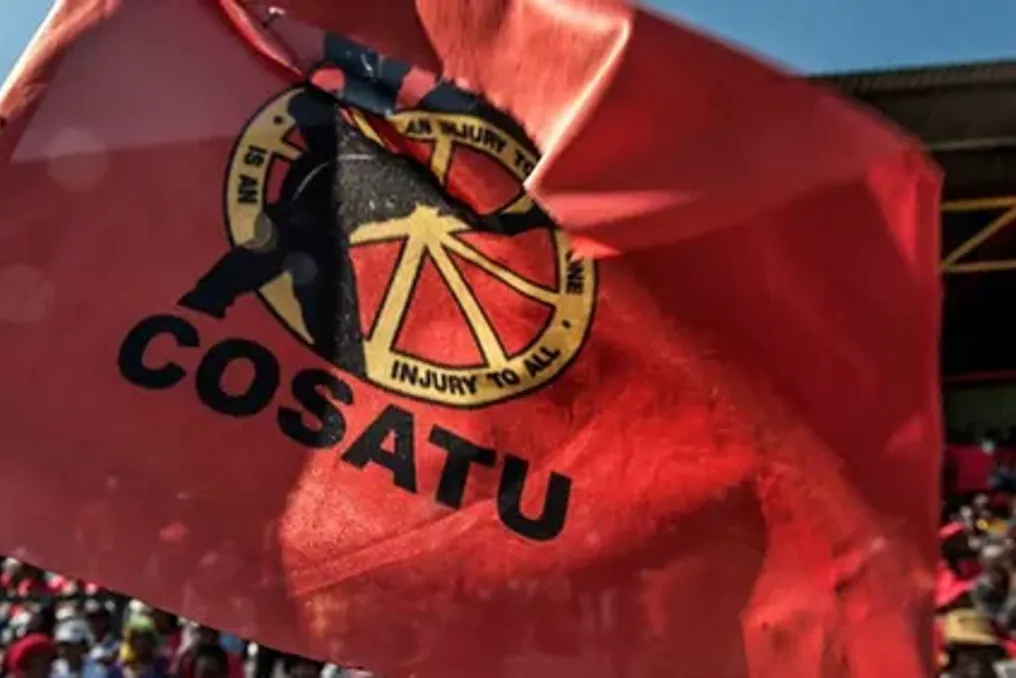
Ahead of the XV National Congress of COSATU and the upcoming local elections in November, ANC representative in KwaZulu-Natal, Michael Mabuyakulu, advocates for maintaining the political alliance, which he believes has ensured decades of success for South African workers.
As the Gallagher Centre in Midrand prepares to host delegates for the XV National Congress of South African Trade Unions from Monday to Thursday, the African National Congress in KwaZulu-Natal expresses support for the trade union federation, its affiliates, delegates, and all progressive workers in the country.
COSATU congresses have always held significance beyond its membership, as decisions made by delegates affect the lives of every working family in the country. It is asserted that the delegates will bring seriousness, discipline, and above all, unity to the meeting, as united workers strengthen the entire revolution.
To understand the hope with which the Congress is viewed, one must recall how far the organized working class in this country has advanced to gain the right to assemble in a hall like Gallagher Estate. This path began under conditions designed to make organization impossible, yet workers continued to move forward.
Organized black labor began to form in the 1890s when the mineral revolution in the then Witwatersrand spawned a system of migrant labor based on settlements, wages calculated as if the rural estate, rather than the employer, bore the cost of family maintenance, and a pass system criminalizing the mere presence of an African worker in the city without official permission. Essentially, it was forced labor disguised as a voluntary contract.
From these conditions emerged the Industrial and Commercial Workers' Union, founded in Cape Town in 1919 by Clement Cadalie with 24 dockers. In less than a decade, it grew, according to some estimates, to a quarter of a million members, becoming the largest black organization established in the country. In our province, this movement produced one of its most significant sons—Allison Wassell George (AWG) Champion, known as uMahlath'amnyama, who turned the Natal branch of the union into the largest and wealthiest in the country before being expelled from Natal and Zululand in 1930 under repressive legislation for excessive organizational activity.
Unfortunately, the ICU did not survive the decade. It collapsed due to internal competition and state pressure. However, its lesson survived. African workers proved for the first time that they could organize as a class and destabilize the economy built on their labor.
The alliance between the trade union movement and the political liberation movement was formed in subsequent years amid open hostility. The Industrial Conciliation Act of 1956 completely excluded African workers from the legal definition of an employee, depriving them of the right to collective bargaining. Against this wall in Johannesburg in 1955, the South African Congress of Trade Unions (Sactu) was founded, taking its place in the Congress Alliance alongside the African National Congress. In the same year, at the People's Congress in Clifton, the Freedom Charter proclaimed that workers had the right to form unions, elect their own officials, and negotiate wage agreements with employers, although each of these declarations was an illegal challenge to the country's laws.
The price of this alliance was paid through banning orders, arbitrary detention, exile, and even death. Comrade Vuisile Mkhini, an organizer of Sactu from Tsomo, who worked and organized in the country, was hanged in 1964, as were many other trade union activists whose names are mentioned much less often in our commemorative events than they should be. This generation supported the illegal alliance under conditions specifically designed for its destruction. Their only weapon was unity, when everything else was taken away.
It must also be remembered that open trade union activism was forced almost entirely underground more than ten years after the Sharpeville massacre, and that it decisively revived here, in KwaZulu-Natal. In January 1973, workers of the Coronation Brick and Tile Company in KwaMagengke, on the outskirts of Durban, stopped work because wages could not keep pace with the rising cost of living. The strike spread with astonishing speed to the textile, engineering, and municipal sectors of Durban, attracting tens of thousands of workers who belonged to no registered union, because none existed for them. The strikes in Durban in 1973 broke the silence imposed by the state since 1960, and our province takes real historical pride in this fact.
Three years later, in 1976, Soweto students rose up against Bantu education, and the resumption of the link between industrial militancy and mass political anger forced the apartheid state to adopt a strategy of top-down reforms, leading to the Whangan and Ricker reforms in 1979. These reforms first granted legal recognition to African trade unions while attempting to manage and divide the very movement it was forced to recognize.
Independent unions did not wait for state permission or accept the conditions offered to them. The formation of the Federation of South African Trade Unions (Fosatu) in 1979 paved the way for the establishment of Cosatu. On December 1, 1985, over 760 delegates from 33 unions gathered in Durban for the official launch of Cosatu, with Elijah Barai becoming its first president.
It would be unfair to present the period preceding the founding of Cosatu as a period of undisputed unity. In those years, the independent trade union movement engaged in real and sometimes sharp debates about whether unions should formally align with the political movement or maintain a narrow focus exclusively on shop-floor issues. This dispute was decisively resolved in Cosatu in favor of what history now calls the Chartist position—not a decree, but the conviction of delegates representing real workers who discussed the issue among themselves. In 1987, Cosatu's own Congress adopted the Freedom Charter as its guiding document, deliberately aligning the federation with the Congress movement's vision of a non-racial, democratic South Africa.
This history is important for understanding the Congress gathering now in Midrand. The question of how closely the organized workforce should stand with the political movement has never been definitively settled. Workers in the hall decide this question preliminarily at each congress.
What has never changed is the result of these debates over four decades, as the so-called Chartist trade union activism has always understood that the national liberation movement cannot change the balance of power without a mass working base, just as the trade union movement without political power commensurate with its industrial might cannot achieve what it won on the shop floor alone.
The lifting of bans on our movement in February 1990 and the democratic breakthrough in April 1994 opened the way for the formal enshrining in the country's supreme law of the rights for which generations of workers died, went to prison, and were exiled. The Labour Relations Act of 1995 completely restructured the architecture of collective bargaining on a non-racial basis. The Basic Conditions of Employment Act of 1997 first established a legislative minimum for every worker in our history, regardless of sector. The Employment Equity Act of 1998, strengthened by the 2022 amendment, made workplace discrimination illegal, not just undesirable. Our Constitution itself, in Section 23, placed the right to organize, bargain, and strike beyond the reach of any future Parliament that might seek to undermine it. The Minimum Wage Act of 2018 provided South Africa with the first legislative minimum wage level covering all economic sectors, a demand the trade union movement had raised since the days of promises of work and security in the Freedom Charter. Land legislation gave landless families and tenant farmers the legal right to return to land that did not exist during colonial or apartheid rule. The National Health Insurance Act, signed in May 2024, fundamentally ended the healthcare system where a person's quality of care depends on the size of their wallet.
We do not present this brief list as a statement that the track record of our movement in government is beyond criticism, or that each of these achievements has been fully realized. But the pattern over three decades is undeniable. Since 1994, almost every legislative achievement benefiting the ordinary worker, whether at home, at work, or in their finances, can be traced back to the political movement that played a decisive role in its creation and continues to hold it accountable.
Cosatu made an important statement affirming its non-partisan role in the tripartite alliance before the elections, against the backdrop of ANC and SACP participating in the elections independently of each other. Michael Mabuyakulu, ANC coordinator in KwaZulu-Natal, asserts that the federation must remain united with the ANC to protect the rights of workers and the achievements of the democratic era.
We are aware that the participation of our own movement in the National Unity Government, formed after the May 2024 elections, which reduced the African National Congress's national vote share, has raised legitimate questions across the Alliance regarding what this agreement means for workers. These questions deserve an honest answer, not a defensive one.
Lenin, in his pamphlet 'Left Communism: Infantile Disorder,' written specifically to correct revolutionaries who confuse dogmatism with principle, drew a clear distinction between a compromise imposed on the movement by objective conditions—which, in his words, does not diminish revolutionary commitment—and a compromise made by people who mask their own selfishness with revolutionary language. The difference between them is demonstrated by whether the movement entered the agreement because it was required by the balance of power, not because it was convenient, whether its own program and organizational independence remain untouched within this agreement, and whether this agreement is viewed as conditional rather than as a permanent merger with those nearby.
When assessed by this criterion, our position in the National Unity Government was not a preference. It was an arithmetic necessity afforded to us by the electorate. Our program is not suspended during this agreement, and our own structures continue to organize, mobilize, and prepare for voting exactly as always. This is the kind of compromise that Lenin considered not diminishing revolutionary commitment. It is an adaptation to the conditions of the time to advance the revolution.
The XV COSATU Congress will take place six weeks before South Africans return to vote in the local elections on November 4, and these two moments cannot be honestly separated. There is a coordinated campaign to overturn the legislative achievements that this movement has secured since 1994. The BELA Act, which returns school admission decisions to communities and provincial governments, has been challenged in court. The National Health Insurance Act...
3.