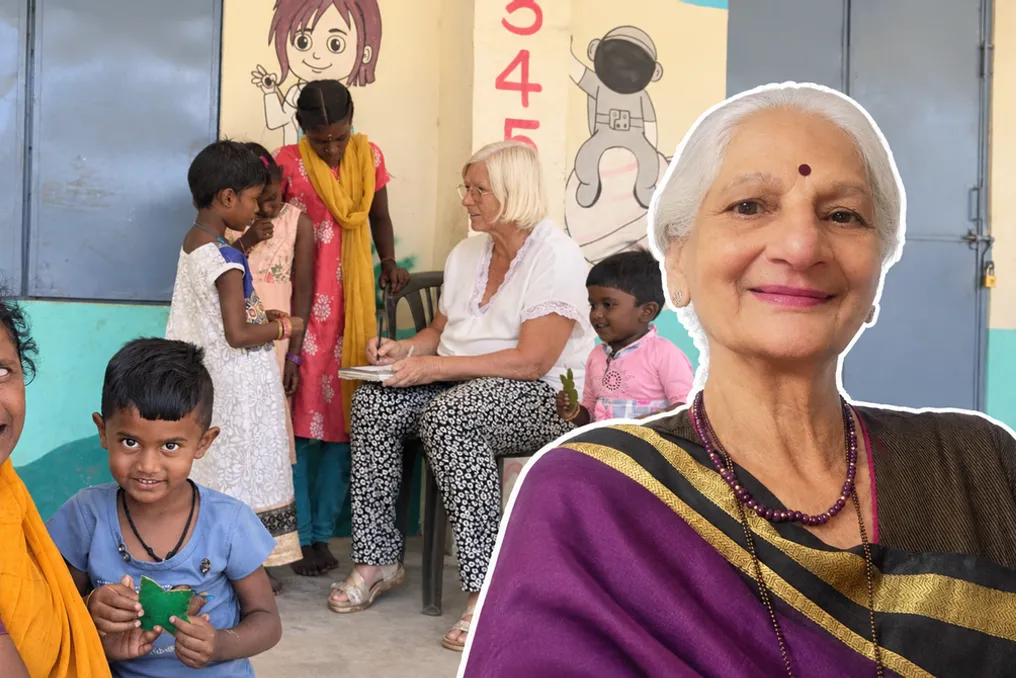
In the tribal settlement of Kombai-Perungadu, located in Kodaikanal, a scene was captured where five-year-old Karnika, with neatly braided hair, greets an interlocutor during a video call. She speaks Tamil, introducing herself as Karnika, and expresses delight at the conversation despite the unstable internet connection. Karnika shares her plans, saying she loves school and her teacher, before joining a group of 30 children who begin singing poems about friendship and cleanliness under the teacher's guidance while parents watch.
Not long ago, this picture was unimaginable. Karnika often missed classes at the local primary school because the appeal of agricultural work was stronger. Like her parents, she was expected to engage in farm labor rather than receive an education.
The situation changed with the introduction of a 'Saturday school' in the village, which attracted 25 children for whom learning became something anticipated for the first time. Over two years, the group grew to more than 52 pioneers, such as Karnika, who were able to move away from the fields and receive an education unavailable to their families.
This opportunity is the result of the many years of experience and determination of an 82-year-old educator. Her teaching experience in the slums of Delhi later led her to realize the same mission in the remote areas of Tamil Nadu.
A promise made in Delhi's slums.
The 'Mai Satya Surabhi' school, located in Attuvampatti, six kilometers from the town of Kodaikanal, has been providing free education to underprivileged children for 27 years (since 1999), excluding travel expenses. The school was founded by Padmini, who began teaching at the age of 19 in Calcutta and continues to work in the classroom daily at 82 years old. The school operates on the philosophy of integrated learning: no subject is studied in isolation; every lesson is permeated with geography, history, and science, becoming, in her words, a 'mark on the child.'
This philosophy developed slowly, thanks to a career that spanned from Calcutta to the British School in Delhi, and then to Kodaikanal. However, its true origin, according to her, goes deeper than any classroom. While working in Delhi, she accompanied students to a nearby slum area twice a week and observed firsthand the gap between privileged and disadvantaged children. She decided she had to do something to improve the status of these people, and the only way, in her opinion, was not feeding or clothing them, but providing them with quality education.
When she finally settled in Kodaikanal and was offered the chance to open a well-funded, exclusive school, she chose differently. She took on teaching 50 children with one hired teacher, while acting as a second instructor for those who came to learn for free. Before this, in 1972, she spent four years teaching at a secondary school in Benin City, Nigeria, where she saw how children from different socioeconomic backgrounds treated each other as equals. This experience shaped her understanding that people fundamentally share the same basic needs and humanity.
This same instinct manifested decades later, leading her to Kombai. She recalls wanting to reach the tribal settlement for years, and the occasion that finally brought her there was solemn—a visit to immerse a relative's ashes in the river. But afterward, she was struck by the children, most of whom, she discovered, never attended school.
Out of approximately 50-60 families in various settlements of the Kombai tribe, most children do not attend school. Families here are mainly farmers, beekeepers, and cotton pickers, and expect their children to also work in the fields. Padmini explains that children are often used for agricultural work, earning 100-200 rupees, which is very valuable to their families, even more so than education.
However, when she invited the children to visit the main campus of 'Satya Surabhi,' the families could not afford the monthly transport fee of 3000 rupees. Therefore, the school decided to come to them. Thus, the 'School Bus' was born.
What Makes 'School on Wheels' Different
The program, which started in 2024, involves two teachers who drive to the village every Saturday according to a schedule to interact with children in the Kombai-Perungadu settlement, which consists of 30 families. This specific settlement was chosen because most of its children had never attended school. When the teachers first arrived in the village, they encountered parental reluctance to allow their children to participate in the planned sessions. Therefore, the teachers first focused on counseling community members. They visited every home to talk to the parents and bring the children to the program. It took 2-3 months to establish trust, after which they could begin classes.
Another problem was that the children came to class unwashed, without personal care, or in torn clothes. The general impression was that community members did not value self-care and appearance. 'We decided not to start with A, B, C, D, or Tamil or Math,' explains Jagatheeshwari Markam, who initially joined the school as a parent and later became an English teacher in 2021. In a community where children were never taught the basics of dignity, cleanliness, or self-care, the first lessons had nothing to do with textbooks. During the first few weeks, they literally brought manicure scissors and trimmed their nails. They talked about cleanliness, handwashing, and proper nutrition.
Only after hygiene and care were mastered did the study of reading, writing, and arithmetic begin, along with providing each child with a snack consisting of a boiled egg, a glass of milk, and cereal.
Nail cutters before ABCs
However, Padmini's fundamental educational philosophy distinguishes the 'School on Wheels' from traditional education. Working for 14 years as head of department and coordinator of French and foreign languages at the British School in Delhi, Padmini encountered a teaching method called 'thematic learning.' She notes that this was striking because it gave her a new perspective on learning and teaching. In her explanation, the idea is that no subject exists in isolation. For example, an English lesson covers not only grammar but also touches upon the geographical, historical, and scientific aspects of that lesson. She believes that 'teaching text without revealing the place where it takes place or how its culture was formed makes the learning incomplete.'
'It requires a lot of work and planning from teachers. But this is the core of holistic learning,' she says. She calls it 'integrated learning,' and it remains the main teaching methodology both in the school and in the outreach program, including Kombai, where the same principle forms something more basic than a textbook lesson: daily life. Cleanliness is related to dignity, nutrition to concentration during lessons, and literacy to self-respect. Trimming nails and washing hands are not separate from education; they are the first thread in one fabric. Only after this foundation is laid does subject-specific learning follow.
Maheshwari, mother of 11-year-old Sudarshan from Kombai, says that thanks to this philosophy, she sees her child take his appearance seriously and strive for excellence in everything. Because he was taught to take care of himself and go to school neatly, he shows special care for everything he does.
What lessons really look like
According to this philosophy, Science teacher Shanti plans a lesson on Friday that combines biology with mathematics, geography, and agriculture for the next day's class of Kombai children. Shanti explains that she took a wild flower seed familiar to the children through their family's agricultural experience. With the social studies teacher, they talk about the region where the plant grows and the history of the area. Then, consulting with the math teacher, Shanti teaches them to measure the seed with a ruler to understand how many seeds would be needed for a certain area of land. The lesson then moves to climate and rainfall patterns, added by another teacher. School director Mary Johnson notes that the reaction is always enthusiastic. The children feel engaged because learning about one small seed from different perspectives fascinates them, especially at this age. More importantly, it cultivates critical thinking in them.
For all teachers, including Jagatheeshwari, this aspect remains one of the most rewarding parts of working at the school. Jagatheeshwari says: 'It is truly pleasant to see how children react with curiosity and ask us more questions to learn further.'
'Every job is worthy and important.' Padmini's approach to education is based on the belief that intelligence comes in many forms, and the school's task is to help every child find their own. Primitive farming is one example of this. She notes that this is a very unique practice offered alongside more traditional subjects. This philosophy traces back to her own self-assessment. She admits that she is not good at mathematics and is not very good at logic, but emphasizes that there are many types of intelligence, confirmed by neurologists and neuroscientists, including emotional (EQ), intellectual (IQ), and spiritual (SQ) quotients. This is a belief she has carried for decades. She felt intuitively that they should be good at something and leave a mark on life.
This conviction dictates her wishes for students: not uniform achievement, but excellence where their passion lies. She asserts: 'You must have a passion for what you do. Not every child can become a high-ranking official. Therefore, the person who becomes a cleaner must be the best cleaner. The best farmer must be the best. In the field they choose, they must shine the brightest.'
For Padmini, it all starts with the basics. 'What you need is basic quality education. That is the key word. It shouldn't just enter the classroom for the teacher to say something, and the child forgets it. It must become a mark on the child. Then the child will automatically strive for perfection.' This is a principle she practices, not just preaches. She says: 'I clean my schoolyard. I set an example. Although I cannot do this in all classrooms, at least they know they must do it too.' This is especially important for the Kombai community, whose generations have been involved in agriculture and hard labor, reminding them that this labor also deserves respect and recognition.
The 80-year-old who wanted to write his name
But for Padmini, education has no age limits—it does not stop after graduation, retirement, or at any other point. She states: 'I am constantly learning. Education should only cease with death. It sounds so final, but it is. What you do every day is your life.' The Kombai outreach program is a testament to this. The program started with 30 children and consistently attracts 25-30 children per session. The children's ages range from 4 to about 13 years. But there is something amazing that stands out in these sessions: adults of various ages also come here who never...
]} , 3.