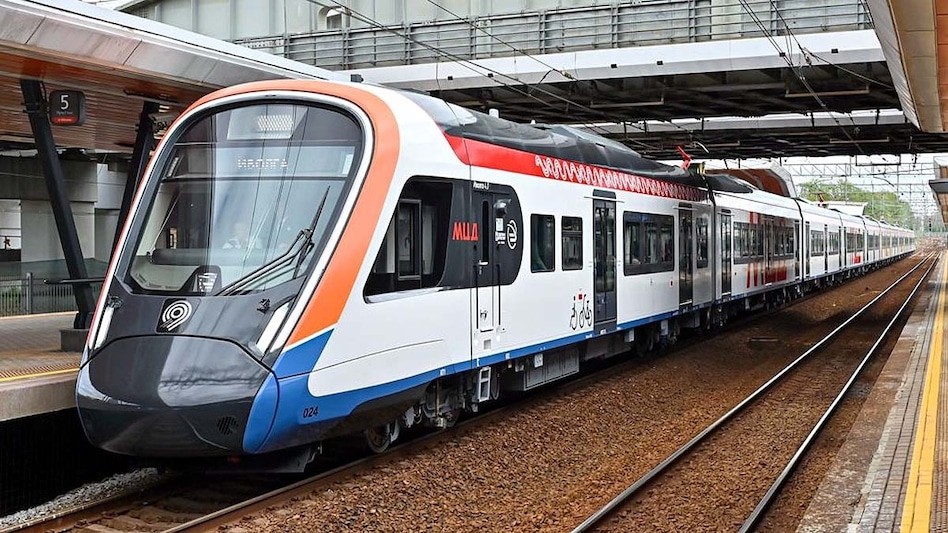
The Indian railway system is undergoing active modernization, and high-speed train projects are among the country's priorities. In this context, the Russian company Transmashholding presented the technology of its high-speed train 'Ivolga' to India during the INNOPROM.India program.
The 'Ivolga' train is capable of reaching speeds of up to 360 kilometers per hour. One set, consisting of eight carriages, is designed to carry 642 passengers and has a stated service life of 30 years. An important aspect of the offer is the possibility of using 80% local content.
This proposal aims to strengthen existing railway cooperation between India and Russia. Transmashholding is already operating in India, having signed a $6.5 billion agreement to create a joint venture for the production of 'Vande Bharat' sleeper coaches, under which 120 trains are planned to be produced. Based on this experience, Russia seeks to enter the high-speed transport segment.
'Ivolga' is a modern electric train developed in Russia. Although it is originally intended for urban and intercity routes, its high-speed version can reach a speed of 360 km/h. The eight-carriage set provides sufficient capacity for passengers. Its appeal is due to its long operational life and low maintenance costs.
A key point is the requirement to use 80 percent local components, which directly supports the 'Make in India' initiative. Technology transfer and local production will allow Indian industry to acquire new competencies. Currently, India is focusing on semi-high-speed 'Vande Bharat' trains, which travel at speeds of 160 to 180 km/h, and is implementing projects similar to bullet trains to create a full high-speed network.
For the Mumbai-Ahmedabad corridor, Japanese Shinkansen technology was chosen, but the Russian proposal could expand options in this region, especially in terms of cost and local production.
There is a long-standing partnership between India and Russia in the field of railway transport. The 'Vande Bharat' project serves as a recent example of this cooperation. Production began at a factory in Latur, and Indian engineers undergo training in Russia. This joint venture has strengthened the industrial ties between the two countries.
The offer of advanced technology, similar to 'Ivolga', is a natural continuation of this cooperation. Discussions at venues like INNOPROM.India are entirely expected, as the focus there is on industrial and technological partnership. Russia is ready not just to sell a finished train but also to participate in joint production and technology exchange, which will increase India's self-sufficiency and develop its export potential.
Safety, track infrastructure, and signaling systems are critically important in high-speed train projects. Simply purchasing a train is not enough; the entire corridor must be adapted for high-speed operation, which involves high costs. The Russian proposal will need to be compared with Japanese technology to assess its competitiveness.
Building on the experience with 'Vande Bharat', the process can be accelerated. The Indian government stimulates domestic production under the 'Make in India' and 'Atmanirbhar Bharat' programs. The promise of 80% local content is a positive signal in this direction. If a deal is concluded, it will lead to job creation and the development of technical skills. Besides Mumbai-Ahmedabad, other routes such as Delhi-Varanasi or routes in South India may be considered.
The Russian proposal aligns with India's goals for developing high-speed railways. Following the success of 'Vande Bharat', the next step is to create a complete high-speed network. Technology transfer and joint production will benefit both sides. India needs to negotiate based on its own needs, reaching an agreement on safety standards, cost, and timelines. This project could elevate the strategic partnership between India and Russia in the railway industry, allowing Indian passengers to enjoy faster and more comfortable journeys, and enabling domestic industry to become globally competitive.