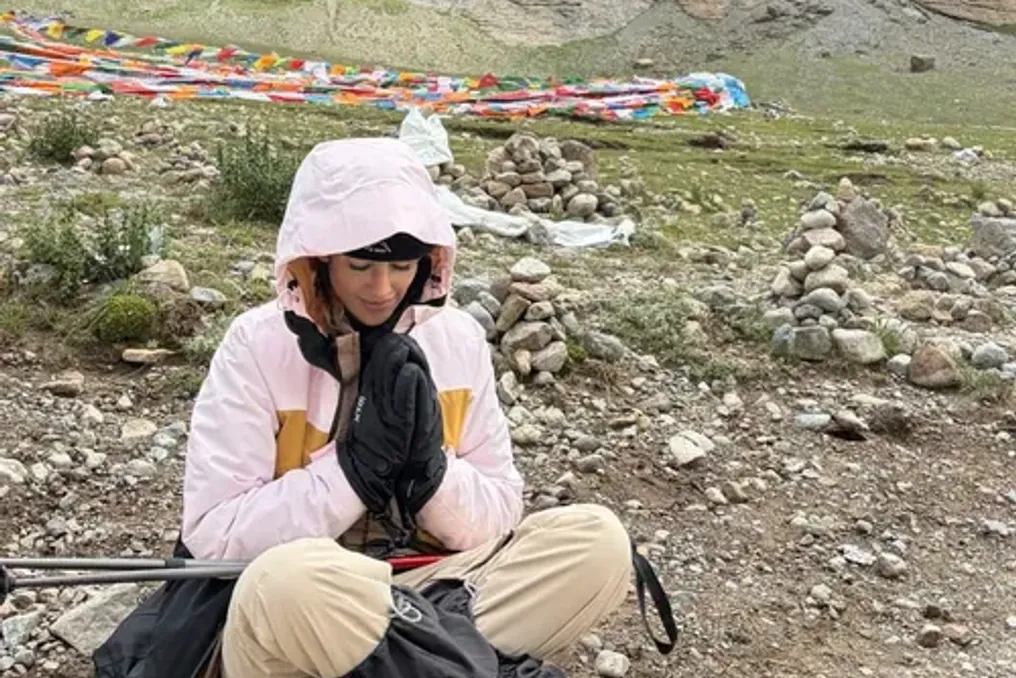
Dr. Kajal Lachminarian's recent pilgrimage to Kailash Kora in August prompted her to delve deeper into questions of faith, science, and the meaning of experiences that cannot always be explained.
The author encountered hostility in the comments section of an innocuous social media post concerning a cloud over the religious mountain. She was drawn to debates about various beliefs, where representatives of other faiths attempted to challenge or mock the statement. However, it was also interesting to observe the reactions of people of the same faith, who became defensive and sometimes spread their own disinformation.
These discussions included assertions about whose divinity was correct and whose beliefs were flawed, inevitably leading to comments suggesting that belief in the spiritual was a sign of insufficient education.
These moments led the author to ponder what truly divides people and the more complex question: is peaceful coexistence possible when deeply divergent views exist?
These questions have become particularly personal for her recently due to the evolution of her own relationship with faith. As a plastic surgeon, the author combines her profession with her faith. Much of her adult life has been dedicated to the world of science, where medicine teaches one to seek evidence, understand physiology, and question the inexplicable. Yet, she highly values this way of thinking while acknowledging that faith occupies an important part of her worldview.
In July, she completed the Kailash Kora pilgrimage. This same pilgrimage later suffered from devastating floods. Initially planning the trip for August, she decided to move it up at the last minute based on an inner impulse. It was surreal to watch videos of the Nepal-Tibet border and other places she had recently visited being washed away by water.
The trek gave her much time to reflect on the interconnection between the scientific and spiritual aspects of her personality. There were experiences she could explain scientifically: at high altitudes, she understood the physiological processes in her body, and the mountain could be studied through geology and the forces that shaped it over millions of years.
Nevertheless, there were other experiences that were harder to define. These were feelings, intuitions, and coincidences that seemed extremely significant. Carl Jung used the term 'synchronicity' to describe such meaningful coincidences without an obvious cause-and-effect relationship. Regardless of how we understand such experiences—psychologically, spiritually, statistically, or simply as something we cannot yet explain—the author began to calmly accept: she does not know.
She does not believe that experiencing the inexplicable automatically makes it divine, nor does she think that the inability to explain an experience renders it meaningless. Perhaps this is why the comments suggesting religious people are less educated troubled her.
Why did we decide that science and spirituality must occupy opposite sides? Standing before Kailash, she realized that geological processes explain the formation of the mountain, while being there allows one to experience something deeply spiritual. These thoughts did not conflict within her: one explained something about the mountain, and the other something about it itself.
Perhaps education should make us more humble, not less. A person can understand science and still feel awe. Another might look at the same mountain and feel nothing spiritual. Neither answer makes one person smarter than the other.
There are things she knows; there are things she believes; and there are things she has experienced. She is learning not to mix these three aspects.
However, religion extends far beyond personal spiritual experience. For many, it encompasses family, origin, culture, childhood, morality, community, and traditions. It accompanies birth, marriage, grief, and death, influencing how people perceive suffering, purpose, and mortality.
Perhaps this is why religious disagreements become so personal. When someone criticizes another's religion, they might think they are challenging an idea, whereas for the other person, it is perceived as an attack on something deeply connected to their identity.
History has shown how dangerous this can become when religious identity intersects with politics, territory, ethnicity, colonialism, and power. Humanity has fought and perished under religious banners for centuries, yet many so-called religious conflicts were struggles for land, resources, and political control. Religion can be both a sincere source of conviction and a powerful banner under which other human conflicts are waged.
Social media has not spawned tribalism, but it has created one of the most effective ways to amplify it. Algorithms reward engagement, and outrage generates engagement. Increasingly, people encounter other religions through short videos, memes, and provocative posts, rather than through their practitioners, scholars, texts, or communities.
Disinformation spreads in all directions. It can come from people attacking religions they barely understand, but it can also come from believers defending their traditions with assertions they themselves have never verified.
Perhaps the main religious problem with social media is that everyone has been given a microphone, while very few have been taught the responsibility that should accompany it.
Ignorance is not new. But what is new is the speed at which ignorance can now be reproduced. This brings her back to that comment section. Why does the expression of another person's faith bother us so much? Why comment on someone else's religious post to tell them that their God, sacred scriptures, ritual, or understanding of the universe is wrong?
There is a crucial difference between criticism and contempt. Religious ideas should be open to scrutiny. History should be studied honestly. Harmful practices should be challenged, and religious institutions, like any institution created and run by humans, must be accountable.
Respect for religion does not require abandoning critical thinking. But challenging an idea and humiliating the person who believes in it are entirely different things. Perhaps education should teach us precisely this distinction. If education only gives us a more sophisticated language to humiliate people whose worldview differs from ours, perhaps we have gained knowledge without gaining wisdom.
Education should include intellectual humility: recognizing what we do not know, maintaining curiosity about why another person thinks differently, and respecting what another person considers sacred, even if we do not believe in it ourselves. Perhaps true coexistence begins right here.
She does not need the other person to believe what she believes, nor does she need to believe what he believes. A Christian, an Hindu, a Muslim, a Jew, a Buddhist, an atheist, and an agnostic do not have to reach the same conclusion about existence to live together in society with dignity.
Perhaps coexistence requires something much more complex than agreement: the ability to hold deeply to one's own beliefs without perceiving the other person's beliefs as a threat.
Her journey around Kailash certainly did not provide answers to humanity's religious questions. On the contrary, it left her with more questions. But perhaps accepting uncertainty is the essence. She can share what she knows, what she believes, and what she has experienced, but she cannot claim that her experience gives her the right to dictate another's truth. And perhaps this humility is what our online conversations desperately need.
We probably will never agree on God. Perhaps we don't need to. The more important question is whether we can remain curious about each other despite these differences, rather than contemptuous. Can we learn not to disagree about heaven without creating hell for each other here on Earth?
