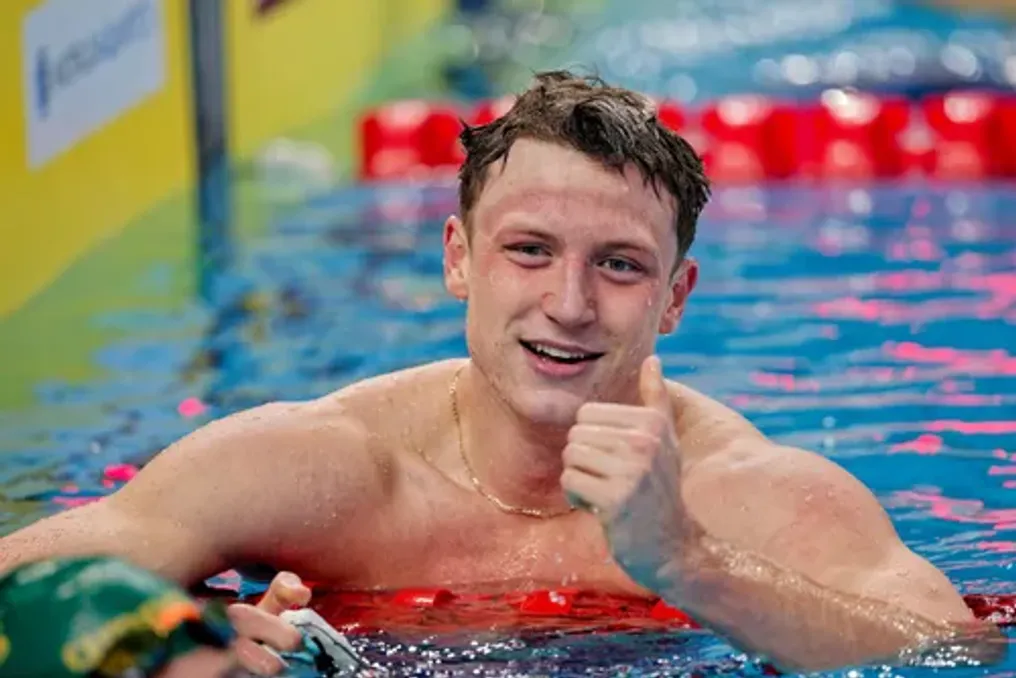
Despite the chaos engulfing swimming in South Africa, the elite Olympic group continues to operate as a protected 'island,' isolated from the scandals in governance, finance, and integrity that are shaking South African swimming (SSA) and the wider Olympic movement.
World and Commonwealth triple champion Pieter Kotsze is one of South Africa's strongest contenders for gold medals at the 2028 Los Angeles Olympics. South Africa's highly effective program has completely separated itself from management-related issues.
While SSA President Alan Fritz and CEO Shaun Adriaans are under temporary suspension by the independent Water Sports Integrity Unit (AQIU) due to alleged abuse of power and provision of false official documents, the elite athletes are working on robust plans that cannot be altered by the board's politics.
In an exclusive interview with IOL Sport, South Africa's high-performance swimming manager, Dean Price, stated that his department operates under a direct mandate from the South African Sports Confederation and Olympic and Paralympic Committee (SASCOC). This mandate strips the federation politicians of the right to interfere with elite athlete preparation.
Price emphasized that administrative turmoil at the SSA headquarters does not affect the roadmap to the 2028 Los Angeles Olympics or even Brisbane 2032. He stated that his mandate prevents anyone, even within South African swimming, from interfering with high-performance achievement plans.
Direct link to SASCOC and management crisis
Price's comments explain why the umbrella body SASCOC bypassed the suspended SSA executives, choosing instead to interact directly with the high-performance operational team. SASCOC confirmed this week that while formal political contact with SSA leadership has not yet occurred, direct operational communication with Price's team is actively underway to ensure funding for athletes, training camps, and qualification pathways.
This self-sufficient strategy is particularly important given that administrative instability extends beyond South African swimming. SASCOC itself faced a crisis after the preliminary suspension of its president Barry Hendrix pending an internal policy investigation, while Vice-President Lwandile Simelane assumed the role of interim president.
Despite these major governance storms, Price's direct operational line with the SASCOC high-performance team ensures funding for leading promising athletes through the Operation Excellence (Opex) framework and regional relay grants.
Price explained that the six swimmers already holding Olympic 'A' category times receive full support. As for nine other swimmers whose results are within three-tenths of a second of the 'A' category time, they receive international competition opportunities through the use of Opex and relay funding from the African Olympic Committee.
He also revealed an ambitious goal for Los Angeles 2028: to send the largest South African swimming contingent in history. They currently have four relay teams ranked in the world's top 12. Qualification for the Olympics will come from the best of the top 12 qualifying rounds at the 2027 Budapest World Championships. If they secure these four relays, it will give them a team of about 20 swimmers—the largest team they have ever sent.
Regarding the high-profile dispute with double Olympic champion Tatjana Smith, who filed a legal claim over unpaid interest amounting to $35,000 USD (approximately 564,000 Rand at the current exchange rate) due to delayed World Championship prize money, Price confirmed that SSA's interim leadership committed to immediately resolving the athletes' issues.
Price recounted meeting with the newly appointed interim SSA president, Ziki Molusi, who was brought in to stabilize the federation following the AQIU suspensions. He explained to the new president that their product is the swimmers, and taking care of them is crucial. Molusi agreed with him, and Price believes he will take the correct and timely action to resolve this within the next 24–48 hours, simply by settling payments.
Price added that Molusi, with his corporate experience, represents a welcome departure from political intrigue. He came with a clean slate and no baggage, wanting to manage it as a business rather than a political issue. He noted that when it comes to performance, they compromise to no one and for nothing.
The road to Los Angeles 2028 and Brisbane 2032 includes three phases. The first phase (until December 2026) involves maintaining fitness and participating in international competitions, including local championships and international tournaments. The second phase (January–December 2027) focuses on qualification and relays, with an emphasis on finishing in the top 12 at the Budapest World Championships. The third phase (2028) is the pre-Olympic stage, which includes visiting facilities in the USA to complete training camps.