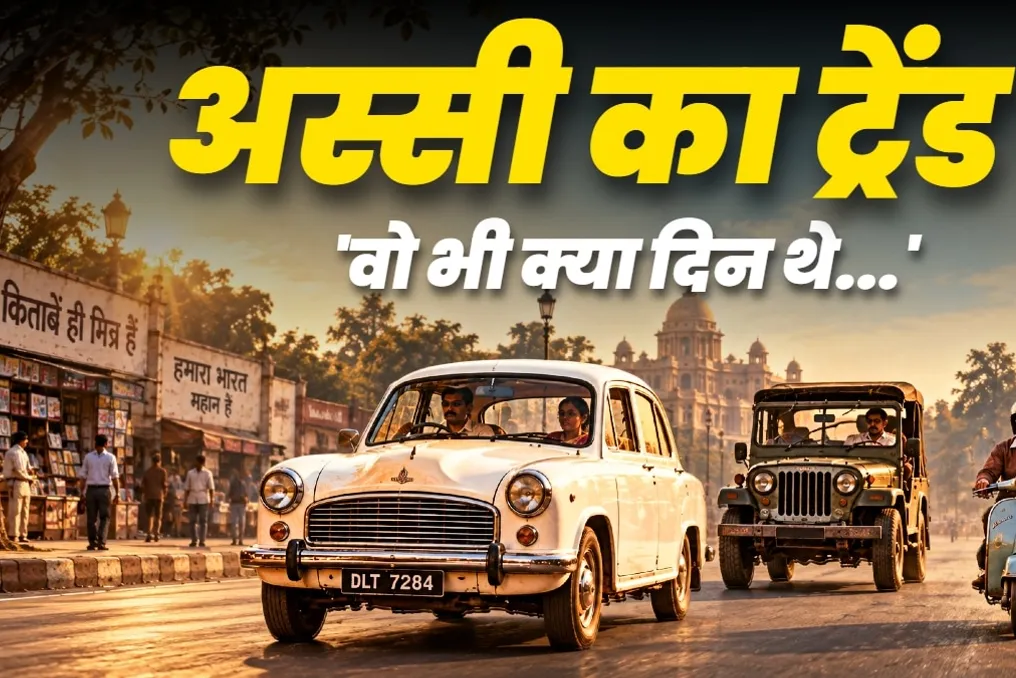
Memories of the past rarely disappear completely; they may only become hazier over time. However, the appearance of old photographs, songs, or vintage cars on social media suddenly creates a feeling as if time has taken a sharp turn. Currently, there is a trend on social media dedicated to the eighties, which evokes strong emotions in an entire generation of millennials.
This 80s trend is not limited to fashion, music, and cinema. In the world of Indian automotive manufacturing, the eighties were a golden age, where every car that appeared on the roads carried its own story. Although these cars are rarely seen on the streets today, their memories remain alive in the minds of millions of Indians.
The memory of these vehicles is not just nostalgia for the history of the auto industry; it is an opportunity to re-experience that India where a scooter could carry the whole family, a motorcycle could grant freedom to a young professional, and a car was the cherished desire of the entire household. The 80s trend opened a window into this old India, where stories associated with these vehicles continue to live, telling how these machines first spurred the dreams of a changing India.
Next, we will delve into this world of memories and meet some vehicles whose engine sounds still resonate in people's hearts like their own heartbeat.
The history of the Mahindra Jeep begins in independent India when roads were scarce, and routes often consisted of difficult trails. Two brothers, Jagdish Chandra Mahindra and Kailash Chandra Mahindra, along with Malik Ghulam Muhammad (who became the third Governor-General of Pakistan after the partition), founded Mahindra & Mohammed in 1945. After the partition, the company was renamed Mahindra & Mahindra when Ghulam Muhammad left India.
In 1947, Mahindra imported 75 units of Willys Jeep from America and assembled them in Mumbai. In 1949, the first Jeep CJ3A assembled in India was released in the country. All these units were delivered to India as Completely Knocked Down (CKD) kits. This Jeep was equipped with a 2.2-liter gasoline four-cylinder Go-Devil L-head engine, paired with a 3-speed manual transmission and a 2-speed gearbox. Its main advantages included a short wheelbase, high ground clearance, a sturdy steel ladder frame, a folding windshield, and a removable canvas top.
Today, given the popularity of SUVs in India, this trend might seem new, but its roots are very deep. Mahindra Jeep paved the way for SUVs on Indian roads, and many other companies wrote their histories following this example. Over time, the Jeep became part of the lives of ordinary people, gaining popularity in both cities and villages, and was also used by the police and army for a long time.
If one imagines the picture of Indian cars from the 80s, the white Hindustan Ambassador immediately comes to mind. Its history began in India in 1957 and continued on the country's roads for decades. The Ambassador was popular everywhere—among government officials, major politicians, businessmen, and ordinary families.
Initially, this car was based on the British Morris Oxford, and at the time of its launch, its cost was around 10,000 rupees. The Hindustan Ambassador was famous for its spacious cabin, sturdy semi-monocoque construction, and comfortable ride. It originally used a 1.5-liter gasoline engine, and later the model was introduced with a 1.5-liter diesel engine. Later versions included features such as power steering, enhanced brakes, remote-controlled gear reduction, a new radiator grille, body-colored bumpers, and an improved interior. After an impressive 57-year journey, this car was officially discontinued in May 2014.
The history of the Kinetic Luna began in 1972 when Pune entrepreneur H. K. Phirodia founded Kinetic Engineering. Phirodia wanted to create a two-wheeled vehicle that could satisfy the simple person's dream of two-wheeled transport at a low price. The Kinetic Luna, initially based on the Italian moped Piaggio Ciao, was launched at a mere price of 2000 rupees, weighing only 30 kilograms. Essentially, it was a hybrid between a bicycle and a scooter.
It was equipped with a 50cc engine, a centrally located engine layout, and a pedal start function. Despite fuel restrictions, this moped could be powered by pedals. Due to its light weight, it was easy to handle. Its 16-inch wheels, dual shock absorbers, and lightweight design made it the most popular two-wheeled transport of its time. To reduce weight, plastic was also used in components such as the fan, air filter, protective casing, and headlight. In the 80s, the demand for it was so high that the Kinetic factory produced about 2000 Luna units per day.
The Walchand group from Mumbai began producing the Premier in 1964.