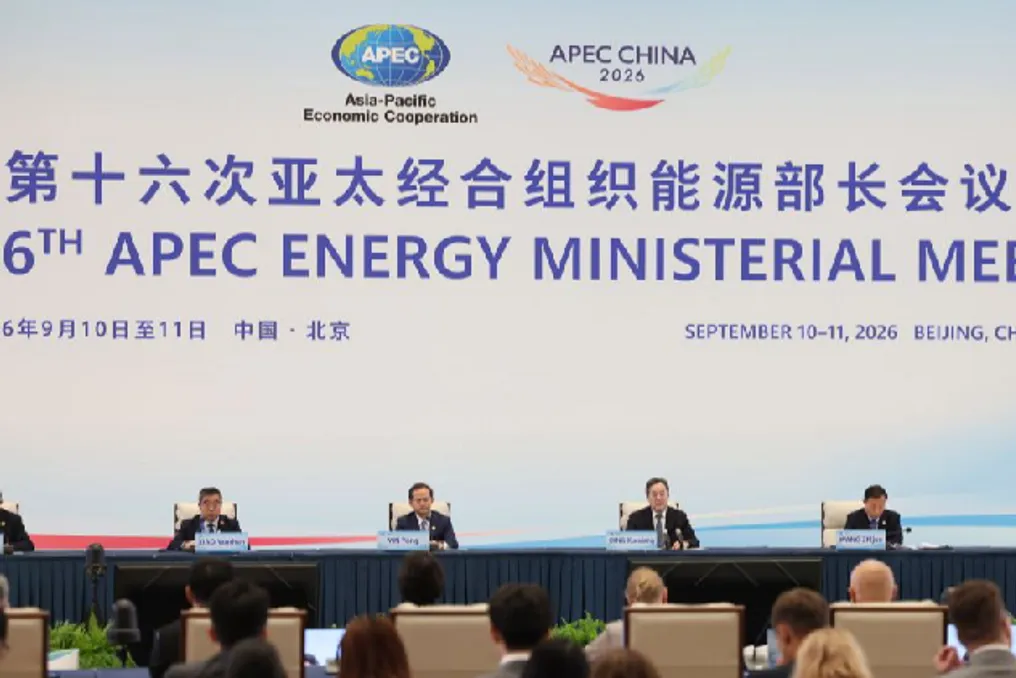
Delegates from APEC economies gathered in Beijing to discuss methods for strengthening regional energy security and accelerating the transition to cleaner energy sources. This necessity arose against the backdrop of vulnerabilities in the Asia-Pacific region's energy supply chains, caused by disruptions in the Strait of Hormuz.
Disruptions in shipping through the Strait of Hormuz, which began in late February 2026, triggered a significant oil supply shock, with daily shortages reaching millions of barrels, highlighting the region's dependence on energy imports.
Konrad Kumul, a delegate from Papua New Guinea, told CGTN that their country is facing the consequences of the war in Iran and related fuel supply problems, noting that they are an import-dependent economy.
The XVI APEC Energy Ministers' Meeting is taking place amid circumstances where Asia-Pacific economies are forced to find ways to ensure energy supply while striving toward long-term transition goals. Some participants believe this crisis could serve as an impetus for developing renewable energy sources.
Steven Dephila, assistant president of the APEC Sustainable Energy Centre, told CGTN that the current situation prompts a significant push for the energy transition, even more so than before, as high oil prices make relatively low-cost renewable sources more attractive.
As the host this year, China is promoting an open and comprehensive approach to facilitate exchange among member countries and encourage cooperation in energy security and sustainable development. During his speech at the opening ceremony, Chinese Vice Premier Ding Xuexiang noted China's active participation in pragmatic energy cooperation within APEC, effectively contributing to the development of regional energy and making an important contribution to global energy security.
To advance global energy security and sustainable development, Ding called for the intensive development of distributed energy sources and charging station infrastructure to improve inclusive energy development in the Asia-Pacific region. Participants emphasized that the meeting aims not only to respond to immediate supply disruptions but also to shape a long-term energy transition that ensures broader access to reliable and affordable energy.
China's Contribution
China's experience in developing renewable energy and related technologies is increasingly being shared with Asia-Pacific economies that seek to diversify energy sources and enhance supply resilience. By the end of 2025, installed wind and solar generation capacity in China reached 1.84 billion kilowatts, accounting for 47.3% of the country's total installed capacity. According to the China Renewable Energy Development Report, last year saw a new record installation of renewable generation capacity in China, exceeding 60% of global increases.
This rapid expansion has allowed China to accumulate large-scale experience in solar energy, energy storage systems, and smart grid technologies. In Southeast Asia, Chinese companies have participated in renewable energy projects combining clean power generation with technologies to enhance grid stability. For instance, in Laos, Sifang Electric from China provided a solution for integrating a 5 MW/10 MWh energy storage system for the first photovoltaic generation and energy storage project in Laos, which commenced operations in 2025. This system utilizes battery energy storage, energy conversion, and energy management technologies to smooth fluctuations from solar generation and maintain stable grid operation.
According to a report by the Center for Strategic and International Studies, China's energy investments have also played a crucial role in Cambodia's energy transition. Shansi Institute, a subsidiary of China Energy Engineering Corporation, won a contract to design, procure, and construct a 250 MW solar power plant in the country. This project is expected to help Cambodia achieve its goal of 1 GW of operational capacity by 2030.
Beyond individual projects, China's clean energy supply chains have become an important part of the region's energy transition. Asia-Pacific economies are utilizing solar panels, batteries, and other clean energy equipment from China to expand renewable capacity and strengthen energy security, attempting to balance growing electricity demand with long-term low-carbon development goals.