Even though electricity tariffs in South Africa have increased by up to 165% over the last decade, the Ministry of Finance maintains that abolishing VAT on electricity is not part of the government's plans.
The Ministry of Finance acknowledges the growing pressure that tariff increases place on household budgets, but it has not conducted a specific assessment of the impact of VAT on the cost of electricity for low and middle-income residents.
According to DebtBusters data, electricity prices have risen by 101% since 2021 and reached an increase of up to 165% over the past ten years. The Ministry of Finance stated that it is aware of these increases but has not assessed the specific impact of VAT on household expenses.
Importance of Maintaining a Broad Tax Base
The Ministry of Finance believes that maintaining a broad tax base is critical for the efficiency of the tax system, and that assigning electricity a zero rate would lead to revenue loss. According to tax statistics for the 2025 financial year from the South African Revenue Service, the electricity, gas, and water sector generated approximately 22.21 billion rand in net VAT in the 2024/25 financial year.
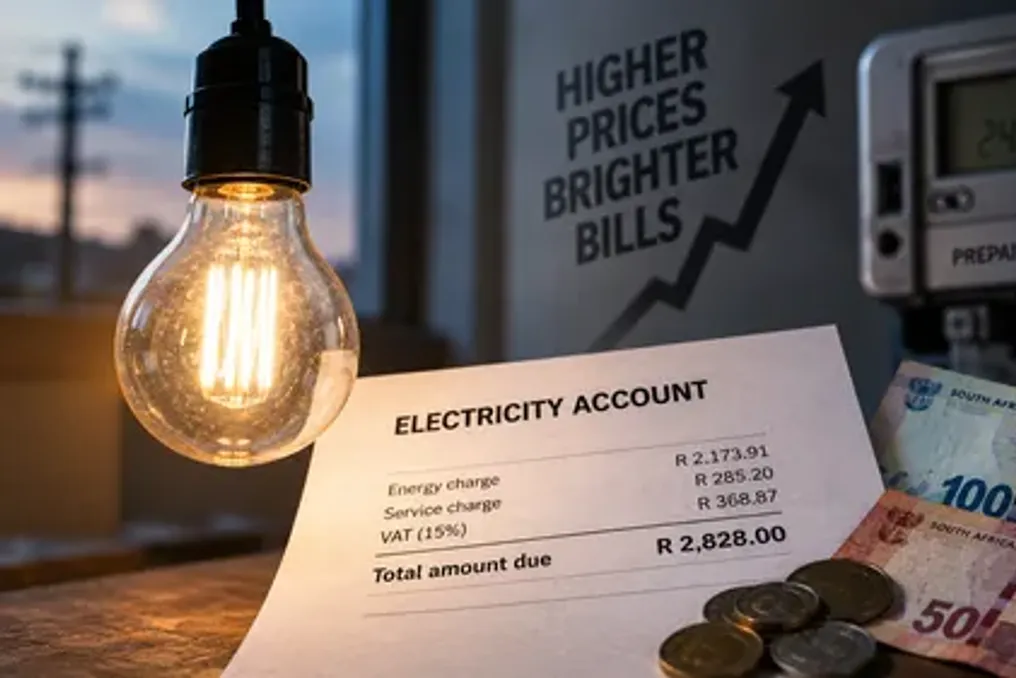
For households, VAT adds 150 rand to every 1000 rand spent on electricity. For example, a family spending 3000 rand per month pays 450 rand in VAT, totaling 5400 rand annually. EnergyBee estimates that a typical three-bedroom house in South Africa consumes between 700 and 900 kWh per month, costing approximately 2900–3750 rand in summer at a price of about 4.17 rand per kWh.
uMkhonto weSizwe (MK) party member Crown Prince Adil Nchabaleng is one of those advocating for including electricity in the list of goods subject to a zero VAT rate. He reported that the party raised this initiative with the Ministry of Finance during last year's debates on VAT increases. Nchabaleng emphasized that VAT exacerbates the burden on households already struggling to afford electricity and stated that there is no point in taxing electricity with VAT in a weak economy.
The Issue of VAT Imposition
Nchabaleng also questions the imposition of VAT on electricity supplied under the government's 'Free Basic Electricity' program, calling it de facto taxation of a grant. Executive Director of the Tax Abuse Watchdog Organization, lawyer Stephanie Fink, does not have a definitive position on abolishing VAT on electricity but believes that energy 'should be subject to VAT unless it is declared a necessary service and exempted from it.'
The main difficulty lies in the impact on state revenue. Fink noted that 'the state will lose a lot of income that it cannot afford. If we were an efficient state, it would certainly be worth considering.'
The Ministry of Finance has not yet calculated the current cost of zero-rating residential electricity for the treasury, nor has it modeled alternatives such as abolishing VAT only on the first 50, 100, or 200 kWh consumed monthly.
Historical Context of the Issue
The question of reducing VAT on electricity dates back to the introduction of VAT in 1991, when a committee considered zero-rating a basic volume of electricity but concluded that support for poorer segments of the population should be provided outside the tax system. The Ministry of Finance revisited this issue in 2007. Analysis showed that zero-rating electricity would disproportionately benefit higher-income households, as they consume more energy and thus receive the largest portion of the tax savings.
An independent commission studying the zero-rate basket came to virtually the same conclusion in 2018 after receiving proposals to include electricity. The government instead continues to rely on the 'Free Basic Electricity' program to assist poor households. Eligible needy households receive 50 kWh per month, for which 21.6 billion rand is allocated in the 2026/27 budget for basic energy. Nevertheless, the Ministry of Finance warns that an intergovernmental working group is reviewing whether the allocation of 50 kWh remains sufficient.